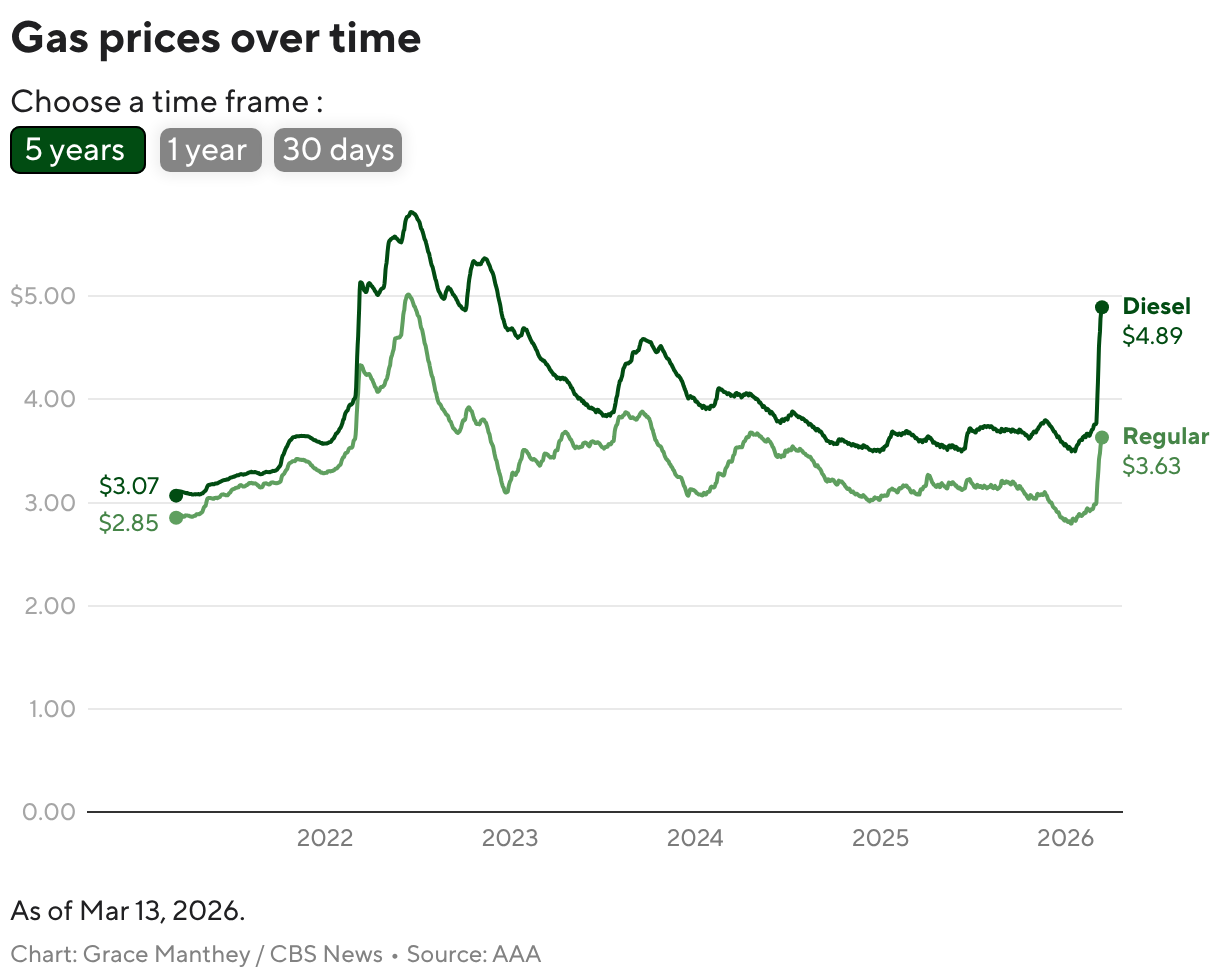
Though the Trump administration is pulling a number of levers to tame power prices amid the widening Iran conflict, the common value of gasoline within the U.S. on Friday neared $4 a gallon, elevating questions on whether or not these efforts are working.
The simplest measure for bringing down oil costs can be to reopen the Strait of Hormuz, the important Persian Gulf waterway that handles some 20% of the world’s oil and pure fuel provides, in accordance with consultants. The strait stays nearly closed as violence within the area escalates, bringing transport visitors to a near-halt.
Within the meantime, the U.S. is popping to different choices to counter rising oil costs, with Brent crude, the worldwide benchmark, at about $108 a barrel, a 48% surge for the reason that begin of the conflict. The Trump administration’s methods vary from tapping the Strategic Petroleum Reserve to easing authorities laws that enhance the price of petroleum merchandise.
“The basic downside is that every one this stuff they’re doing are measures to, ‘How do I counteract having taken 20% of the world’s provide off the market?’,” Willy Shih, professor of administration at Harvard Enterprise Faculty and power market professional, instructed CBS Information.
President Trump and his power group have thought of “all of the choices on the desk” to mitigate rising oil costs, White Home spokeswoman Taylor Rogers instructed CBS Information. These embrace releasing emergency oil reserves, offering political danger insurance coverage from the U.S. Improvement Finance Company to cargo ships within the Gulf and briefly releasing up sanctioned oil, amongst different choices, she stated.
Oil and fuel costs will drop quickly, even dropping under their pre-war costs, as soon as the U.S. achieves its navy aims, she added. “Because of this, American households will profit drastically in the long run,” she stated.
Here is what consultants stated concerning the numerous measures to maintain a lid on power costs.
Tapping the Strategic Petroleum Reserve
President Trump ordered the discharge of 172 million barrels of oil from the U.S. Strategic Petroleum Reserve (SPR) on March 11, when Brent crude had reached $92 a barrel. The oil launch started this week and can roll out over 120 days.
The SPR was created within the Nineteen Seventies to supply an financial cushion in opposition to power disruptions, resembling successful to grease refineries from a pure catastrophe.
The discharge marks the second-largest within the reserve’s historical past after former President Joe Biden’s transfer in 2022 to withdraw 180 million barrels. Mr. Biden had tapped the SPR to counter the results of Russia’s invasion of Ukraine in February of that 12 months, together with lingering inflation from the pandemic. These twin crises had led to U.S. fuel costs surging to a median of greater than $5 a gallon.
The Trump administration’s SPR launch is way too small to counter the Iran conflict’s influence on power provides, Clayton Allen, a follow head on the world political danger analysis agency Eurasia Group, instructed CBS Information.
The Worldwide Vitality Company estimates that Gulf nations have minimize oil manufacturing by 10 million barrels per day resulting from provide constraints for the reason that outbreak of hostilities in Iran. Earlier than the conflict, about 20 million barrels of oil traveled by means of the Strait of Hormuz every day.
“The discharge will not have a lot influence in any respect,” added Patrick De Haan, petroleum analyst at GasBuddy, which tracks fuel costs across the U.S. “It is form of like making an attempt to switch a water essential with a straw.”
Releasing oil from the Strategic Petroleum Reserve additionally takes time. The quickest the U.S. has been in a position to attract down provides from the reserve is 1 million barrels a day, though the Trump administration is aiming for 1.4 million barrels a day, Allen famous.
“There are bodily constraints on their potential to do this,” he stated. “So U.S. oil just isn’t going to achieve the market as shortly as individuals anticipate.”
Allen added, “If persons are anticipating this to out of the blue take us again to $3.50 gasoline, that is not likely sensible.”
Waiving the Jones Act
Mr. Trump on Wednesday ordered a 60-day waiver of the Jones Act, a roughly 100-year-old legislation that requires items shipped between American ports to be carried on ships which can be U.S.-built, -flagged and -crewed.
Briefly suspending the legislation will enable international ships to maneuver gasoline between U.S. ports, doubtlessly boosting native provide and decreasing costs on the pump. A latest evaluation from the Heart for American Progress, a nonpartisan coverage institute, estimates that waiving the legislation would cut back fuel costs by 3 cents per gallon.
The waiver is “too little, too late” to assist maintain a lid on oil and fuel costs, Harvard’s Shih instructed CBS Information, including that “It’s a drop within the bucket when it comes to influencing costs if you’ve taken 20% of the worldwide provide offline.”
Lifting Russian oil sanctions
On March 12, the U.S. stated it might briefly approve the acquisition of Russian oil that is already loaded on ships which have put out to sea. Treasury Secretary Scott Bessent stated the one-month waiver “is not going to present important monetary profit to the Russian authorities.”
It is unclear whether or not lifting these sanctions on Russia will do a lot to learn U.S. motorists in accordance with consultants. The explanation: There are solely about 124 million barrels of Russian oil at the moment at sea globally. That is equal to about six days’ value of regular shipments by means of the Strait of Hormuz, or barely greater than sooner or later’s value of world consumption of about 101 million barrels per day.
Would oil costs have moved larger with out these measures?
Oil has brushed up in opposition to $120 a barrel a number of instances this month, however for now stays under that threshold.
Allen of Eurasia Group instructed CBS Information that the Trump administration’s actions are stopping oil from surging larger.
“Is {that a} success? It will depend on the way you outline success, and actually, the willpower of how huge the value impacts are going to be is how lengthy this conflict continues,” he stated.
Different choices into consideration
The Trump administration is contemplating taking extra steps to tamp down power costs, with Bessent telling Fox Enterprise on Thursday that it might “unsanction” Iranian oil that is already on the water.
“It is about 140 million barrels, relying on the way you depend — that is 10 days to 2 weeks of provide, that the Iranians had been pushing out, that may have all gone to China,” Bessent stated.
In a associated effort to stabilize world oil costs, the U.S. stated it’s permitting Iranian oil tankers to cross the Strait of Hormuz. “The Iranian ships have been getting out already, and we have let that occur to provide the remainder of the world,” Bessent stated in an interview with CNBC on Monday.
Roughly 80% of Iran’s oil is shipped to Asia, with China accounting for the lion’s share of that consumption.
The U.S. can also be contemplating waiving a regulation that bans fuel stations from promoting a mix referred to as E15 from June 1 to Sept. 15, Reuters reported. The mix is not bought in hotter months as a result of its larger ethanol content material means it evaporates extra simply in sizzling climate, which might contribute to air air pollution.
Some state lawmakers are additionally pushing to waive native gasoline taxes, aiming to decrease costs on the pump. The Georgia Home of Representatives on Wednesday permitted a measure that may droop the state’s 33-cent per-gallon fuel tax for 60 days, whereas lawmakers in Connecticut, Maryland and Pennsylvania are contemplating related approaches.
On the international coverage entrance, Mr. Trump is pressuring different nations to assist open the Strait of Hormuz. Six main U.S. allies on Thursday voiced their “readiness to contribute to acceptable efforts to make sure protected passage by means of” the strait, though the leaders of the U.Ok., France, Germany, Italy, the Netherlands and Japan offered no specifics.
“We do not have to finish the conflict — we’ve got to trust concerning the potential of ships to maneuver by means of Hormuz,” David Victor, power professional and a professor of public coverage on the College of California San Diego, instructed CBS Information. “There’s not loads else you are able to do over the quick time period past what’s being achieved already.”
As soon as the strait reopens, Victor added, “There can be rapid results available in the market. There can be a giant discount in value and enchancment in liquidity.”