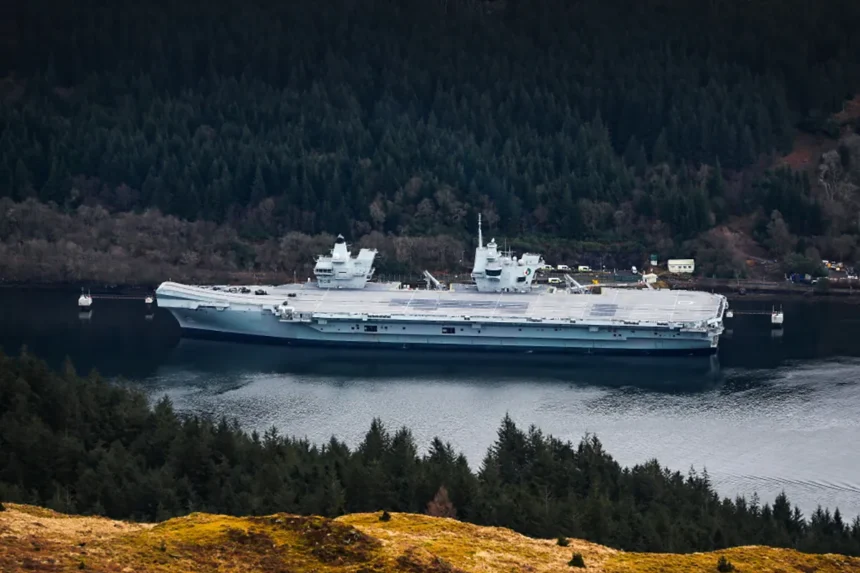
The Royal Navy aircraft carrier HMS Queen Elizabeth has arrived in Scotland, navigating the Firth of Clyde to reach the jetty at Glenmallan on Loch Long. This stop is part of a broader mission involving training and operations across the United Kingdom and northern Europe.
Strategic Stop at Glenmallan Jetty
According to a Royal Navy spokesperson, Commander Adrian Visram, the vessel is undertaking a “short logistics and engagement stop” at Glenmallan before resuming its operational duties. The 65,000-tonne carrier departed from Portsmouth earlier this month for a three-month deployment. During this period, HMS Queen Elizabeth is serving as NATO’s command ship for the Allied Response Force, a significant role that neither of the Queen Elizabeth-class carriers had previously undertaken.
Glenmallan, situated on the western shore of Loch Long in Argyll, boasts a jetty that is uniquely equipped to accommodate vessels of the carrier’s substantial size on the west coast. This capability has led both Queen Elizabeth-class ships to utilize the facility multiple times since its recent refurbishment.
Jetty Upgrade Enhances Naval Capabilities
The Glenmallan jetty underwent a significant £67 million upgrade, with the contract awarded in 2019. This extensive project, managed by Jacobs and designed by Arch Henderson, aimed to modernize a facility that had not seen substantial improvements since the 1970s and had reached the end of its operational lifespan. A notable aspect of the upgrade was the allocation of approximately £20 million to local Scottish suppliers and small to medium-sized enterprises.
The refurbishment is projected to extend the jetty’s service life by an estimated fifty years, ensuring its continued accessibility for the Royal Navy’s largest carriers. Key enhancements included:
- Installation of four new navigational aids to ensure safe passage through the waterway.
- Deployment of two modular fender spacer units designed to adjust with tidal changes, maintaining clearance for the flight deck.
- Addition of dolphin mooring points capable of securely holding a vessel of the carrier’s dimensions.
Operational Context and NATO Responsibilities
HMS Queen Elizabeth’s current deployment is multifaceted. As the NATO command ship for the Allied Response Force, she plays a crucial role in maintaining collective security and readiness within the alliance. This command role, assumed in July, underscores the UK’s commitment to NATO’s maritime posture.
The carrier’s sister ship, HMS Prince of Wales, previously visited Glenmallan ahead of Operation Firecrest. This operation, announced by the Prime Minister, saw the carrier strike group traverse the North Atlantic and the High North. Operation Firecrest was designed with multiple objectives, including deterring Russian aggression, safeguarding critical undersea infrastructure, and demonstrating the capacity for large-scale force projection within the NATO framework. This mission occurred against a backdrop of a reported 30% increase in Russian naval vessels operating near British waters over the preceding two years.
The deployment of HMS Prince of Wales also involved participation in NATO’s Arctic Sentry mission and exercises with Standing NATO Maritime Group One, which Britain led throughout 2026. These activities highlight the interconnected nature of naval operations and the importance of interoperability among allied forces.
Future Training and Carrier Development
HMS Queen Elizabeth’s own training program is distinct from her sister’s recent activities. She is scheduled to undergo advanced training under the Flag Officer Sea Training program, engaging in exercises that cover the full spectrum of modern naval warfare. This will include rehearsing coordinated operations for allied naval forces during crisis scenarios.
Looking ahead, HMS Queen Elizabeth is slated to participate in major NATO exercises next year. These preparations are in anticipation of her assuming the role of fleet flagship and high-readiness strike carrier in late 2027, taking over from HMS Prince of Wales. This progression signifies the continuous development and integration of the UK’s carrier strike capability.
The Royal Navy’s investment in carrier aviation is further exemplified by the £240 million committed in the Defence Investment Plan towards developing drones for a Hybrid Carrier Air Wing. This initiative includes the development of jet-powered unmanned aerial vehicles intended to operate alongside the F-35B fighter jets, signaling a forward-looking approach to naval air power.
A Moment of Remembrance
During her transit up the Clyde, HMS Queen Elizabeth made a poignant stop over the wreck of HMS Dasher. This escort carrier tragically sank on March 27, 1943, with the loss of 379 crew members. The ship’s company observed a moment of remembrance and laid a wreath, acknowledging the profound impact of the tragedy on naval aviation safety. A statement from the ship noted that “the lessons from the tragedy improved the safety of carrier aviation. We still benefit from those lessons.”
HMS Dasher, a converted merchant vessel, sank rapidly in the Firth of Clyde due to an internal explosion. The subsequent inquiry led to significant changes in the storage and handling of aviation fuel aboard aircraft carriers, advancements that continue to influence safety protocols today. The first visit by a Queen Elizabeth-class ship to the upgraded Glenmallan jetty occurred in March 2021, when HMS Queen Elizabeth called there en route to her maiden operational deployment, marking her first visit to western Scotland after being assembled on the Forth.
HMS Queen Elizabeth’s current visit to Glenmallan is a testament to the enhanced capabilities of the upgraded jetty and the strategic importance of Scotland’s west coast for naval operations. The carrier’s deployment underscores the UK’s ongoing commitment to NATO and the continuous evolution of its maritime defense capabilities.