[ad_1]
Washington — The Home is about to vote Wednesday on the SAVE America Act, which might implement strict new necessities for registering to vote and casting ballots, strikes that Democrats have warned would disenfranchise thousands and thousands of eligible voters.
The SAVE America Act would require documentation that reveals proof of citizenship, like a passport or a beginning certificates, to register to vote in federal elections. It might additionally implement picture ID necessities for voting itself, one other GOP precedence. The invoice is the most recent iteration of a measure Home Republicans have sought to move by way of each chambers for a number of years.
Republicans have lauded the measure as an inexpensive approach to forestall noncitizens from casting ballots, although cases of noncitizens voting are exceedingly uncommon.
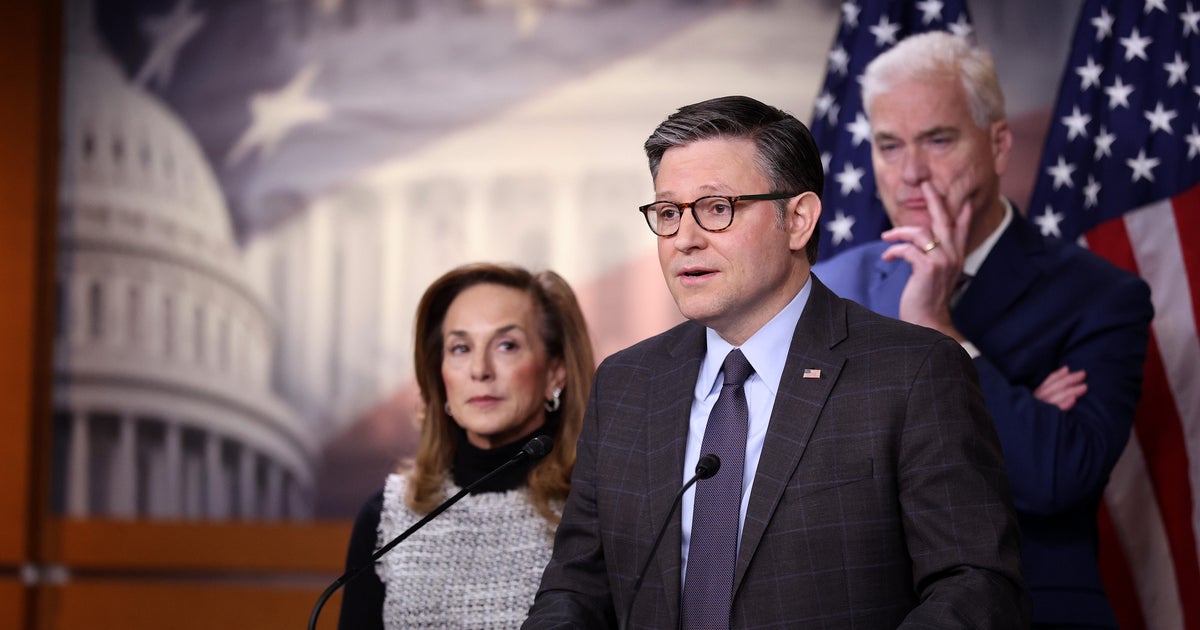
“Commonsense laws to only be sure that Americans resolve American elections — it truly is that straightforward,” Home Speaker Mike Johnson, a Louisiana Republican, stated Tuesday.
Kevin Dietsch / Getty Photographs 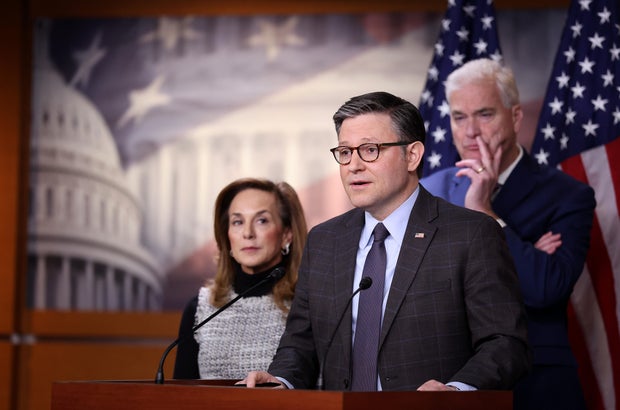
Johnson pointed to polling that reveals excessive ranges of help for exhibiting proof of citizenship and picture ID to vote. An October 2024 ballot from Gallup discovered that 83% of People again a coverage to require people who find themselves registering to vote for the primary time to offer proof of citizenship. And a ballot from the Pew Analysis Heart revealed final August discovered 83% of People favor requiring voters to indicate government-issued picture ID to vote.
However Democrats and a few consultants have argued that the invoice would have implications for thousands and thousands of People who do not have entry to paperwork proving their citizenship.
“In the event you’re one of many 50% of People who would not have a passport, or if you happen to’re one of many tens of thousands and thousands of People who cannot shortly entry your beginning certificates, the SAVE Act may, in impact, take away your proper to vote,” Senate Minority Chief Chuck Schumer, a New York Democrat, stated on the Senate flooring Monday, calling the laws “excessive.”
President Trump has referred to as on Republicans to help the laws, saying “we cannot have a rustic any longer” if it isn’t enacted. Mr. Trump has stated it is important that each one voters present identification and proof of citizenship. However he is additionally gone a step additional and demanded an finish to mail-in ballots, with some exceptions.
Johnson has expressed confidence within the laws’s passage within the Home.
“Regardless of the vehement and incoherent and albeit ridiculous opposition from Democrats, Republicans will proceed to face with the overwhelming majority of People who need safe elections,” Johnson stated. “We will do the best factor, we’ll do the common sense factor, and we’ll move this.”
Home Minority Chief Hakeem Jeffries criticized the laws Monday and accused Republicans of adopting “voter suppression as an electoral technique.”
“That is what the so-called SAVE Act is all about,” he stated. “And this model is worse than the final model.”
The New York Democrat insisted that “it isn’t going to move,” including that if it “squeaks by the Home, it is lifeless on arrival within the Senate.”
Earlier variations of the invoice have handed the Home twice, with help from a handful of Democrats. However a 60-vote threshold for advancing most laws within the Senate makes passage within the higher chamber unlikely, and GOP leaders have but to take up the measure.
Senate Majority Chief John Thune, a South Dakota Republican, has confronted intense strain in current weeks to maneuver ahead with the invoice. The laws’s proponents have referred to as on him to make use of a maneuver referred to as a speaking filibuster to sidestep the 60-vote threshold for ending debate, however doing so would eat up invaluable flooring time and allow Democrats to supply limitless amendments.
Senate Republicans mentioned learn how to transfer ahead with the laws at their convention lunch Tuesday, a number of senators stated. Sen. Mike Lee, a Utah Republican, who’s led the push on the speaking filibuster within the higher chamber, stated a presentation on the maneuver was well-received.
Sen. Mike Rounds, a South Dakota Republican, instructed reporters “it has been dialogue,” however he referred to as the speaking filibuster “very unworkable.”
“Nonetheless, it is a type of issues that a few of the of us have gotten an curiosity in,” Rounds stated. “We will proceed to do some extra analysis on it. Actuality is, I would love to have the ability to see this explicit SAVE Act introduced in and voted on, and make our Democrat colleagues vote on the problem.”
To succeed in the 60-vote threshold, Senate Republicans would want help from at the very least seven Democrats. And already one Republican, Sen. Lisa Murkowski of Alaska, has come out towards it, citing considerations about adjustments to elections too near the midterms.
“Election Day is quick approaching. Imposing new federal necessities now, when states are deep into their preparations, would negatively impression election integrity by forcing election officers to scramble to stick to new insurance policies probably with out the mandatory sources,” Murkowski stated on X on Tuesday. “Guaranteeing public belief in our elections is on the core of our democracy, however federal overreach is just not how we obtain this.”
Thune stated Tuesday that Senate Republicans are having a “very sturdy dialog” in regards to the path ahead for the laws.
“How we get to that vote stays to be seen,” Thune added.
[ad_2]