[ad_1]
Washington — The longest authorities shutdown in historical past got here to an finish on Wednesday after weeks of gridlock inflicting air journey disruptions, denying entry to meals advantages to tens of millions and forcing 1000’s of federal staff to go with out paychecks.
After 43 days and greater than a dozen makes an attempt to reopen the federal government, President Trump signed the funding bundle, handed by the Senate and Home, into regulation late Wednesday, that means the funding lapse is formally over.
This is how the shutdown began, and ultimately got here to an finish:
A Senate standoff
The standoff started in late September as lawmakers confronted a deadline to fund the federal government by the beginning of a brand new fiscal 12 months on Oct. 1. Home Republicans handed a short-term funding measure on Sept. 19 to maintain the federal government funded at present ranges till Nov. 21. However with Democratic assist wanted to maneuver ahead with any funding measure within the Senate, the chamber was at an deadlock.
The highest Democrats in Congress had been pushing since August to fulfill with GOP leaders and the White Home on the funding concern, ramping up their calls to deal with expiring well being care tax credit because the Oct. 1 shutdown deadline drew close to.
Alex Wong / Getty Photographs 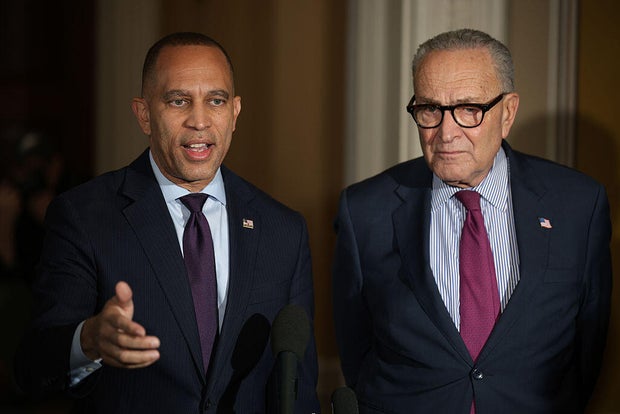
With few alternatives to exert affect with a GOP-controlled Home, Senate and White Home, Democrats got down to heart well being care points within the funding battle — setting their sights on the expiring medical insurance tax credit as their key demand. The credit, beneath the Reasonably priced Care Act, assist tens of millions of Individuals pay for medical insurance premiums for plans bought on state exchanges. Their expiration would imply eye-popping will increase in insurance coverage prices for these with ACA plans.
Months earlier, Senate Minority Chief Chuck Schumer confronted intense pushback for voting to advance a GOP measure over the past funding battle, growing the strain on him to dig on this time round.
Democrats sought to barter, introducing a counter-proposal to the Home-passed measure to fund the federal government that included their well being care calls for. However Republicans remained steadfast of their perception that well being care and different points must be negotiated outdoors the context of funding the federal government, and urged Democrats to conform to a “clear” non permanent funding extension.
Allison Robbert / Bloomberg through Getty Photographs 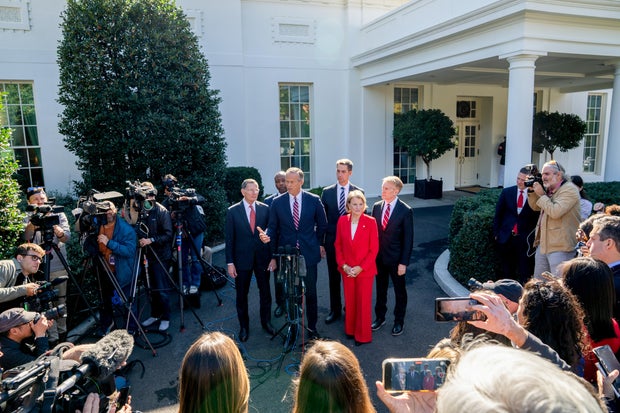
Over the course of seven weeks, Republicans and Democrats traded blame for the funding deadlock. Senate Republicans put ahead the Home-passed funding measure for a vote 14 occasions, in search of to peel off assist from Democrats because the caucus remained largely united of their opposition. However all through all of it, member-level bipartisan conversations in search of an offramp have been effervescent beneath the floor.
Because the weeks dragged on, the real-world results of the shutdown started to take their toll, elevating the stakes for the persevering with stalemate and pushing Democrats to make a deal. Hundreds of thousands of federal staff started lacking paychecks, straining these with little financial savings or no entry to credit score. Chaos started to emerge at airports after the Trump administration mentioned it will scale back flight visitors amid staffing shortages brought on by strained air visitors controllers. And tens of millions of Individuals have been prone to dropping entry to meals assist beneath the Supplemental Diet Help Program, or SNAP.
A bipartisan undercurrent
As early as the primary days of the shutdown, a small group of reasonable senators started signaling tepid curiosity to find a means out on the member stage, whereas leaders refused to interact.
What started as a big bipartisan huddle on the Senate ground would go on to contain various senators from throughout each the Democratic caucus and Republican convention.
The conversations throughout the aisle ramped up because the shutdown neared the longest on file. Sen. Katie Britt, an Alabama Republican and appropriator, informed reporters on Oct. 30 she had spoken with Schumer to “lay the inspiration” on continued appropriations work. And though Schumer did not vote for the ultimate deal to finish the shutdown, the long-term funding efforts turned a key to unlocking an eventual settlement by demonstrating Republicans’ willingness to work on the appropriations course of on a bipartisan foundation.
SAUL LOEB/AFP through Getty Photographs 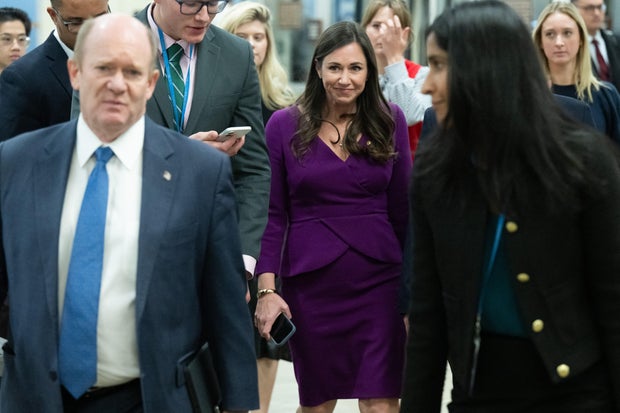
The contours of the eventual deal started to emerge through the first week of November, with senators discussing an settlement that will fund the federal government alongside a trio of long-term appropriations payments. In alternate for his or her assist, Democrats can be promised a vote on extending medical insurance tax credit that they’d demanded.
Britt informed reporters on Nov. 4 that she made calls by means of the prior weekend on the funding bundle, saying she was hopeful it may very well be a part of what ends the stalemate. Sen. Mike Rounds, a South Dakota Republican concerned within the talks, mentioned on the identical day that the appropriations bundle would possibly entice Democrats to “vote for one thing different than simply merely a unbroken decision” whereas offering “a path ahead” past a vote on the well being care tax credit. And Democrats concerned within the talks usually remained tight-lipped, signaling that issues have been shut.
However the deadlock would stretch on for a number of extra days, after Democrats swept key races in off-year elections. The victories emboldened the holdouts, who argued that voters had given them marching orders to not cave on their well being care calls for.
In the meantime, Home Speaker Mike Johnson made clear that he wouldn’t decide to a vote on the medical insurance tax credit within the decrease chamber. That remark underlined issues from some Democrats {that a} future Senate vote on well being care, which they have been set to obtain as a part of a deal to reopen the federal government, would go nowhere.
Tom Brenner / Getty Photographs 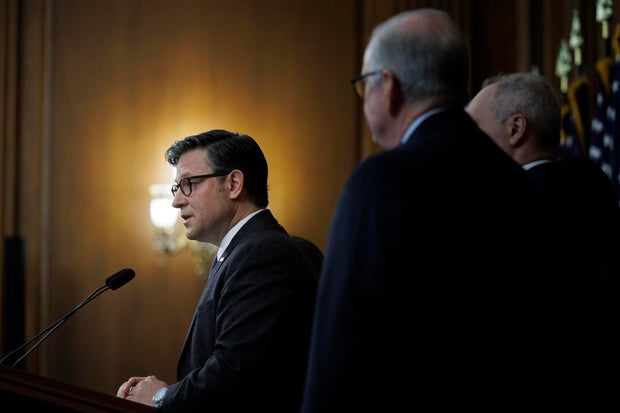
Nonetheless, the shutdown’s toll on Individuals continued to ratchet up strain on senators to succeed in a decision.
On Nov. 7, Senate Democrats introduced a proposal to Republicans, saying they might finish the federal government shutdown in alternate for a one-year extension of the well being care tax credit and a plan to proceed broader talks. However the proposal was swiftly rejected by Republicans as a “nonstarter,” as Senate Majority Chief John Thune maintained the place that negotiations on well being care may solely come after the federal government reopened.
The long-sought breakthrough
On Nov. 9, the deal to finish the shutdown lastly got here collectively, with a gaggle of eight Democrats agreeing to advance a funding measure as a part of a broader settlement to finish the shutdown.
Led by Sens. Jeanne Shaheen and Maggie Hassan of New Hampshire and Sen. Angus King of Maine, the deal they struck with Thune and the White Home secured a vote in December on the Reasonably priced Care Act tax credit. The deal connected the trio of full-year funding payments, whereas restoring meals assist at increased ranges, and paving the best way for a bipartisan appropriations course of on different spending payments. And it reversed all authorities layoffs that occurred through the shutdown, whereas stopping them for a restricted time going ahead.
Nathan Posner/Anadolu through Getty Photographs 
The moderates considered the deal — after Republicans leaders refused Schumer’s supply — as the very best supply they may safe, arguing that persevering with the shutdown would solely inflict extra ache with none hopes of a greater deal.
The ultimate flip appeared to come back with the availability within the invoice that will deal with the Trump administration’s layoffs. Sen. Tim Kaine of Virginia, one of many eight Democrats to again the funding deal, had lengthy known as the difficulty his principal precedence within the shutdown battle. And he mentioned he joined the group of Democrats simply 48 hours earlier than the deal was introduced.
GOP Sen. Markwayne Mullin of Oklahoma informed reporters that the language within the new persevering with decision reversing the layoffs got here from the White Home. Mullin mentioned the White Home informed Republicans they have been prepared to revert the layoffs if it may assist win Kaine over.
“It was the fitting provision which introduced him over, which introduced a pair different folks over, too,” Mullin mentioned. “That is what bought it over the end line.”
With coordination with the Home and White Home, the deal was on a glidepath to passage within the decrease chamber, and to swiftly safe the president’s signature.
The Home handed the invoice late Wednesday, and Mr. Trump signed it throughout an Oval Workplace ceremony hours later. He applauded congressional Republicans and the Democratic senators who voted for the deal, whereas lashing out at most different Democrats.
“We’re sending a transparent message that we’ll by no means give in to extortion,” he mentioned.
[ad_2]