The United Nations’ high nuclear watchdog instructed CBS Information that Iran might revive components of its nuclear program, although U.S. army strikes have dented it — and stated any mission to get better Iran’s stockpiles of enriched uranium can be extraordinarily troublesome.
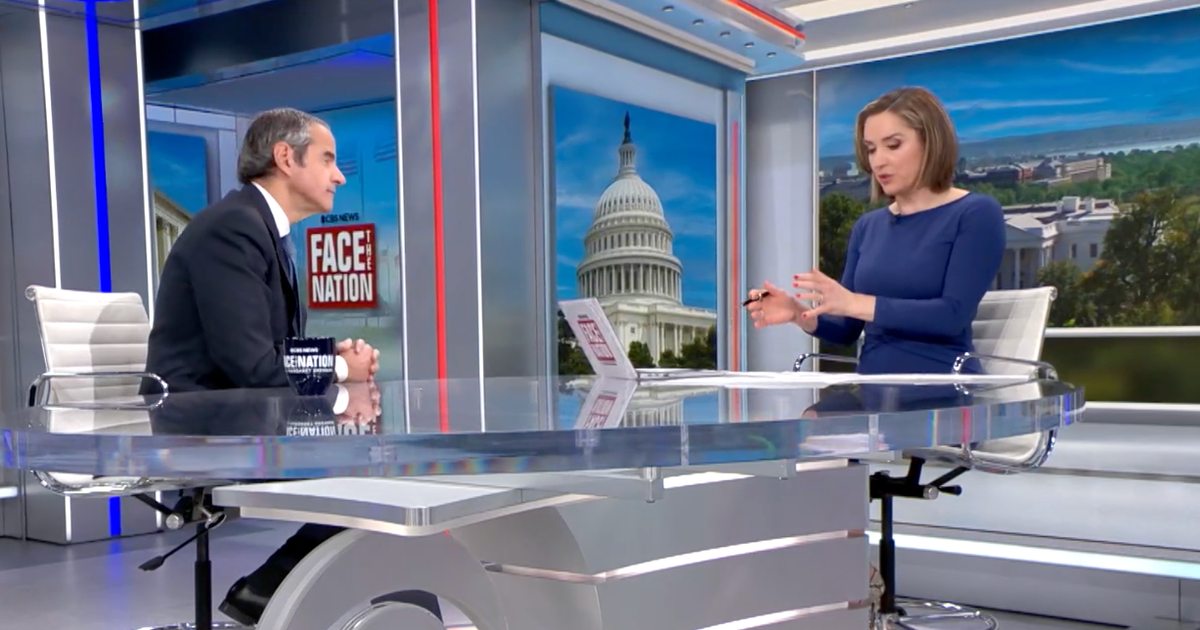
Rafael Grossi, director-general of the Worldwide Atomic Vitality Company, spoke with “Face the Nation” moderator Margaret Brennan on Thursday, because the U.S. and Israel’s conflict with Iran nears the three-week mark. President Trump has pointed to Iran’s nuclear program as one catalyst for the conflict, accusing Iran of harboring ambitions to construct nuclear weapons, which Iran denies.
Grossi spoke concerning the possible state of Iran’s nuclear program, the prospect of restarting it and whether or not a deal to curb this system was potential earlier than the conflict.
Listed below are the most important takeaways:
After conflict ends, “we’ll nonetheless inherit a variety of main points”
Grossi stated U.S. army motion has degraded Iran’s nuclear program — however components of this system have survived, and Iran nonetheless has the technical know-how to counterpoint uranium.
Final June’s U.S. bombing marketing campaign towards three Iranian nuclear services — the Fordo and Natanz enrichment websites and the Isfahan analysis web site — was “fairly efficient,” Grossi stated. Some strikes have additionally been reported on nuclear services within the present army operation, although Grossi stated they’ve been “comparatively marginal” contemplating the conflict’s broader scope.
“One can’t deny that this has actually rolled again this system significantly,” he stated. “However my impression is that after the army effort involves an finish, we’ll nonetheless inherit a variety of main points which have been on the heart of all of this.”
These lingering points embrace Iran’s stockpile of 60%-enriched uranium, which is a brief step away from weapons-grade materials, and a few services which have possible survived the U.S. bombing marketing campaign, in keeping with Grossi.
Director of Nationwide Intelligence Tulsi Gabbard testified to lawmakers this week that Iran didn’t try and rebuild its uranium enrichment capabilities following the June strikes. Grossi stated the IAEA additionally has not “seen exercise” suggesting a rebuilding effort.
However “rather a lot nonetheless has survived,” Grossi added. “They’ve the capabilities, they’ve the information, they’ve the commercial skill to try this.”
Navy operation to take away extremely enriched uranium can be “very difficult”
Earlier than final June’s airstrikes, the IAEA assessed that Iran had enriched some 972 kilos of uranium to 60% purity. In line with the IAEA’s metrics, about 92.5 kilos is theoretically sufficient to construct a single nuclear weapon if enriched to 90%.
A lot of that materials is probably going nonetheless buried beneath the rubble, Grossi famous.
Mr. Trump has not made up his thoughts on whether or not to ship U.S. forces into Iran to grab that materials in what can be a harmful operation, CBS Information reported earlier this week. White Home press secretary Karoline Leavitt didn’t rule out the thought, telling reporters a floor operation is “an choice on the desk for him.”
Grossi stated recovering that materials can be robust.
“We’re speaking about cylinders containing gasoline of extremely contaminated uranium hexafluoride at 60%, so it is very troublesome to deal with,” he stated. “I am not saying it is inconceivable. I do know that right here there are unimaginable army capacities to try this, however it could be [a] very difficult operation for positive.”
Grossi famous that when the U.S. and Iran held oblique peace talks previous to the conflict, negotiators mentioned “downblending” Iran’s extremely enriched uranium to make it simpler to deal with.
Iran can rebuild centrifuges: “You can’t unlearn what you’ve got realized”
Grossi stated he believes it could be “very potential to reconstruct” Iran’s enrichment program.
Even when airstrikes have destroyed a lot of Iran’s centrifuges, the information required to construct them can’t be bombed away, Grossi famous.
“You can’t unlearn what you’ve got realized,” he stated.
Grossi described a centrifuge — which enriches uranium by spinning at excessive speeds to separate out a fissile isotope of uranium known as U-235 — as a “refined washer.”
He added that the 2015 nuclear deal between the U.S. and Iran was predicated on Iran having “very primitive” centrifuges, however since then, Iran has developed “probably the most refined, quick and environment friendly machine that exists, they usually know make them.”
Was a nuclear deal to avert conflict with Iran potential?
Within the weeks main as much as the present conflict, negotiators from the U.S. and Iran held a number of rounds of oblique talks over Iran’s nuclear program. Hours earlier than the U.S. and Israel’s bombing marketing campaign started in late February, Omani Overseas Minister Badr Albusaidi, who mediated the negotiations, instructed CBS Information {that a} “peace deal is inside our attain.”
Albusaidi described the broad contours of a possible U.S.-Iran deal, together with an Iranian settlement to “by no means, ever have … nuclear materials that may create a bomb,” and a plan to mix down Iran’s present stockpiles of extremely enriched uranium.
Grossi stated a cope with Iran had not but been reached, however “whereas there is a negotiation, there’s at all times a risk of an settlement.” Previous to the beginning of hostilities, negotiators had been set to carry technical talks in Vienna, residence to the IAEA’s headquarters, he identified.
“We had been having very frank and really deep discussions. So one can’t deny the the Aristocracy of the trouble of somebody who’s attempting to forestall a conflict, and I applaud that as a diplomat and as a citizen,” he stated. “However there was no settlement at that time.”
Was the Tehran Analysis Reactor an issue?
One obvious stumbling block within the U.S.-Iran negotiations was the Tehran Analysis Reactor, a Sixties-era nuclear reactor that the U.S. equipped to Iran earlier than the nation’s present regime rose to energy in the course of the Islamic Revolution. The reactor — which may produce nuclear materials for medical functions — is powered by 20%-enriched uranium, which is a major step towards the 90%-enriched materials utilized in weapons.
However Mr. Trump had pushed for Iran to finish all uranium enrichment, stopping it from making gas for the analysis reactor. A 2015 nuclear deal between Iran, the U.S. and a number of other different main powers — which Mr. Trump withdrew from throughout his first time period — solely allowed Iran to counterpoint uranium to three.67%, although it stated Iran should buy gas for the Tehran facility from overseas if wanted.
After the conflict began, a senior Trump administration official alleged to reporters that Iran was truly stockpiling uranium on the analysis reactor, calling claims that it was wanted for medical functions a “false pretense.” The official stated U.S. negotiators made that discovery with the assistance of the IAEA, which revealed that Iran had saved extra gas on the facility than obligatory.
Requested about these allegations, Grossi stated his function is to supply technical experience, to not weigh in on whether or not Iran was sincere or dishonest. However he stated that “20% is a whole lot of enrichment.”
Grossi famous that “we had been in the midst of a negotiation which was continuing from the idea that there would not be any enrichment,” or “one thing very, very restricted.”
“So … while you speak about 20%, you might be exceeding that quantity. Overlook about if there was [a] stockpile or not,” stated Grossi.
The “new stuff” the IAEA noticed in Iran
The U.S. intelligence neighborhood assessed final spring that Iran was not actively constructing a nuclear weapon, and a previous weaponization program was suspended in 2003. However lately, Iran has enriched uranium to 60%, close to the extent required to construct a bomb. (Iran has lengthy denied any curiosity in constructing a nuclear weapon and says its program is peaceable.)
Grossi instructed CBS Information that “we have not seen a scientific program” just like the alleged nuclear weapons improvement program that existed previous to 2003.
“However there have been many, many regarding issues, many unanswered questions,” stated Grossi.
He stated that after he turned the IAEA’s director-general in 2019, a yr and a half after Mr. Trump withdrew from the Obama-era nuclear deal, “we began seeing new stuff. We began seeing and getting new components that gave rise to issues, and we had been speaking about them with Iran.”
He stated these issues included the invention of uranium particles in locations that Iran had not formally declared as nuclear websites, which Grossi described publicly in a 2024 assertion.
Final yr, the IAEA formally declared that it “just isn’t capable of confirm that there was no diversion of nuclear materials … to nuclear weapons or different nuclear explosive gadgets.”