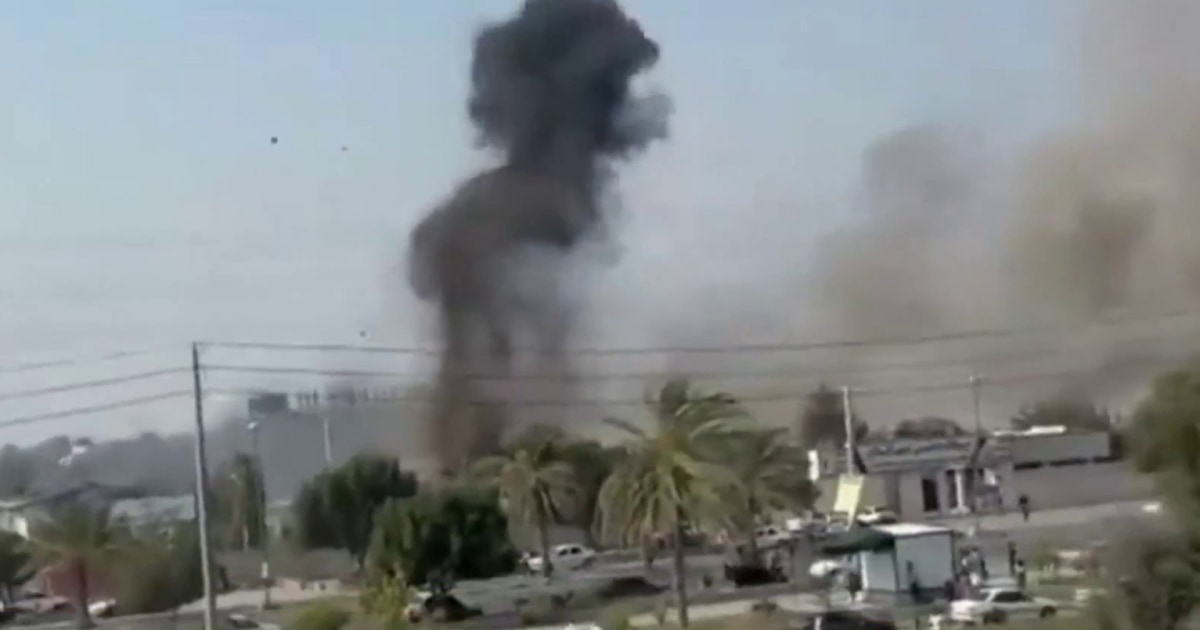
DUBAI, UAE – Iran is wagering it could outlast america and Israel — not militarily, however by grinding the struggle right into a brutal contest of endurance. Its technique is stark: unleash drones and missiles, minimize very important power routes and jolt world markets onerous sufficient to drive Washington to blink first.
Regardless of the shock of the US-Israeli strikes and the lack of key figures, the Islamic Revolutionary Guards Corps (IRGC) — lengthy the final word guardian of the Islamic Republic — is firmly in management, directing the battlefield, executing pre-planned contingencies and dictating technique and targets within the struggle.
The IRGC additionally performed the decisive position in elevating Mojtaba Khamenei as supreme chief after Ayatollah Ali Khamenei was killed within the opening US-Israeli strikes.
“For them, they’re waging an existential battle. That is an all-out struggle,” mentioned Fawaz Gerges of the London College of Economics. “They imagine their very survival is at stake. They’re prepared to deliver the temple down on everybody’s heads.” Alex Vatanka, a senior fellow on the Center East Institute and knowledgeable on Iranian politics, added: “They’re like a bleeding animal — wounded, however due to this fact extra harmful than ever.”
That each one-out struggle mindset is behind Iran’s escalating strikes throughout the Gulf, concentrating on power hubs from Qatar to Saudi Arabia to maximise financial disruption in a calculated try to drive up prices for its neighbors, Europe and america and check Washington’s political will.
US President Donald Trump informed Republican lawmakers on Monday, March 9, the struggle would proceed till Iran is “completely and decisively defeated” however predicted it might be over quickly.
He added that when america is completed with the navy operation towards Iran, Tehran won’t have any weapons towards america, Israel and US allies for a very long time.
Iranian insiders say this escalation was anticipated lengthy earlier than the struggle started 11 days in the past. Iranian planners assumed confrontation with Washington and Israel was inevitable, and ready a layered technique coordinated throughout the Guards’ sprawling navy networks and proxy forces.
Now, with little left to lose, Iran is executing that plan and turning the battle right into a grinding struggle of attrition geared toward exhausting its adversaries politically and economically.
The results are already seen at dwelling.
Mojtaba’s choice as supreme chief, insiders say, proves the Guards’ dominance as kingmakers. They are saying the stability of energy has shifted. The supreme chief holds the title, however the way forward for the Islamic Republic, and the authority of the clerical institution itself, now relies on whether or not the Guards can climate the storm unleashed by the US-Israeli marketing campaign.
How lengthy?
However a important unknown within the struggle, says Mohannad Hage Ali, a senior fellow on the Carnegie Center East Heart, is how lengthy the Guards can maintain its missile marketing campaign, the spine of its technique towards its adversaries.
US officers say a big share of Iran’s arsenal has already been destroyed, however regional sources say Tehran should retain greater than half its pre-war stockpile. If that estimate holds, Iran might maintain launching missiles for a number of extra weeks, a timeframe that would show vital for Washington as financial stress mounts at dwelling and overseas.
The Guards’ attain additionally extends far past the battlefield because it reshapes every day life. An Iranian observer mentioned items that when sat for weeks at ports are actually cleared instantly. Paperwork comes later.
Officers described that as preparation for a struggle economic system, guaranteeing provide strains maintain transferring below stress, whereas additionally consolidating the IRGC’s management over the state and asserting continuity of governance.
Equally important is inside stability. Thus far, there aren’t any indicators of protests, elite defections or fractures inside the institution, in response to observers and contacts inside Iran.
An insider in Tehran described a metropolis below bombardment however nonetheless functioning. “The home windows shake day and night time,” the particular person mentioned. “However life goes on.” Retailers and banks stay open, provides can be found and most residents haven’t fled the capital.
The assaults, nevertheless, could also be producing an impact reverse to what Washington and Israel meant, he famous. Regardless of long-standing grievances with the federal government, a surge of nationwide solidarity is taking maintain as strikes hit infrastructure and the opportunity of inside insurgencies is overtly mentioned.
“Individuals are not ready for Iran to disintegrate,” the supply mentioned.
For now, that sentiment could also be shopping for the management time. “I don’t know if the regime will survive in the long run,” he added. “However for the following couple of weeks, it won’t collapse.”
Who will blink first?
For strategists on each side, the struggle is more and more outlined by two parallel assessments of endurance: whether or not Iran can maintain firing missiles and whether or not america and Israel can maintain the financial, navy and political prices of stopping them.
“The massive query is who blinks first on this all-out struggle—Donald Trump or Iran’s leaders?” Gerges mentioned.
By driving up power costs and spreading monetary ache throughout Western economies, Tehran hopes the stress will drive a US retreat.
Early indicators are that the consequences are already biting. Oil costs are spiking, gasoline prices are rising and political unease is rising in Washington because the financial fallout collides with November midterm elections.
Below that stress, Trump, Gerges mentioned, might ultimately search an exit by declaring victory, citing the killing of Iran’s supreme chief, the destruction of Iran’s nuclear and missile capabilities and key navy infrastructure.
For Tehran, nevertheless, survival alone could be sufficient.
Even when a lot of its strategic infrastructure is destroyed, Iran’s management can declare triumph and survival towards one of many biggest navy armadas in historical past.
What emerges could also be a wounded Iran, however a bleeding Iran might show simply as harmful — and maybe extra unpredictable — than the institution that entered this battle. – Rappler.com