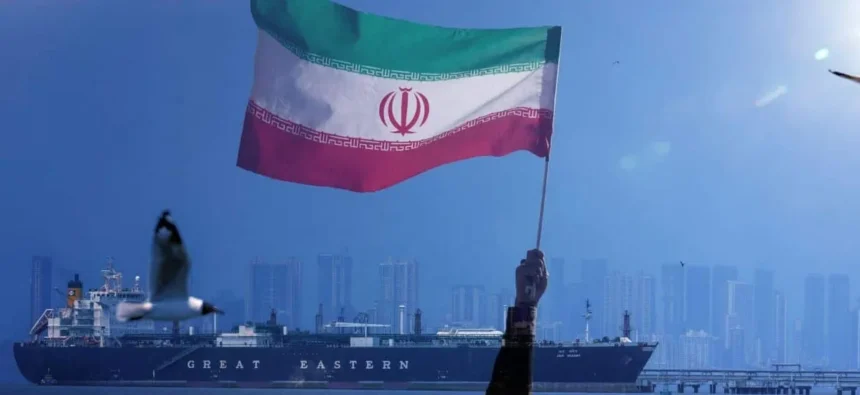
US President Donald Trump declared on social media that the Navy will “seek and interdict every vessel in international waters that has paid a toll to Iran. No one who pays an illegal toll will have safe passage on the high seas.” He noted involvement from other nations without specifying them.
Strategic Importance of the Strait
The Strait of Hormuz serves as the primary peacetime route for about one-fifth of global oil shipments. Iran’s closure of the strait after US and Israeli strikes on February 28 sparked international oil price surges and major trade disruptions. During a fragile ceasefire, Iran now seeks to include tolls on transiting ships in any enduring peace agreement, using the vital chokepoint to advance its conflict with Israel and the United States.
Iran’s 10-Point Proposal
Iran’s plan to end the war features a clause permitting it and Oman—on the strait’s opposite shore—to levy fees on passing vessels. A regional official indicated last week that Iran intends to direct the revenue toward reconstruction efforts.
Widespread International Opposition
Numerous nations, including Australia, reject the idea. Transport Minister Catherine King expressed concerns on a Sunday broadcast, stating, “We’d be very concerned about it. It’s not something I think Australian communities would be very happy with, not something the Australian government would be very happy with, and I don’t think the global community would either. It’s really important that we do have free navigation of the seas, that’s a principle of international maritime law.”
The United Nations International Maritime Organization warns that such tolls would “set a dangerous precedent,” noting no international agreement authorizes fees for transit through international straits.
Legal Barriers Under International Law
Imposing tolls violates the fundamental principle of freedom of peaceful navigation in international maritime trade. The United Nations Convention on the Law of the Sea (UNCLOS), effective since 1994, ensures transit passage rights through international straits like Hormuz. Even in territorial waters of Iran and Oman, ships enjoy “innocent passage” without impediments, provided they avoid threats, fishing, pollution, or research.
Donald Rothwell, an international law expert at Australian National University, asserts, “You cannot legally impose a toll. And we say that it cannot do that because, under the Law of the Sea, a country like Iran, which borders the strait, cannot what’s called, ‘hamper,’ transit passage. The key word there is ‘hamper.’ That word has been universally understood as one that prohibits the imposition of a toll.”
No modern precedent exists for unilateral strait tolls, per shipping industry sources. Iran has demanded multimillion-dollar payments and verification by the Islamic Revolutionary Guards Corps. Tankers recently received radio warnings of military strikes for unauthorized passage.
Broader Implications for Global Trade
Jennifer Parker, adjunct professor at the University of Western Sydney’s Defence and Security Institute and former naval officer with Middle East experience, cautions, “Should you start to see a trend that reduces freedom of navigation … it would fundamentally change the way we think about maritime trade.”
Similar tensions arise in the South China Sea and Taiwan Strait over transit control, though without tolls. Egypt and Panama lawfully charge for their man-made Suez and Panama canals. Australia mandates licensed pilots for certain Torres Strait vessels—a safety measure endorsed by the International Maritime Organisation for hazardous waters.
Enforcement Challenges and Backlash
Post-US and Israeli strikes, Iran mined the strait and threatened airstrikes, yet some friendly-nation vessels transited after alleged payments. Parker notes, “Most shipping companies will refuse to do that because of the precedent that you would set around the world. It would not be in their interest to do so.”
Greek Prime Minister Kyriakos Mitsotakis deems tolls “completely unacceptable.” The United Arab Emirates insists the strait “cannot be held hostage by any country,” demanding free navigation in any war settlement. Qatar’s foreign ministry affirms regional rights to unrestricted use, postponing financial discussions until reopening.
Response Strategies
Parker outlines options: initial diplomacy, followed by sanctions—though Iran has endured them for decades. If needed, military action could neutralize threats, despite Iran’s geographic dominance along the rugged coast.
US-Iran peace talks in Islamabad collapsed Sunday without agreement. Despite the ceasefire and US insistence on reopening, few ships navigate the lane. US destroyers transited Sunday to clear mines, per military statements, while Iranian state media denies their passage. Tasnim news agency highlights the strait as a core dispute in ongoing delegations.