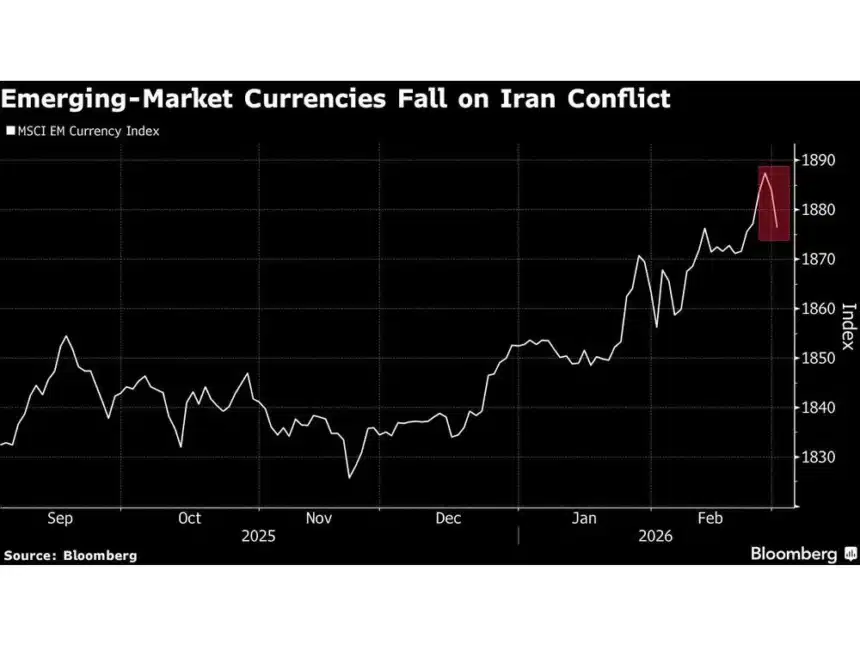
Emerging-market currencies and stocks declined sharply during Asian trading on Monday, as escalating tensions in Iran and surging oil prices dampened appetite for riskier assets.
Currency Weakness Spreads
A benchmark index tracking developing nations’ currencies fell 0.5%, extending losses for a second straight session amid a strengthening U.S. dollar. The Philippine peso and Taiwan dollar posted the largest drops among regional currencies, while South Korean markets remained closed for a public holiday.
Stocks Tumble Broadly
Emerging market equities dropped as much as 1%, marking the steepest decline in over two weeks. The regional conflict has disrupted oil production, shipping routes, and air travel, fueling market volatility.
Brent crude oil prices surged to their highest level in more than a year before pulling back, while the dollar and gold advanced as investors rushed to safe-haven assets. This shift exacerbated pressures on emerging market currencies and heightened inflation risks.
Expert Analysis on the Selloff
“This is a shock that pushes EM weaker,” stated Brendan McKenna, emerging market strategist at Wells Fargo in New York. He highlighted Iran’s more aggressive response compared to past incidents, including the effective closure of the Strait of Hormuz and closer U.S.-Israel coordination. “That shock, combined with the theme that EM is overvalued and overowned at current levels, should drive a selloff in the early days of the conflict,” McKenna added.
Oil-import-dependent economies like South Korea, Taiwan, India, the Philippines, and Thailand face heightened currency weakness, according to Sim Moh Siong and Christopher Wong, strategists at Oversea-Chinese Banking Corp.
Sector Winners and Losers
The tensions lifted Asian shares in energy, shipping, defense, and gold sectors, while airlines, travel firms, and growth stocks slid. Taiwan’s Wan Hai Lines and Evergreen Marine gained ground, but Singapore Airlines, Japan Airlines, and Eva Airways declined sharply.
Further escalation, particularly a Strait of Hormuz blockade, could drive oil prices to $108 per barrel. “The scope of the conflict appears vast and the stakes high—with Iran confirming the supreme leader was killed,” noted analysts led by Dina Esfandiary. “This confrontation could prove longer and more intense than the 12-day war in June.”