Iran asserts dominance over the Strait of Hormuz, the world’s primary oil transit route, through a new inspection regime enforced by the Islamic Revolutionary Guard Corps (IRGC). Ships must enter Iranian waters for checks, with at least two vessels paying transit fees. This setup disrupts global trade, slashing strait traffic by 90% since the conflict began and fueling sharp rises in oil prices, alongside shortages in Asia dependent on Gulf supplies.
Shipping Traffic Plummets
Data from Lloyd’s List Intelligence shows only about 150 vessels, including tankers and container ships, passed through since March 1—barely more than one day’s normal pre-conflict volume. Analytics from Kpler indicate Iran’s Kharg Island terminal loaded 1.6 million barrels in March, matching prior levels. Small private Chinese refineries, undeterred by U.S. sanctions, buy most of this oil.
Ships heading east from the Gulf dominate recent transits. Ownership data reveals Iran-linked vessels at 24%, Greece at 18%, and China at 10%. Iran-connected ships comprised 60% early in the conflict and nearly 90% lately. Roughly half disable automatic identification systems (AIS) before transit, reactivating them in the Gulf of Oman.
De Facto Toll Booth Operations
The IRGC enforces a toll-like system, Lloyd’s List Intelligence reports. Ships increasingly use a northern lane around Larak Island, entering Iranian territorial waters. Operators submit cargo details, ownership, destinations, and crew lists to IRGC-approved intermediaries for clearance. Approved vessels receive a code and escort, with oil shipments prioritized after geopolitical vetting.
Not all pay directly, but at least two did—in yuan. Diplomatic efforts secured passage for two Indian liquid petroleum gas carriers. Iran’s government informed the International Maritime Organization (IMO) of “precautionary measures” for maritime safety, claiming compliance with international law.
Local media cite lawmaker Mohammadreza Rezaei Kouchi stating parliament advances legislation to codify Iran’s control, oversight, and fee collection in the strait.
Security Risks and Global Impact
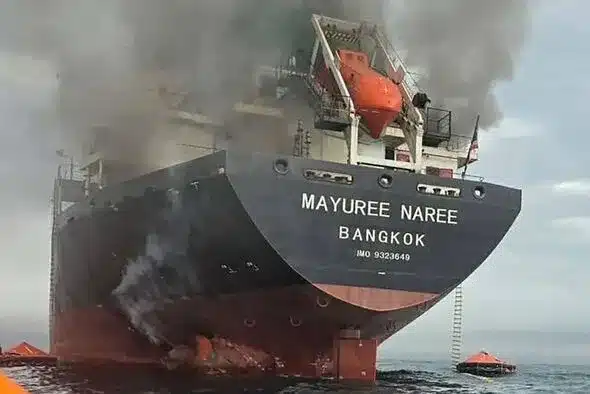
The IMO reports 18 ships struck and seven crew killed, without naming attackers. It condemns the violence and urges coordinated efforts for safe navigation.
Sultan al-Jaber, head of Abu Dhabi National Oil Co., warned: “Weaponizing the Strait of Hormuz is not an act of aggression against one nation. It is economic terrorism against every consumer, every family that depends on affordable energy and food. When Iran holds Hormuz hostage, every nation pays the ransom, at the gas pump, at the grocery store and at the pharmacy.” He added, “No country can be allowed to destabilize the global economy in this way.”
International Law Violations
U.N. Law of the Sea Treaty Article 19 mandates innocent passage for compliant ships, with no toll provisions. Maritime historian Sal Mercogliano of Campbell University notes: “There’s no provision in international law anywhere to set up a toll booth and shake down shipping. This is Iran using the element that they have right now, which is control of the Strait of Hormuz.”
Gulf Cooperation Council Secretary General Jasem Mohamed al-Budaiwi calls the fees “an aggression and a violation of the United Nations agreement on the law of the sea.” Such charges may breach U.S. and European sanctions on the IRGC, which oversees Iran’s missile program and quelled recent protests.