On this 2017 photograph, Ayatollah Ali Khamenei, Iran’s supreme chief, sits in a session to ship his message for the Iranian New Yr. A portrait of the late revolutionary founder, Ayatollah Ruhollah Khomeini, is subsequent to him.
Workplace of the Iranian Supreme Chief/AP
cover caption
toggle caption
Workplace of the Iranian Supreme Chief/AP

On this 2017 photograph, Ayatollah Ali Khamenei, Iran’s supreme chief, sits in a session to ship his message for the Iranian New Yr. A portrait of the late revolutionary founder, Ayatollah Ruhollah Khomeini, is subsequent to him.
Workplace of the Iranian Supreme Chief/AP
Iran’s supreme chief, Ayatollah Ali Khamenei, was killed in Israeli assaults, with U.S. assist, on Saturday. He was 86 years outdated.
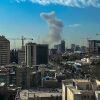
President Trump introduced the Iranian chief’s demise on social media, saying Khamenei couldn’t keep away from U.S. intelligence and surveillance. A supply briefed on the U.S.-Israeli assaults on Iran advised NPR earlier Saturday that an Israeli airstrike killed Khamenei.
Throughout his 36-year rule, Khamenei was unwavering in his steadfast antipathy to the U.S. and Israel and to any efforts to reform and convey Iran into the twenty first century.
Khamenei was born in July 1939 into a non secular household within the Shia Muslim holy metropolis of Mashhad in northeastern Iran and attended theological faculty. An outspoken opponent of the U.S.-backed Shah Mohammad Reza Pahlavi, Khamenei was arrested a number of occasions.
He was surrounded by different Iranian activists, together with Ayatollah Ruhollah Khomeini, who grew to become Iran’s first supreme chief following the nation’s Islamic Revolution within the late Nineteen Seventies.
Khamenei survived an assassination try in 1981 that price him the usage of his proper arm. He served as Iran’s president earlier than succeeding Khomeini as supreme chief in 1989.
Alex Vatanka, a senior fellow on the Center East Institute in Washington, D.C., says Khamenei was an unlikely candidate. Then a midlevel cleric, Khamenei lacked non secular credentials, which left him feeling susceptible, Vatanka says.
“He knew himself. He did not have the status, the gravitas to be … the successor to the founding father of the Islamic Republic, Ayatollah Khomeini,” he says.

In 2005, Ali Khamenei (middle), newly elected President Mahmoud Ahmadinejad (proper), outgoing President Mohammad Khatami and former President Ali Akbar Hashemi Rafsanjani attend Ahmadinejad’s inaugural ceremony in Tehran.
Atta Kenare/AFP by way of Getty Pictures
cover caption
toggle caption
Atta Kenare/AFP by way of Getty Pictures

In 2005, Ali Khamenei (middle), newly elected President Mahmoud Ahmadinejad (proper), outgoing President Mohammad Khatami and former President Ali Akbar Hashemi Rafsanjani attend Ahmadinejad’s inaugural ceremony in Tehran.
Atta Kenare/AFP by way of Getty Pictures
“He spent the primary few years in energy being very nervous,” says Vatanka. “He actually actually felt that anyone goes to, you realize, take him down from the place of energy.”
However Khamenei was crafty and in a position to outwit different senior political figures within the Islamic Republic, in keeping with Ali Vaez, director of the Iran Challenge on the Worldwide Disaster Group. He says that with the assistance of the formidable Islamic Revolutionary Guard Corps, Khamenei constructed up his energy base to grow to be the longest-serving chief within the Center East.
“Ayatollah Khamenei was a person with strategic persistence and was in a position to calculate a number of steps forward,” he says. “That is why I feel he managed — on the again of the Revolutionary Guards — to more and more acceptable all of the levers of energy in his fingers and sideline everybody else.”
Khamenei’s shut ties to the Revolutionary Guards allowed Iran’s army to develop an unlimited industrial empire answerable for many components of the economic system, whereas unusual Iranians struggled to get by.

Ali Khamenei (proper) speaks to members of the armed forces of the Islamic Republic throughout the Iran-Iraq Warfare on Oct. 4, 1981.
AFP/Getty Pictures
cover caption
toggle caption
AFP/Getty Pictures

Ali Khamenei (proper) speaks to members of the armed forces of the Islamic Republic throughout the Iran-Iraq Warfare on Oct. 4, 1981.
AFP/Getty Pictures
Vaez says Khamenei additionally started to construct up Iran’s defensive insurance policies, reminiscent of growing proxies like Hezbollah in Lebanon and Hamas within the Gaza Strip to discourage a direct assault on Iranian soil.
“After which additionally turning into self-reliant in growing a viable typical deterrence, which took the type of Iran’s ballistic missile program,” Vaez says.
As supreme chief, Khamenei additionally had the ultimate phrase on something to do with Iran’s nuclear program.
Over time, Khamenei more and more injected himself into politics. Such was the case in 2009, when he intervened within the presidential election to make sure that his favored candidate, the controversial conservative Mahmoud Ahmadinejad, received workplace.
Iranians took to the streets to protest what was extensively seen as a fraudulent election. Khamenei brutally crushed these demonstrations, triggering each a backlash and extra protest actions through the years.
Iran killed hundreds of its residents below Khamenei’s rule, together with greater than 7,000 folks killed throughout weeks of mass protests that began in late December 2025, in keeping with the Human Rights Activists Information Company, a U.S.-based group that carefully tracks rights abuses in Iran.

Iran’s supreme chief, Ayatollah Ali Khamenei (middle), prays with the Iranian president and different authorities officers in Tehran in 2014.
Anadolu Company/Getty Pictures
cover caption
toggle caption
Anadolu Company/Getty Pictures

Iran’s supreme chief, Ayatollah Ali Khamenei (middle), prays with the Iranian president and different authorities officers in Tehran in 2014.
Anadolu Company/Getty Pictures
“Khamenei had at all times supported and endorsed repressive authorities crackdown, recognizing that these protests had been damaging to the steadiness and legitimacy of the state,” says Sanam Vakil, an Iran skilled at Chatham Home, a London-based suppose tank.
However Khamenei was unconcerned about attending to the foundation of the protests, says the Center East Institute’s Vatanka, and remained caught in an Islamic revolutionary mindset towards the West.
“He on so many events refused point-blank to just accept the essential actuality that the place he was by way of his worldview was not the place the remainder of his folks had been,” Vatanka says.
He provides that 75% of Iran’s 90 million folks had been born after the revolution and have watched different international locations within the area modernize and combine with the worldwide group.
“The 75% he ought to have catered to, listened to and handle[ed] insurance policies to fulfill their aspirations,” he says. “He failed in that miserably.”

Ali Khamenei wears a masks as a result of COVID-19 pandemic as he arrives to solid his poll throughout Iran’s presidential election on June 18, 2021.
Atta Kenare/AFP by way of Getty Pictures
cover caption
toggle caption
Atta Kenare/AFP by way of Getty Pictures

Ali Khamenei wears a masks as a result of COVID-19 pandemic as he arrives to solid his poll throughout Iran’s presidential election on June 18, 2021.
Atta Kenare/AFP by way of Getty Pictures
The Worldwide Disaster Group’s Vaez says after the Arab Spring uprisings in 2011, Khamenei did begin worrying concerning the survival of his regime. Iran’s economic system was crumbling, due largely to stringent Western sanctions, fueling extra unrest.
In 2013, Khamenei agreed to secret negotiations with the U.S. about Iran’s nuclear program, which ultimately led to the 2015 Joint Complete Plan of Motion nuclear settlement. Vaez says Khamenei deeply distrusted the U.S. and was skeptical concerning the deal.
“His argument has at all times been that the U.S. is at all times in search of pretexts, for placing strain on Iran,” he says. “And if Iran concedes on the nuclear problem, then the U.S. would put strain on Iran due to its missiles program or due to human rights violations or due to its regional insurance policies.”
President Trump’s withdrawal from the nuclear deal throughout his first time period in workplace gave some credence to Khamenei’s cynicism. Analysts say Iran elevated its nuclear enrichment after that to a degree the place it was near having the ability to construct a bomb.
In early 2025, when Trump reached out to Iran a couple of new deal, Khamenei dragged out negotiations till they started in mid-April.
However time ran out. In June, Israel made good on its risk to neutralize Iran’s nuclear program, launching strikes on key services and killing scientists and generals. Iran retaliated, and the 2 sides exchanged a number of days of missile strikes.

On June 21, 2025, the U.S. launched main airstrikes on three of Iran’s nuclear enrichment websites. Trump mentioned the services had been “utterly and completely obliterated,” though there was debate among the many White Home and nuclear consultants as to how severe Iran’s nuclear program had been set again.
Vakil, of Chatham Home, says Khamenei underestimated what Israel and the U.S. would do.
“I feel that Khamenei at all times assumed that he may play for time, and what he actually did not perceive is that the world round Iran had very a lot modified,” she says. “The world had uninterested in Khamenei and Iranian foot-dragging and antics … and in order that was a miscalculation.”
But it surely was Iran’s use of proxy militias throughout the area that ultimately led to Khamenei’s downfall.
When Hamas — the Palestinian Islamist group backed by Iran — attacked Israel on Oct. 7, 2023, killing almost 1,200 folks and kidnapping 251 others, it triggered a cascade of occasions that in the end led to Israel’s assault on Iran.
The day after the 2023 Hamas-led assault, Iran-backed Hezbollah in Lebanon began firing rockets into Israel, triggering a battle that led to the Shia militia’s high brass being decimated — together with high chief Hassan Nasrallah.

Israel and Iran traded direct airstrikes for the primary time in 2024 as a part of that battle.
Israel’s bombing of Iranian weapons shipments in Syria additionally helped weaken the regime of Syria’s then-dictator, Bashar al-Assad, an essential ally of Iran. Assad fell in December 2024 and fled to Russia in early January 2025.
By the point Khamenei died, his legacy was in tatters. Israel had hobbled two key proxies, Hamas and Hezbollah, and had worn out Iran’s air defenses. With U.S. assist, it left Iran’s nuclear program in shambles.
What stays is a strong ballistic missile program, the brainchild of Khamenei. It is unclear who will change him to steer a now weakened and susceptible Iran.