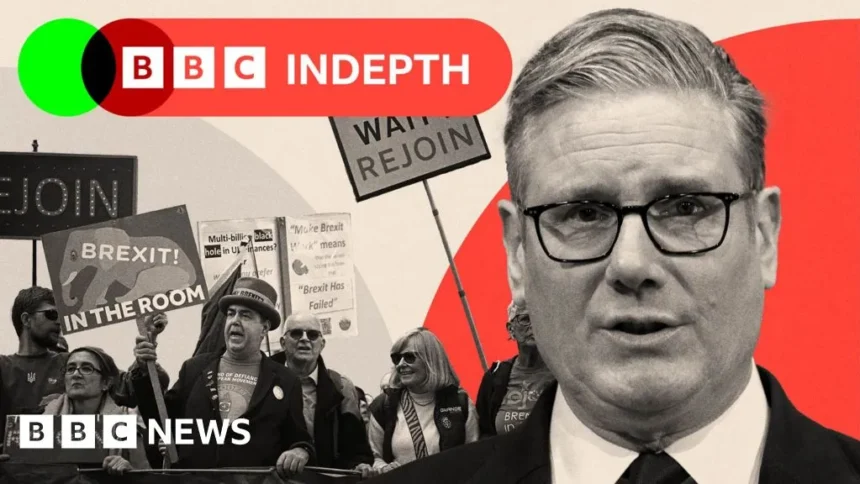
Chancellor Rachel Reeves declares that Brexit inflicted deep damage on the UK economy during her Mais lecture. She directly addresses European allies, stating, “This government believes a deeper relationship is in the interest of the whole of Europe,” while emphasizing no intent to reverse Brexit.
Push for Economic Reset
Government ministers signal a strategic pivot as the UK tackles sluggish growth. Reeves advocates aligning UK regulations with EU standards where beneficial to boost economic performance. The 2024 Labour manifesto outlined renegotiating the 2020 Trade and Cooperation Agreement, particularly to eliminate customs checks on food and agricultural exports through regulatory alignment. It firmly ruled out rejoining the single market, customs union, or restoring freedom of movement.
This position stemmed from Labour’s 2019 election rout, after which the party endorsed leaving the EU and backed the agreement. Recent rhetoric has evolved. Prime Minister Sir Keir Starmer notes Brexit significantly harmed the economy and calls for closer EU ties. Health Secretary Wes Streeting remarks, “I’m glad that Brexit is a problem whose name we now dare speak,” linking EU absence to growth challenges. Deputy Prime Minister David Lammy deems Brexit’s economic damage self-evident, citing Turkey’s gains from its EU customs deal.
London Mayor Sadiq Khan urges rejoining the customs union and single market before the next election, followed by an EU membership campaign. Despite manifesto red lines, Reeves signals broader regulatory alignment for growth. UK GDP rose 1.3% in 2025, up from 1.1% in 2024 but below 1.5% forecasts.
Political Calculations
The shift carries electoral risks, potentially alienating Brexit supporters. Yet data reveals Labour’s 2024 victory relied little on reclaiming working-class Leavers. British Election Study and National Centre for Social Research figures show 80% of Labour support from pro-rejoin voters, similar to 2019’s 86%. Gains came more from pro-EU former Conservatives than Leavers. Working-class advances matched or lagged middle-class ones.
Current polls place Labour at 19%, trailing Reform UK by eight points. One in 10 2024 Labour voters now back Reform. However, losses to Greens (19%) and Liberal Democrats (8%) outpace Reform shifts. Labour’s vote drops nine points among Leavers but 19 among Remainers since 2024, highlighting the need to recapture pro-EU defectors favoring Brexit reversal.
Voter Sentiments on Reset
YouGov polls indicate 76% of 2024 Labour voters support closer EU ties without rejoining key structures; 82% back full EU rejoin. Recent data shows 73% favor starting rejoin talks. Labour’s core reset—removing food export checks via veterinary agreement—polls at 63% support initially. Yet trade-off questions yield narrower 45-40% preference for EU alignment over independent rules and checks.
Such findings suggest challenges ahead. Opponents may frame resets as Brexit betrayal, following Brussels rules over Westminster’s. Labour must persuade voters amid apparent trade-offs.
Professor Sir John Curtice, Politics Professor at Strathclyde University and Senior Fellow at the National Centre for Social Research, analyzes this evolution from Labour’s initial Leaver outreach to Remainer focus for electoral viability.