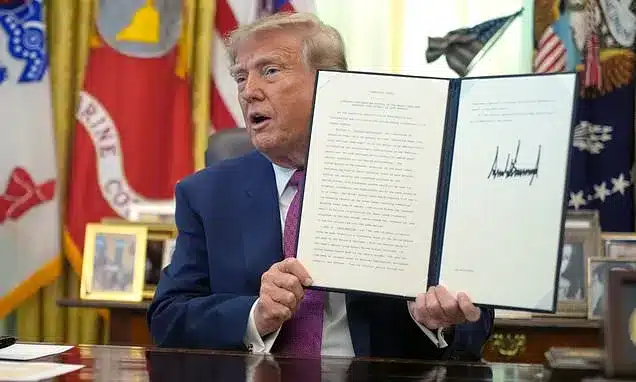
In a significant escalation of ongoing trade disputes, President Donald Trump has signed an executive order officially renaming Lake Ontario to ‘Lake America.’ The move, announced during a press briefing in the Oval Office, signals a deepening rift in diplomatic and economic relations between the United States and Canada.
Presidential Decree and Rationale
The executive order, effective immediately upon signing, formally changes the designation of the Great Lake that borders both nations. President Trump stated during the signing ceremony, “I guess the purpose of this, more than anything else, is we’re going to be changing the name of Lake Ontario, effective immediately to Lake America. That’s going to take place right now as I sign the order.”
When questioned by reporters about the motivation behind this unprecedented action, the President expressed frustration with the existing trade relationship. “We defend Canada for nothing, we don’t get anything,” Trump remarked. He further elaborated, “We love the people of Canada, but their representatives aren’t doing an appropriate job.” The President indicated that the idea of renaming the lake had been under consideration for an extended period.
Context of US-Canada Trade Relations
This renaming initiative occurs against a backdrop of protracted trade negotiations and disputes between the United States and Canada. For months, the two neighboring countries have been engaged in discussions and disagreements over various trade policies, tariffs, and market access issues. These tensions have impacted numerous sectors, including agriculture, manufacturing, and energy.
Historical Trade Dynamics
The economic relationship between the U.S. and Canada is one of the largest and most integrated in the world. Billions of dollars in goods and services cross the border daily. Historically, the two nations have maintained a generally cooperative trade environment, underpinned by agreements like the North American Free Trade Agreement (NAFTA) and its successor, the United States-Mexico-Canada Agreement (USMCA). However, recent years have seen increased friction as the U.S. administration has sought to renegotiate terms it deems unfavorable.
Specific Trade Grievances
While the President did not detail specific trade grievances that led to the lake renaming, past U.S. complaints have often centered on:
- Dairy Markets: U.S. producers have expressed concerns about Canadian dairy policies that they argue limit access for American products.
- Lumber Disputes: Long-standing disagreements exist over U.S. tariffs on Canadian softwood lumber, which the U.S. claims is unfairly subsidized by the Canadian government.
- Automotive Sector: Discussions have included rules of origin for vehicles under the USMCA and broader concerns about trade imbalances in the automotive industry.
- Intellectual Property: Issues related to the protection and enforcement of intellectual property rights have also been points of contention.
Geopolitical and Diplomatic Implications
The renaming of a shared natural landmark carries significant symbolic weight, potentially altering the perception of the bilateral relationship. While the U.S. government has the authority to rename geographical features within its own territory, Lake Ontario is a transboundary body of water. The unilateral nature of the decision is likely to be viewed critically by Canadian officials and the public.
Potential Canadian Response
Canadian authorities have yet to issue a formal statement regarding the renaming of Lake Ontario to Lake America. However, it is anticipated that the move will be met with disappointment and possibly reciprocal actions. Canada has previously responded to U.S. tariffs with its own retaliatory measures, demonstrating a willingness to defend its economic interests.
Impact on Public Perception
Such symbolic actions can influence public opinion and national sentiment. The renaming could be interpreted as a nationalistic gesture, emphasizing American interests above shared regional cooperation. This may further complicate efforts to resolve underlying trade issues, as it introduces an emotional and symbolic layer to the economic disputes.
Economic and Environmental Considerations
Beyond the political symbolism, the practical implications of renaming a major Great Lake are complex. Lake Ontario is a vital waterway for shipping, recreation, and ecological systems that span both countries. Its official designation has historical and geographical significance recognized internationally.
Shipping and Commerce
The St. Lawrence Seaway, which connects Lake Ontario to the Atlantic Ocean, is a critical artery for international trade. While the name change is unlikely to alter the physical infrastructure or the flow of commerce, it could introduce bureaucratic complexities in documentation, navigation, and international agreements related to the waterway.
Environmental Cooperation
Environmental protection efforts for the Great Lakes often involve joint initiatives between the U.S. and Canada. Organizations like the International Joint Commission (IJC) work to manage shared water resources and address pollution. A unilateral renaming could potentially strain these collaborative frameworks, although the core environmental challenges remain shared.
Conclusion
The decision to rename Lake Ontario to ‘Lake America’ represents a dramatic escalation in the U.S.-Canada trade dispute. While the President frames it as a response to perceived unfairness in the trade relationship, the move carries significant symbolic weight and potential diplomatic repercussions. As the situation evolves, the focus will remain on whether this action leads to a constructive resolution of trade issues or further exacerbates tensions between two closely linked nations.