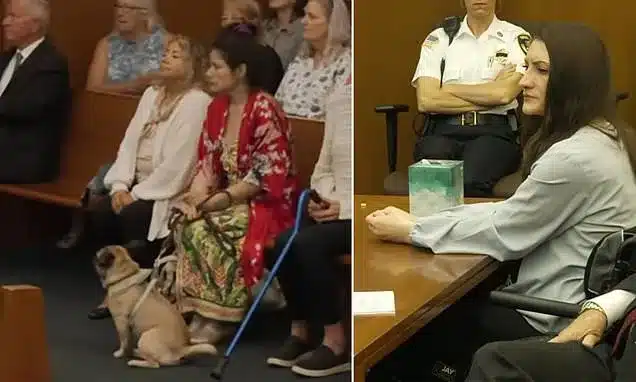
A courtroom spectator’s decision to bring her pet dog into the proceedings for the high-profile Lindsay Clancy murder trial has ignited a firestorm on social media. The woman, who remained unidentified, was observed with her pug, named Chorizo, seated quietly by her feet in the back of the Plymouth Superior Court. The dog was reportedly wearing a blue harness and remained leashed to its owner throughout the proceedings, drawing significant attention and sparking widespread debate online.
The Lindsay Clancy Trial Context
The presence of the dog occurred as the trial of Lindsay Clancy, 36, neared its conclusion. Clancy is accused of murdering her three young children: Cora, 5; Dawson, 3; and 8-month-old Callan. The tragic events took place on January 24, 2023, in Duxbury, Massachusetts. Prosecutors contend that Clancy intentionally killed her children, while her defense team argues she was not criminally responsible due to a severe mental health crisis, specifically postpartum psychosis brought on by prescribed medications.
The trial, which commenced on July 20, has involved extensive testimony and arguments from both the prosecution and the defense. The jury, composed of nine women and three men, was recently sent out to deliberate on the charges, which include first-degree murder, second-degree murder, and manslaughter. The judge, William Sullivan, introduced manslaughter as a potential verdict, a lesser charge than murder that carries a maximum sentence of 20 years, compared to life in prison for a murder conviction. A mistrial could result if the jury cannot reach a unanimous decision.
Social Media Reaction to the Dog in Court
The unusual sight of a dog in the courtroom quickly became a topic of intense discussion on social media platforms, particularly X (formerly Twitter). Many users expressed disbelief and criticism, with comments ranging from calling the situation “wild” to deeming it “unnecessary.” Some reactions also targeted the judge, questioning the decision to permit an animal in a sensitive legal environment. Speculation arose about whether the dog was an official service animal or an emotional support animal, with some users suggesting the judge may have been concerned about potential legal repercussions for denying entry.
The debate highlighted differing perspectives on the appropriateness of animals in public spaces, especially within the solemn atmosphere of a murder trial. While some defended the owner’s right to have her emotional support animal present, citing potential benefits for anxiety, many others felt it was disrespectful to the gravity of the proceedings and the victims.
Closing Arguments and Jury Deliberations
The spectator’s dog incident occurred against the backdrop of compelling closing arguments. Lindsay Clancy’s attorney, Kevin Reddington, urged the jury to consider the “manipulation” by the state and pointed to inconsistencies in the investigation, including the discovery of prescription pill bottles that were allegedly not found during an initial police search. Reddington strongly refuted the prosecution’s characterization of his client’s suicide attempt as minor, asserting it was a significant act driven by her profound mental distress.
He argued that Clancy was suffering from a “disease and defect” and was therefore not guilty of murder. Conversely, Assistant District Attorney Jennifer Sprague emphasized the prosecution’s stance that Clancy’s mental illness, while acknowledged, should not serve as a complete defense. Sprague suggested that Clancy’s actions were rational, pointing to her prior discussions with family about harming her children and her fear of them being taken away if she sought help. She also graphically detailed the children’s final moments and contested claims that the exercise bands used were knotted.
The Defense and Prosecution’s Key Arguments
The defense’s core argument centers on Clancy’s state of mind at the time of the killings, attributing her actions to a severe mental breakdown exacerbated by prescribed medications for postpartum depression. They maintain that she lacked the intent required for a murder conviction due to her compromised mental state.
The prosecution, however, posits that Clancy was aware of her actions and possessed the requisite intent. They highlight evidence suggesting a degree of premeditation and rational thought, such as her alleged discussions about harming her children and her subsequent suicide attempt. The prosecution aims to prove that despite her mental health struggles, Clancy was criminally responsible for the deaths of her children.
Conclusion: Awaiting the Verdict
As the jury begins its deliberations, the case of Lindsay Clancy remains one of the most heart-wrenching legal battles in recent memory. The presence of the dog, Chorizo, in the courtroom, while a minor detail in the grand scheme of the trial, served to underscore the intense public interest and the emotional weight surrounding the proceedings. The ultimate verdict will hinge on the jury’s interpretation of the evidence presented regarding Clancy’s mental state and criminal responsibility, with profound implications for her future and the ongoing conversation about postpartum mental health.