[ad_1]
Police in New Zealand are ready for nature to take its course after a person allegedly tried to smuggle a 33,000 New Zealand greenback ($19,000) pendant out of a jewellery retailer by swallowing it.
The 32-year-old man, who has not been publicly named, is accused of consuming an ornate Fabergé octopus pendant at Partridge Jewelers in Auckland on Nov. 28.
Proof of the alleged theft has but to emerge, police stated Wednesday.
“On the time of his arrest he underwent a medical evaluation, and an officer is assigned to consistently monitor the person,” Inspector Grae Anderson stated in an announcement. “At this stage the pendant has not been recovered.”
Charging paperwork seen by the Guardian newspaper affirm the person was charged on November 29 for allegedly stealing the Fabergé x 007 Particular Version Octopussy Egg Shock Locket, valued at $33,585.
The person was arrested inside the shop minutes after the alleged theft. He appeared within the Auckland District Courtroom on Nov. 29, the place he didn’t enter a plea on a cost of theft.
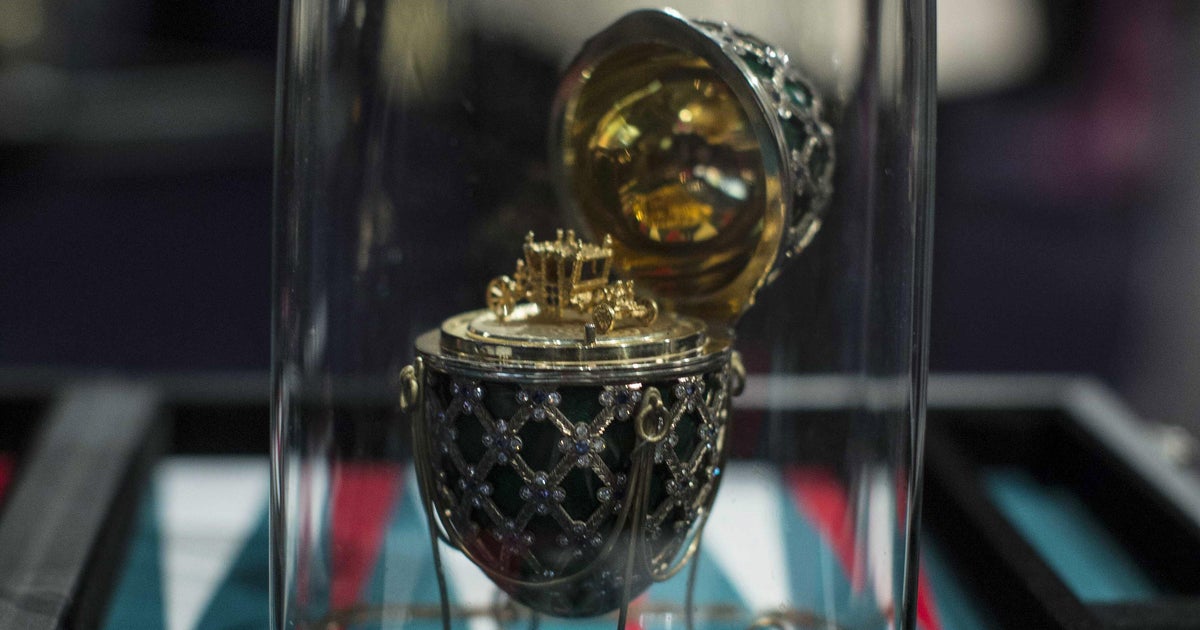
The alleged loot was a limited-edition, Fabergé egg pendant impressed by the 1983 James Bond movie Octopussy. Central to the movie’s plot is a jewel-smuggling operation that entails a faux Fabergé egg.
The shop’s web site says the egg, solely 50 of which have been made, is crafted from gold, painted with inexperienced enamel and encrusted with 183 diamonds and two sapphires. The pendant is 8.4 centimeters (3.3 inches) tall and is mounted on a stand.
“The egg opens to disclose an 18ct yellow gold octopus nestled inside, adorned with white diamond suckers and black diamond eyes,” an merchandise description stated. “The octopus shock pays homage to the eponymous antagonist on the centre of the Octopussy movie.”
Christian Palma / AP 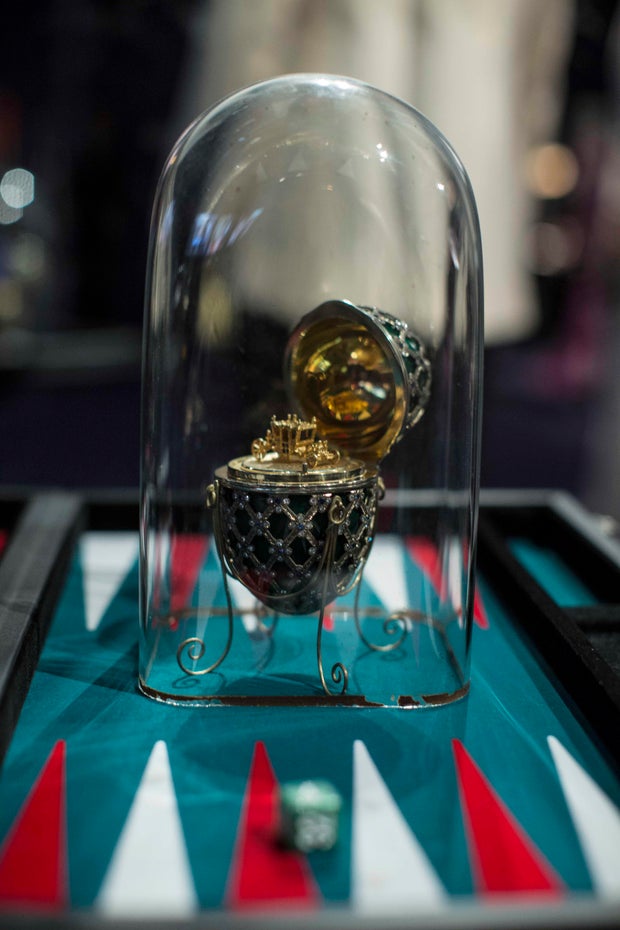
Time and digestion will inform if one other octopus shock is forthcoming.
“Given this man is in Police custody, we’ve an obligation of care to proceed monitoring him given the circumstances of what has occurred,” Anderson stated.
The accused man is because of seem in court docket once more Dec. 8.
Crystal Fabergé egg sells for document $30.2 million
In the meantime, in London, a uncommon crystal and diamond Fabergé egg crafted for Russia’s ruling household earlier than it was toppled by revolution shattered data Tuesday because it offered at public sale for 22.9 million kilos ($30.2 million).
The Winter Egg, which was in comparison with the enduring Mona Lisa, was simply considered one of seven of the opulent ovoids remaining in personal fingers, Christie’s London public sale home stated.
The 4-inch (10-centimeter) tall egg is constituted of finely carved rock crystal, coated in a fragile snowflake motif wrought in platinum and 4,500 tiny diamonds. It opens to disclose a detachable tiny basket of bejeweled quartz flowers symbolizing spring.
Kirsty Wigglesworth / AP 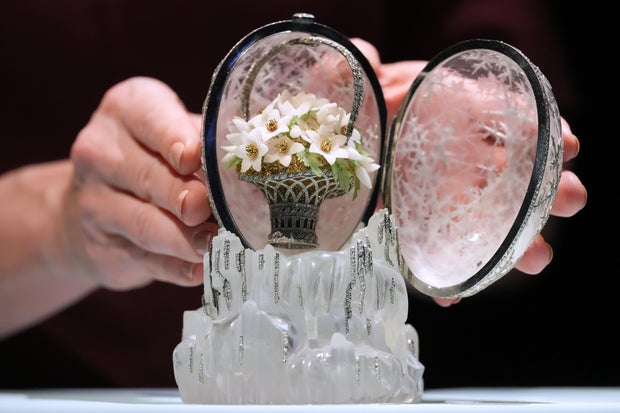
The sale worth, which included a purchaser’s premium, topped the $18.5 million paid at a 2007 Christie’s public sale for one more Fabergé egg created for the Rothschild banking household.
Craftsman Peter Carl Fabergé and his firm created greater than 50 of the eggs for Russia’s imperial household between 1885 and 1917, every elaborately distinctive and containing a hidden shock. Czar Alexander III began the custom by presenting an egg to his spouse every Easter. His successor, Nicholas II, prolonged the reward to his spouse and mom.
Czar Nicholas II commissioned the egg for his mom, Dowager Empress Maria Feodorovna, as an Easter current in 1913. It was considered one of two eggs created by feminine designer Alma Pihl; her different egg is owned by Britain’s royal household.
The Romanov royal household dominated Russia for 300 years earlier than the 1917 revolution ousted it. Nicholas and his household have been executed in 1918.
Purchased by a London supplier for 450 kilos when the cash-strapped Communist authorities offered off a few of Russia’s inventive treasures within the Twenties, the egg modified fingers a number of occasions. It was believed misplaced for 20 years till it was auctioned by Christie’s in 1994 for greater than 7 million Swiss francs ($5.6 million on the time). It offered once more in 2002 for $9.6 million.
Every time the egg has offered, it has set a world document worth for a Fabergé merchandise, Christie’s stated.
Margo Oganesian, the pinnacle of Christie’s Russian artwork division, known as the egg “the ‘Mona Lisa’ for ornamental arts,” an outstanding instance of craft and design.
“Right now’s outcome units a brand new world public sale document for a piece by Faberge, reaffirming the enduring significance of this masterpiece,” Oganesian stated in an announcement.
She added the sale celebrated “the rarity and brilliance of what’s extensively considered considered one of Faberge’s most interesting creations, each technically and artistically.”
Faberge, the grasp jeweler whose creations bedazzled Russia, created 50 Imperial Easter Eggs for the then-ruling Romanov household over a 31-year interval, making them extremely uncommon and beneficial, Oganesian informed AFP forward of the public sale.
There are 43 surviving imperial Fabergé eggs, most in museums.
[ad_2]