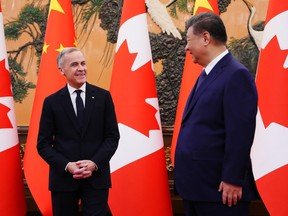
WASHINGTON, D.C. — Prime Minister Mark Carney’s recent trade agreement with China sparks concerns in Washington and beyond, raising questions about whether the potential for expanded commerce justifies the dangers of exploitation and retaliation. Insights from Michael Kovrig, a former Canadian diplomat detained unjustly in China for nearly three years following the 2018 arrest of Huawei executive Meng Wanzhou, highlight China’s pattern of employing economic and political pressure in international relations.
Evaluating the Partnership’s Viability
Kovrig describes the new China deal as pragmatic yet hazardous. When asked if the reduced trade barriers justify the partnership’s risks, he responds succinctly: “No.” He emphasizes uncertainties surrounding implementation, noting that outcomes hinge on Canada’s management strategies and reactions from China and the United States.
“One essential premise to understand is that the Chinese Communist Party is a strategic and systemic rival to Western countries,” Kovrig explains. “It actively seeks to undermine them and gain advantage over them, and to increase other countries’ dependence on China while reducing and diversifying its own dependence on others.” He argues that any agreement benefiting the Chinese Communist Party requires Canada to ensure net gains outweigh concessions, warning against providing tools for potential coercion.
Breaking Down the Canola-EV Exchange
The deal partially restores market access for Canadian canola farmers, benefiting the economy and bolstering political support in Western Canada for the Liberal government. However, Kovrig cautions that these gains remain susceptible to future Chinese leverage. “If I were a betting man, I’d put money on China weaponizing that trade again one day,” he says, urging diversification of production and markets to mitigate vulnerabilities.
The “strategic partnership” updates a longstanding 2005 agreement, signaling normalized diplomatic ties. Yet, Kovrig warns that increased business engagement could heighten risks of foreign influence and interference. “The more entwined Canada is with China, the greater the risks,” he states, advocating for robust mitigation measures.
Automotive Sector Vulnerabilities
A major concern centers on Canada’s automotive industry, where the deal trades agricultural relief for potential exposure to Chinese electric vehicle (EV) imports. While quotas and incentives aim to encourage local investment, Kovrig views the benefits as speculative. “The industrial benefits are speculative ‘expectations,’ not enforceable obligations,” he notes, referencing economic analyses that highlight asymmetric risks.
Initially limited to certified manufacturers like Tesla, Polestar, Volvo, Ford, GM, and BYD, imports could pressure domestic producers if demand erodes price protections. Kovrig predicts a possible loss of Canada’s auto sector without careful oversight, including binding local content rules and enforcement mechanisms. “The default outcome of opening a smaller market to a massively over-capacity producer is import penetration, not building new ecosystems,” he warns.
Chinese automakers face domestic overproduction, driving export needs. Investments in Canada might serve as assembly hubs to bypass trade barriers, offering limited jobs and technology transfer. “The end result is likely to be China dominating the market with imports and a few token assembly plants for political optics,” Kovrig says, stressing the national security implications of supply chain dependence.
Geoeconomic and Geopolitical Implications
The agreement could strain Canada-U.S. relations under the Canada-United States-Mexico Agreement (CUSMA), especially amid threats of U.S. tariffs viewing Canada as a conduit for Chinese EVs. Kovrig suggests clarifying quotas and barriers to affirm no backdoor access to the U.S. market. “Any concession to Washington should reinforce continental integration, not weaken it,” he advises.
China’s industrial policies, including subsidies and market distortions, fuel global de-industrialization by undercutting competitors. Kovrig links this to Canada’s commodity export reliance, which now exceeds half of total exports. “This move encourages a trend of Canada exporting raw materials rather than finished products,” he observes, questioning long-term aspirations: “Does Canada want to be a carmaker or a gas station?”
Such dependence risks elite capture and policy subordination, as seen in Australia’s loss of its auto industry. Kovrig calls for industrial policies promoting value-added production, warning of path-dependent de-industrialization leading to economic stagnation.
Long-Term Success Metrics
For the deal to succeed, Kovrig envisions preserved auto manufacturing, no retaliatory actions from Beijing or Washington, and sustained investments in batteries and EVs. A transactional, limited relationship without deepened entanglements would mark progress. “Success would not be measured by import volumes or lower sticker prices,” he clarifies.
Red Lines and Diversification Strategies
Kovrig urges clear boundaries in dealings with China, including automatic reversals for non-compliance, sector exclusions, and refusals to trade silence on security issues for market access. “Engagement without pre-set guardrails and exit ramps is not pragmatic diplomacy; it’s just deferred coercion,” he asserts.
Diversification requires broadening trade across partners while fortifying North American ties, focusing on ecosystems in batteries and critical minerals. “Real diversification means deepening those ecosystems with trusted partners in Europe and Asia, not introducing a China-shaped vulnerability,” Kovrig recommends.
Moral and Strategic Balance
Reflecting on Carney’s recent engagements, Kovrig praises honest discourse on power dynamics as a moral win but critiques concessions like deferential rhetoric and Taiwan-related gestures as losses. Strategically, reopened channels offer gains, yet underestimated automotive impacts pose risks. Canada’s competitive clean-energy platform remains a key asset, provided it avoids erosion under pragmatism’s guise.
Hostage Diplomacy Concerns
Risks of renewed “hostage diplomacy” escalate with actions angering Beijing, such as arrests of Chinese nationals amid disputes. Kovrig stresses resilience through ally coordination and clear deterrence: “The protection isn’t goodwill — it’s resilience, coordination with allies, and making clear that intimidation only damages the relationship.”