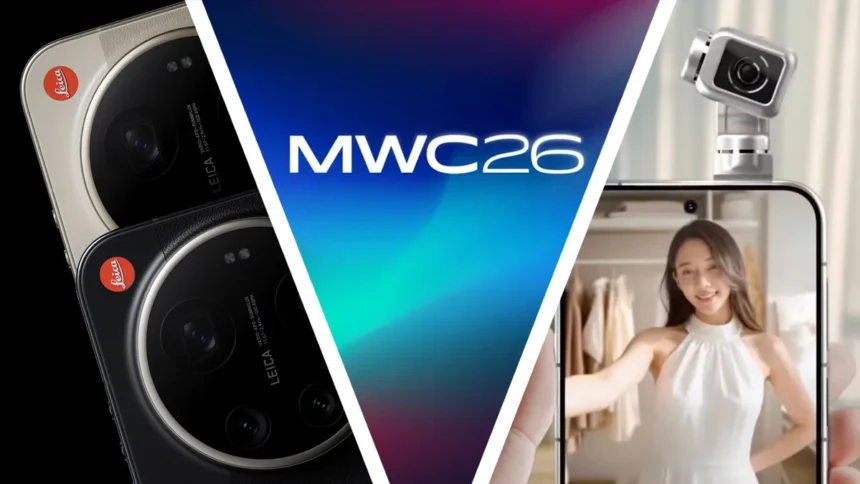
Mobile World Congress 2026 delivered a packed lineup of smartphones, highlighting innovations in foldables, flip devices, swivel designs, and rugged builds. Hands-on testing of approximately 30 models over two days pinpointed six standout devices worth watching. These picks focus on production-ready phones with broad appeal, excluding pure concepts and region-locked rarities. Two emerge as personal favorites for everyday use, while the others offer compelling features for various users.
Honorable Mentions
Several devices generated buzz but missed the top spots. Samsung showcased exclusive online colors for the Galaxy S26 series, revealing striking silver and pink finishes that enhance its appeal. The Nubia Air Pro, unveiled last year, continues to impress. Nothing Phone (4a) debuted at a parallel event with significant fanfare. Concept prototypes, such as Tecno’s modular phone and Honor’s Robot Phone, sparked ideas but lack consumer availability. Honor V6 and Nubia Fold took a backseat to stronger entries from their brands. The Vivo X300 promised excitement, though access was limited.
Honor Magic 8 Pro
The Honor Magic 8 Pro, recently launched, anchors Honor’s MWC presence alongside flashier concepts. This flagship packs a 350MP camera array: 50MP main, ultrawide, and front sensors, plus a 200MP periscope for 3.7x optical zoom. Powered by the Snapdragon 8 Elite Gen 5, it features a 6.71-inch OLED display, 7,100mAh battery, 100W wired charging, and 80W wireless. A time-of-flight sensor aids selfie depth. While software includes some bloat, seven years of Android updates add longevity. Priced at around $1,500, it competes with premium rivals through raw specs rather than gimmicks.
Nubia Z80 Ultra
Nubia Z80 Ultra delivers flagship performance with unique flair. Its 6.85-inch AMOLED screen hides the front camera underneath, paired with Snapdragon 8 Elite Gen 5, a 50MP main/50MP ultrawide/64MP 2.7x periscope triple-camera setup, 7,200mAh battery, and 80W wired/wireless charging. Standout designs include a Starry Night-inspired spiral pattern alongside standard black and white. Entry-level pricing at $649 makes it a value powerhouse, though availability varies.
Nubia Neo 5 GT
Nubia expands gaming options with the Neo 5 GT, bypassing its Red Magic sub-brand. Targeting budget gamers, it offers Dimensity 7400 chipset, 12GB RAM, 6.8-inch AMOLED display, 6,210mAh battery, 80W charging, and side haptic triggers. A flush rear camera array eliminates wobble during tabletop play with controllers, outshining the standard Neo 5. Pricing remains unannounced but expected to undercut premium siblings.
Xiaomi 17 Ultra / Leica Leitzphone
Xiaomi 17 Ultra elevates photography with a 50MP 1-inch main sensor, adjustable 200MP periscope (3.2x-4.3x zoom), and 50MP ultrawide, enhanced by Leica modes. Leica Leitzphone variant adds a rotating camera ring. Supporting specs include Snapdragon 8 Elite Gen 5, 16GB RAM, 6.9-inch AMOLED, 6,000mAh battery, 90W wired/50W wireless charging, and IP69 rating. No microSD slot disappoints creators. Starting at $1,700 (Leica at $2,200), U.S. availability is absent, positioning it as a premium camera benchmark.
TCL NxtPaper 70 Pro
TCL NxtPaper 70 Pro refines e-paper integration for eye comfort and battery savings. A dedicated switch activates NxtPaper mode, optimizing UI for reading libraries. Mid-range internals feature a 6.9-inch screen, MediaTek Dimensity 7300, 50MP main/8MP ultrawide cameras, 5,200mAh battery, and 33W charging. Priced around $400, it launches in the U.S. with inconsistent global rollout.
Tecno Camon 50 Pro
Tecno Camon 50 Pro revives curved-edge design in vibrant colors, prioritizing ergonomics over maximal screen real estate. Its 50MP main/50MP 3x telephoto/8MP ultrawide rear and 50MP front cameras stand out in budget territory. A 6.78-inch 144Hz AMOLED display, Helio G200 Ultimate chipset, 6,150mAh battery, 45W charging, MIL-STD-810 durability, and IP69K rating add value. HIOS software emphasizes AI tools. Under $600 pricing could make it a rare Android buyer’s choice outside major markets.