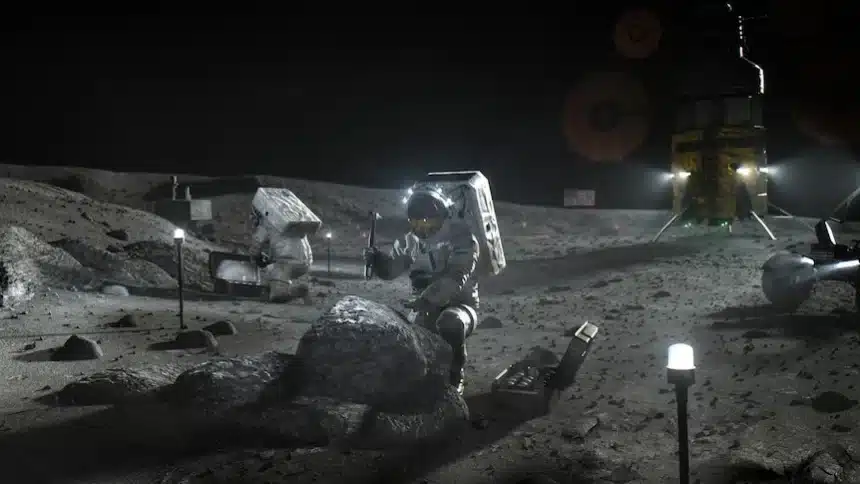
NASA has abandoned plans for a space station in lunar orbit, opting instead to construct a $28.7 billion base directly on the moon’s surface. Components from the largely completed Lunar Gateway station will support this new surface infrastructure, while the agency also prepares a nuclear-powered mission to Mars.
Sweeping Changes to Artemis Program
NASA Administrator Jared Isaacman unveiled major updates to the Artemis moon initiative, aiming to accelerate humanity’s return to the lunar surface ahead of China’s targeted astronaut landings around 2030. Isaacman, who assumed leadership last December, emphasized building momentum through incremental steps.
The revised strategy includes deploying additional robotic landers, a fleet of drones, and foundational systems for nuclear power on the moon in the coming years. “This revised step-by-step approach to learn, build muscle memory, bring down risk, and gain confidence is exactly how NASA achieved the near impossible in the 1960s,” Isaacman stated, drawing parallels to the Apollo era.
Nuclear Propulsion Mission to Mars
NASA plans to launch the Space Reactor 1 Freedom spacecraft to Mars by the end of 2028. This mission will demonstrate advanced nuclear electric propulsion in deep space, transitioning the technology from labs to operational use. Upon arrival, the spacecraft will release helicopters to explore the Martian terrain.
Repurposing Lunar Gateway Components
The Lunar Gateway, constructed primarily by Northrop Grumman and Intuitive Machines subsidiary Lanteris Space Systems, was originally destined for lunar orbit as a research hub and staging point for surface missions. “It should not really surprise anyone that we are pausing Gateway in its current form and focusing on infrastructure that supports sustained operations on the lunar surface,” Isaacman announced from NASA headquarters in Washington.
Repurposing these assets for a surface base presents engineering challenges and raises questions about the roles of key international partners—Japan, Canada, and the European Space Agency—which committed components to the orbital station. “Despite some of the very real hardware and schedule challenges, we can repurpose equipment and international partner commitments to support surface and other program objectives,” Isaacman added.
European Space Agency Director General Josef Aschbacher, present at the announcement, indicated he will review the plans and maintain discussions with NASA.
Current timelines target the first astronaut landings on the moon in 2028, with Gateway previously envisioned as a waypoint for descending to the surface.
Lunar Lander Developments and Urgency
The Artemis program’s core human landing system involves competitors SpaceX and Blue Origin, both developing vehicles for 2028 crewed missions but facing delays. Acting Associate Administrator Lori Glaze noted that SpaceX is exploring design alternatives for its Starship lander and adopting a streamlined process to accelerate progress. The agency will prioritize the first available lander rather than a fixed sequence.
A recent NASA inspector general report highlighted SpaceX’s two-year delay since its 2021 selection, alongside ongoing technical hurdles for both companies. These shifts reshape billions in contracts, driven by competitive pressures as China advances toward its 2030 moon goals.
Launched in 2017, Artemis builds on the Apollo legacy, establishing routine lunar operations after a half-century hiatus.