[ad_1]
After working round a hydrogen leak, NASA pressed forward with a “moist gown” rehearsal countdown of its Artemis II moon rocket Monday, loading the massive rocket with greater than 750,000 gallons of liquid oxygen and hydrogen gas, solely to be derailed by further leakage early Tuesday.
Consequently, NASA stated it was suspending an tried launch of a crewed spacecraft on a flight across the moon and again utilizing the rocket till subsequent month on the earliest.
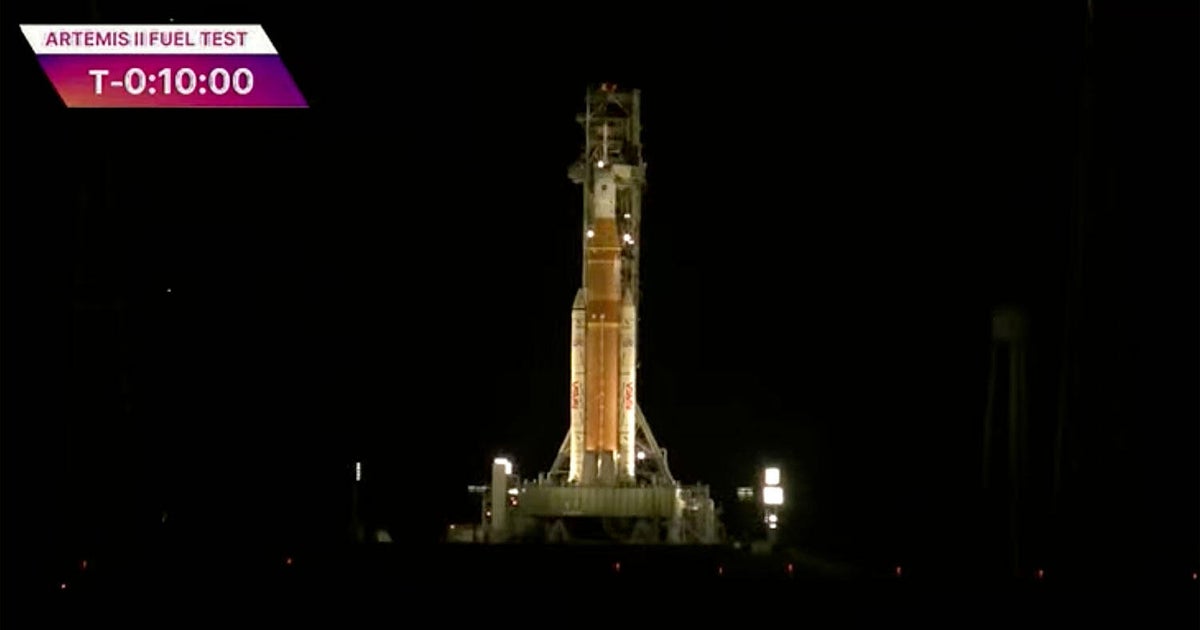
Already working a number of hours delayed, the countdown resumed on the T-minus 10-minute mark round 12:09 a.m. EST Tuesday, ticking down towards a simulated engine begin.
However four-and-a-half minutes later, the countdown stopped once more as a result of a “liquid hydrogen leak on the interface of the tail service mast umbilical, which had skilled excessive concentrations of liquid hydrogen earlier within the countdown,” NASA stated on social media.
The House Launch System rocket’s cellular launch platform is provided with two tail service masts, massive side-by-side constructions on the base of rocket that home propellant traces resulting in pull-away umbilical assemblies on a aspect of the booster’s engine compartment.
“The launch management crew is working to make sure the SLS rocket is in a protected configuration and (to) start draining its tanks,” NASA stated.
The company stated in a weblog put up early Tuesday that, “To permit groups to evaluation information and conduct a second moist gown rehearsal, NASA now will goal March because the earliest doable launch alternative for the flight take a look at.”
“Shifting off a February launch window additionally means the Artemis II astronauts might be launched from quarantine, which they entered in Houston on Jan. 21. Consequently, they won’t journey to NASA’s Kennedy House Middle in Florida Tuesday as tentatively deliberate. Crew will enter quarantine once more about two weeks out from the following focused launch alternative,” NASA added.
The company solely had three days — Feb. 8, 10 and 11 — to propel 4 astronauts on a flight across the moon and again this month.
Hydrogen leaks have confirmed extraordinarily tough to restore on the launch pad, and a Tremendous Bowl Sunday launch seems unlikely until managers conclude the leak is manageable as is. However no ultimate choices on a path ahead are anticipated till engineers have an opportunity to evaluation the information. A information briefing is predicted at 1 p.m. Tuesday.
The follow countdown started Saturday night — two days late due to frigid climate alongside Florida’s House Coast and, after a gathering Monday morning to evaluate the climate and the crew’s readiness to proceed, Launch Director Charlie Blackwell-Thompson cleared engineers to start the remotely-controlled fueling operation.
The take a look at bought underway about 45 minutes later than deliberate however initially gave the impression to be continuing easily as supercold liquid oxygen and hydrogen gas had been pumped into the House Launch System rocket’s first stage tanks. Shortly after, hydrogen started flowing into the rocket’s higher stage as deliberate.
However after the primary stage hydrogen tank was about 55 p.c full, a leak was detected at an umbilical plate the place a gas line from the launch pad is linked to the bottom of the SLS rocket’s first stage. After a short pause, engineers resumed gas move however once more lower it off with the tank about 77 p.c full.
After extra dialogue, they determined to press forward on the idea the leak would lower as soon as the tank was full and in a replenishment mode when move charges had been lowered. And that turned out to be the case.
“NASA groups have accomplished filling the core stage of the SLS rocket with liquid hydrogen,” NASA stated in a short internet replace at 4:45 p.m. “Engineers proceed to look at the leak on the interface of the tail service mast umbilical, however the liquid hydrogen focus within the umbilical stays inside acceptable limits.”
The countdown was timed for a simulated launch at 9 p.m. EST, however the take a look at ran longer than initially deliberate. As of 9:55 p.m., the countdown was in an prolonged maintain on the T-minus 10-minute mark. The rely lastly resumed simply after midnight, solely to be stopped a ultimate time at T-minus 5 minutes and 15 seconds.
NASA 
The SLS is the rocket NASA plans to make use of to ship Artemis astronauts to the moon aboard Orion crew capsules. It’s the strongest operational launcher on this planet, a towering 332-foot-tall rocket powered by two strap-on stable gas boosters and 4 essential engines burning liquid oxygen and hydrogen gas that generate 8.8 million kilos of thrust at liftoff.
Artemis II commander Reid Wiseman, Victor Glover, Christina Koch and Jeremy Hansen are hoping to launch atop the SLS rocket as early as Sunday night time for a nine-day two-hour flight across the moon and again. They deliberate to fly to Florida Tuesday to start ultimate preparations, however that may rely upon the outcomes of the countdown evaluation.
The SLS rocket’s first and thus far solely mission got here in 2022, when it was launched on an unpiloted take a look at flight. Within the marketing campaign main as much as launch, engineers bumped into a wide range of issues starting from gas leaks to surprising propellant move habits within the launch pad’s plumbing. Launch was delayed for months whereas engineers labored to resolve the issues.
For the rocket’s second launch, a number of upgrades and enhancements had been applied and Blackwell-Thompson stated she was optimistic the fueling take a look at would go properly.
“Why do we expect that we’ll achieve success? It is the teachings that we realized,” she stated final week.
“Artemis I used to be the take a look at flight, and we realized lots throughout that marketing campaign, attending to launch,” she stated. “And the issues that we realized relative to how you can go load this automobile, how you can load LOX (liquid oxygen), how you can load hydrogen, have all been rolled in to the way in which through which we intend to load the Artemis II automobile.”
A lot of the fixes and upgrades appeared to work as deliberate. However leakage on the tail service mast umbilical, an issue through the first Artemis flight in 2022, cropped up once more the second time round.
[ad_2]