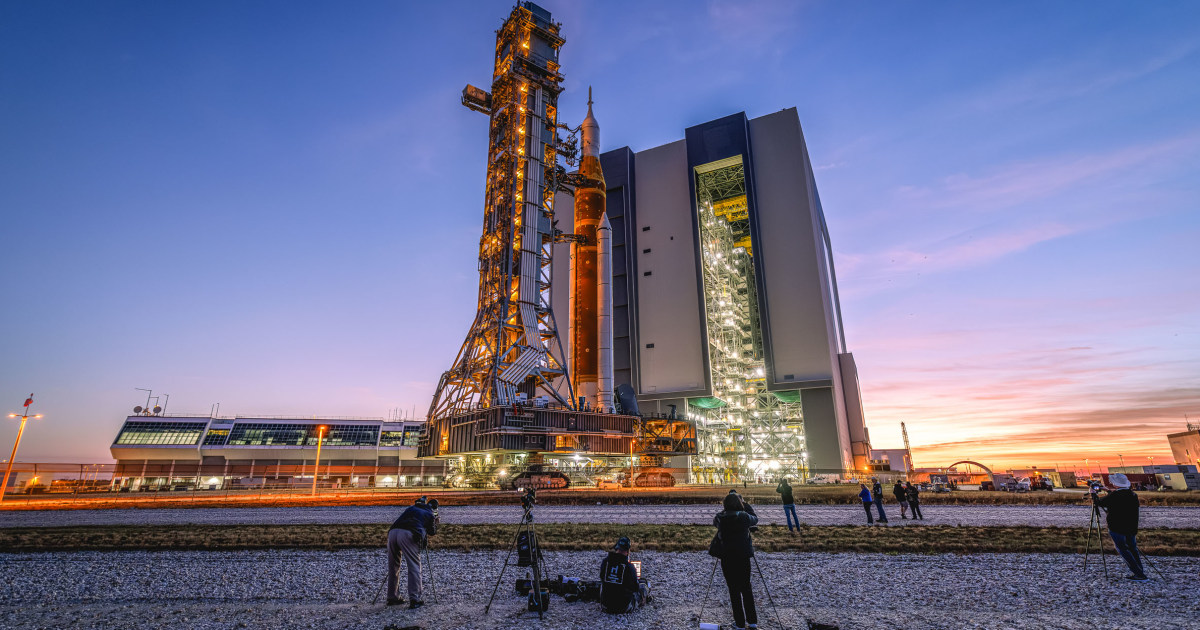
NASA plans to roll its big moon rocket again to the launchpad at Florida’s Kennedy House Middle on Thursday night, setting the stage for 4 astronauts’ much-anticipated journey across the moon.
The 322-foot-tall House Launch System rocket, topped with the Orion capsule, will launch the crew on a 10-day journey as early as April 1. However first, the rocket and spacecraft should make a painstakingly sluggish, 4-mile trek from the hangar to the launchpad.
The journey is about to start at 8 p.m. ET and can seemingly wrap up round 12 hours later.
It’s the second rollout course of for the 11-million-pound rocket. It was first rolled to the launchpad in mid-January, however a number of weeks in the past, engineers discovered a blockage within the move of helium that required NASA to roll the rocket again to its Car Meeting Constructing for repairs.
The automobile’s return to the launchpad will contain a shifting platform generally known as a crawler-transporter, which is able to inch alongside at a tempo of round 1 mile per hour.
The mission, generally known as Artemis II, will mark the primary time that NASA’s House Launch System rocket and Orion spacecraft carry individuals. Will probably be the system’s second spaceflight, following an uncrewed mission across the moon, Artemis I, in 2022. When the crew members — NASA astronauts Reid Wiseman, Christina Koch and Victor Glover and Canadian astronaut Jeremy Hansen —swing across the moon, they might attain a distance farther from Earth than any people have gone earlier than.
NASA mentioned it was in a position to repair the helium move points whereas the rocket was within the hangar by changing a seal in a line that feeds helium from floor programs into the rocket. Engineers additionally changed batteries on the rocket and the Orion spacecraft and performed numerous exams.
The helium concern was uncovered after an hourslong fueling take a look at and launch-day walkthrough, generally known as a moist gown rehearsal. It was the rocket’s second such rehearsal, after the primary needed to cease early resulting from leaking hydrogen on the tail finish of the rocket.
Final week, NASA officers met for a two-day convention generally known as a flight readiness evaluate. Mission managers, the four-astronaut crew and different NASA representatives mentioned the upcoming flight, its dangers and the work forward. The company determined to press forward with a launch try in April, formally certifying the rocket and spacecraft for flight.