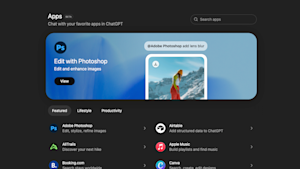
OpenAI has begun accepting submissions from third-party builders for his or her apps to be accessible immediately in ChatGPT, and has launched a brand new App Listing (don't name it a "retailer"!) that may be opened from the ChatGPT sidebar and on the URL chatgpt.com/apps.
This implies the 800 million+ customers of OpenAI's hit chatbot can seek for, uncover and start utilizing newly permitted third-party apps instantly. As soon as put in, apps could be triggered throughout conversations by mentioning them by identify (utilizing @) or choosing them from the instruments menu.
The third-party app submission course of formally went dwell final night time, December 17, as OpenAI introduced in a weblog put up and on its developer account on X, although the corporate notes it is going to be reviewing all new third-party app submissions earlier than approving them for itemizing within the App Listing, and making them accessible to ChatGPT customers, to make sure they adjust to the corporate's public pointers. Apps that move OpenAI’s assessment course of will start rolling out to customers beginning early 2026.
For these enterprises who wish to get in on the motion with their very own ChatGPT apps, OpenAI mentioned it should host a public webinar “Construct Hour” occasion for third-party builders on January 21, the place OpenAI engineers will stroll by how one can construct, submit, and design apps for ChatGPT, utilizing real-world examples and taking questions.
App Listing vs. GPT Retailer
This complete effort marks the beginning of a broader developer ecosystem past the small set of curated companions OpenAI launched its Apps commonplace growth package (SDK) earlier this fall, and appears to be fulfilling a few of the hype that ensued again when OpenAI debuted its "GPT Retailer" again in early 2024, almost two years in the past.
Nonetheless, regardless of the pledge of income sharing that OpenAI made again then, it hasn't since supplied many updates on the GPT Retailer, nor have we heard a lot from GPT builders about making substantive income from it.
However whereas these customized, user-generated GPTs had been restricted primarily to text-based experiences, the brand new ChatGPT App Listing and SDK options permit for a much more interactive expertise together with person accessible buttons, maps, multi-views, sliders, shaders, and different interplay modalities. The GPT Retailer additionally nonetheless stays accessible now.
Monetization, restrictions, and assessment course of
On this early part, ChatGPT apps could hyperlink out to exterior web sites to finish purchases for bodily items solely.
Promoting digital items, subscriptions, or in‑app companies isn't but allowed, although OpenAI says it’s exploring further monetization choices over time.
All apps should:
-
Adjust to OpenAI’s utilization insurance policies
-
Be appropriate for basic audiences, together with teenagers
-
Embrace a transparent privateness coverage and assist contact
-
Keep away from promoting, misleading habits, or prohibited commerce classes
Builders submit apps by the OpenAI Developer Platform, the place they’ll monitor assessment standing. Just one model of an app could be below assessment at a time.
What this implies for builders and customers
OpenAI first launched the Apps SDK at its DevDay convention in October, positioning it as a solution to construct “apps within ChatGPT.” CEO Sam Altman described the imaginative and prescient as enabling “a brand new technology of apps which are interactive, adaptive, and personalised.”
Constructed on the open Mannequin Context Protocol (MCP) developed by rival Anthropic, the Apps SDK lets builders join exterior companies, fetch real-time context, set off actions, and render UI immediately inside ChatGPT.
Till now, ChatGPT apps had been restricted to a listing of seven pilot companions together with:
-
Reserving.com
-
Canva
-
Coursera
-
Expedia
-
Figma
-
Spotify
-
Zillow
That record has since expanded to dozens of recent apps, together with fashionable software program like Adobe PhotoShop (and Acrobat and Specific), Github, Replit, Gmail and Google Drive, Microsoft Groups, Mailchimp, Stripe, and lots of extra.
And with basic submissions now open, any verified developer—from solo builders to massive enterprises—can construct and submit apps for ChatGPT, supplied they meet OpenAI’s high quality, security, and privateness requirements.
For customers, the change means ChatGPT can now act as a hub for specialised instruments and workflows. Apps can lengthen conversations by pulling in dwell knowledge, rendering interactive interfaces, or taking actions on a person’s behalf—like designing a presentation, trying to find housing, or interacting with an exterior service—with out leaving the chat.
Apps can seem in a number of codecs, together with:
-
Inline playing cards or carousels contained in the dialog
-
Fullscreen views for immersive duties like maps or slide decks
-
Image‑in‑image modes for video, tutorials, or dwell classes
The purpose, OpenAI says, is to maintain every part feeling conversational whereas including actual utility.
How ChatGPT is dealing with Apps knowledge
One of many largest open questions round ChatGPT apps is how person knowledge is dealt with when third‑social gathering apps are concerned. Based mostly on OpenAI’s documentation and pointers, right here’s what is evident—and what stays unanswered.
What OpenAI has acknowledged clearly:
-
When a person connects to an app, ChatGPT discloses what sorts of knowledge could also be shared with the third social gathering and surfaces the app’s privateness coverage earlier than connection.
-
Third‑social gathering builders are accountable for how their apps deal with knowledge as soon as obtained.
-
Apps should reduce knowledge assortment, requesting solely what is important to carry out a particular process.
-
Apps are prohibited from requesting full chat transcripts, broad contextual knowledge “simply in case,” or delicate private knowledge.
-
Any motion that sends knowledge outdoors ChatGPT or modifies exterior methods should be clearly labeled and require person affirmation.
-
Apps should not reconstruct or infer a person’s full chat historical past and should keep away from undisclosed monitoring or profiling.
What OpenAI has not clarified publicly:
-
Whether or not OpenAI itself retains or logs the info handed between ChatGPT and third‑social gathering apps.
-
Whether or not knowledge exchanged with apps can be utilized for mannequin coaching or inside analytics.
-
How lengthy, if in any respect, OpenAI shops metadata or interplay traces associated to app utilization.
In consequence, whereas OpenAI emphasizes robust guardrails for builders and transparency for customers, it has not explicitly detailed OpenAI’s personal position as a knowledge processor in app interactions. That ambiguity has already drawn scrutiny and stays an open challenge because the app ecosystem expands.
The larger image
With app submissions now open and an App Listing dwell, ChatGPT is now not only a conversational AI—it’s turning into a distribution platform for AI‑native software program.
Builders get entry to an enormous constructed‑in viewers, whereas customers achieve instruments that may be found and used in the intervening time they’re wanted, immediately inside a dialog.
OpenAI describes this as “only the start.” However with the infrastructure now in place, the shift from chatbot to app ecosystem is formally underway.