[ad_1]

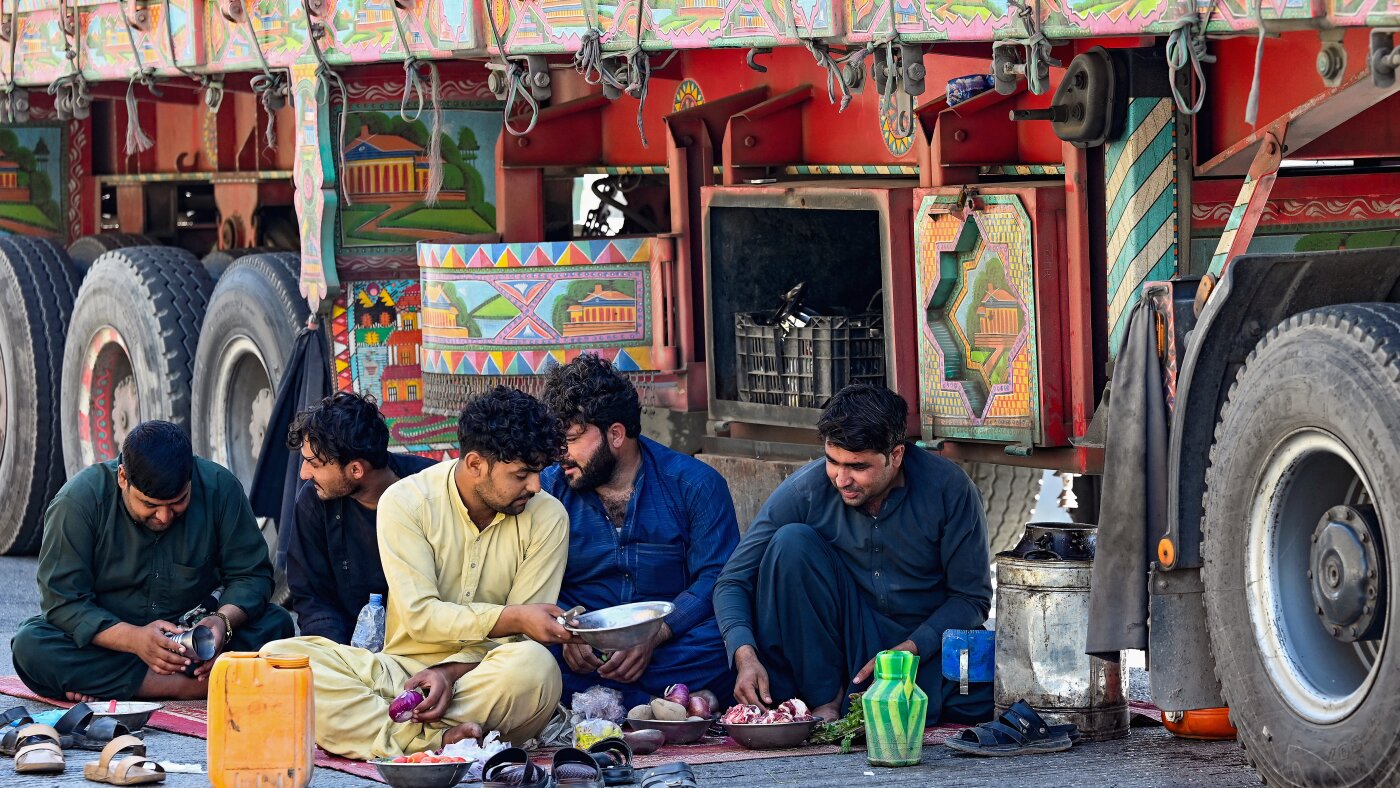
Truck drivers eat on the bottom by their stalled autos close to Torkham, Pakistan, on Oct. 13, 2025. Greater than three months later, the Torkham border stays closed without end.
ABDUL MAJEED/AFP through Getty Pictures
disguise caption
toggle caption
ABDUL MAJEED/AFP through Getty Pictures
PESHAWAR, Pakistan — For greater than three months, Afghan truck driver Anwar Zadran has been parked in Pakistan with a truck stuffed with cement he was supposed to move from a manufacturing facility in Nowshera district to Afghanistan’s capital, Kabul. The duty grew to become unattainable beginning in mid-October, when Pakistan and Afghanistan shut their borders in response to combating between the 2 nations, stranding Zadran mid-route close to the Torkham border crossing.
He now spends his sunlight hours huddled at roadside tea stalls with different stranded drivers, ready for an indication that restrictions at Torkham will loosen. On daily basis, Zadran places on the identical skinny garments he arrived in months in the past, when the climate was heat — retreating to his truck to sleep within the evenings when the air turns icy chilly. “The persons are destroyed and the products are broken as nicely,” he says. “I want the border would open quickly in order that we are able to get some reduction.”
Zadran, who’s from Afghanistan’s Nangahar province, and his fellow drivers are used to intermittent closures alongside this border, which snakes greater than 1,600 miles by means of the rugged mountains and deserts that separate Pakistan and Afghanistan. Usually a whole bunch of vans cross by means of each day. Prior to now, border disruptions often had been resolved inside days or perhaps weeks, however this one has stretched past 100 days — the longest closure in latest a long time, with no clear finish in sight. It has introduced commerce between Pakistan and Afghanistan to a halt and paralyzed a key transit route that extends throughout Central Asia.
The closure of 5 energetic commerce borders is an element of a bigger dispute between Afghanistan and Pakistan over tips on how to deal with a lethal surge in militancy, principally alongside the border belt, but in addition together with a suicide assault final week claimed by ISIS at a mosque in Islamabad that killed dozens. Pakistan has repeatedly accused Afghanistan of harboring militant teams that perform assaults on Pakistani soil, a cost Afghanistan’s Taliban authorities denies. Among the many teams is the Tehreek-e-Taliban Pakistan, referred to as the Pakistan Taliban or TTP, which goals to convey down Pakistan’s authorities and has develop into extra energetic in Pakistan for the reason that Taliban took over Afghanistan in 2021.
The tipping level got here when Afghan and Pakistani forces fired at one another throughout the border in October. The nations agreed to a ceasefire and took half in a number of rounds of peace talks in Istanbul, Doha and Riyadh. All didn’t convey a couple of decision. After the ceasefire, the Taliban authorities accused Islamabad of finishing up airstrikes inside Afghan territory that killed civilians, together with 9 youngsters. Pakistan denied attacking civilians.
Pakistan’s Prime Minister Shehbaz Sharif mentioned late final month that Pakistan had no selection however to shut its border as a result of the Taliban could not decide to stopping militant teams that function from Afghanistan. “We did not need to, however they compelled us,” he mentioned. The Taliban authorities accused Pakistan of shutting its borders as a strategy to assert financial and political strain, and desires Pakistan to present ensures that it will not.
On the lookout for workarounds
In Peshawar, round 40 miles from the Torkham border, enterprise leaders have been compelled to search for doable workarounds. On a whiteboard in his workplace, dealer Shahid Hussain has mapped out alternate routes for his exports by means of China. His shipments of meals merchandise to Uzbekistan and Kyrgyzstan usually cross by means of Afghanistan. However not anymore.
The China route is believable, Hussain says, however insurance policies for Pakistan to make use of China for transit commerce are unclear. An alternative choice is thru Iran. The nation is beneath worldwide sanctions, although, and banking channels with Pakistan are restricted. Political instability there additionally makes this path unsure.
Hussain, who usually additionally exports cement to Afghanistan, estimates losses of round $400,000 simply from broken and expired shares for the reason that border closures began. He stopped paying salaries for his staff beginning this month and compares his enterprise of greater than 20 years to a tree disadvantaged of water. “There is not any work,” he says. “And what different exercise ought to we do?”
In January, enterprise leaders from each nations fashioned a joint committee to evaluate the state of affairs. The group has thus far held two conferences on-line and hopes to satisfy within the coming months on the Torkham border if they will get authorities approval. Either side agree that the state of affairs is dire and are attempting to persuade their respective nations’ leaders of the identical.
However the enterprise group has been left with out a lot leverage, says Jawad Hussain Kazmi, president of the Khyber Chamber of Commerce and Trade, a regional commerce physique. He heads the joint committee fashioned final month for the Pakistan aspect. “Our authorities has a one-point agenda,” he says, “and that is that safety issues ought to be resolved.”
Naqibullah Safi, secretary basic of the Pakistan-Afghanistan Joint Chamber of Commerce and Trade in Kabul, says the border closures even have halted the entry of products certain for Afghanistan from different Asian nations, together with China, Malaysia and Vietnam. This contains transport containers stuffed with meals, fabric and medical provides, a few of which stay caught on the port in Karachi.
“That is the worst state of affairs for the non-public sector,” he says.
Safi says there have been minor worth will increase in Afghanistan for items together with rice, drugs and cooking oil.
Losses within the a whole bunch of tens of millions
Abdul Salam Jawad, the spokesperson for Afghanistan’s commerce ministry, instructed NPR in a press release despatched through WhatsApp that his nation’s exports to Pakistan (together with fruits, greens and coal) had been round $300 million much less final 12 months — when border closures started — than within the earlier 12 months. Pakistan’s commerce ministry didn’t reply to a request for commerce figures. Final month, Pakistan mentioned it might enable for caught items certain for Afghanistan to be re-exported to their nations of origin.
Because the extended border closures drag on, Afghanistan has sought to diversify its commerce with different nations within the area, together with India and Iran. As a part of this effort, the Taliban authorities has requested India to assist facilitate the motion of Afghan items by means of a port by which India has been concerned within the Iranian metropolis of Chabahar.
The Taliban individually ordered a whole ban on Pakistani prescribed drugs beginning this month, citing high quality considerations — a blockade that would proceed even when borders reopen.
On account of restricted manufacturing in Afghanistan, the nation depends on Pakistan for greater than 60% of its drugs, and Pakistan’s yearly pharmaceutical exports to Afghanistan are value round $200 million, in keeping with Tauqeer Ul Haq, former chairperson of the Pakistan Pharmaceutical Producers Affiliation. He says shares meant for Afghanistan cannot simply be redirected, particularly temperature-controlled drugs that obtained caught in transit. “We worry that it will likely be wasted,” he says. “It won’t be usable.”
At a marketplace for Pakistani drugs in Peshawar, store house owners are already combating the lack of enterprise from Afghanistan, which makes up a good portion of their gross sales. Along with wholesale patrons from Afghanistan, this market serves Afghan sufferers who come throughout the border to purchase medicines in bulk which are exhausting to get of their nation.
Aslam Pervez, a store proprietor and basic secretary for Peshawar of the Pakistan Chemists’ and Druggists’ Affiliation, says he worries for sufferers who want lifesaving medicines resembling insulin.
“From each side, it is the people who find themselves going to be the losers,” Pervez says. “We will not change our neighbor.”
Wasim Sajjad contributed to this report from Peshawar and the Torkham border.
[ad_2]