Quebec Iranians Rally in Celebration After Khamenei’s Death in US-Israel Strikes
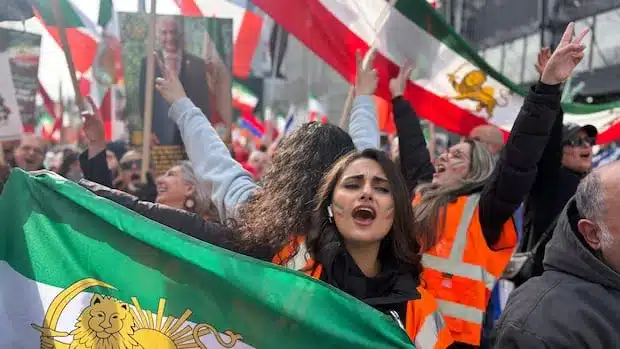
Iranian residents in Quebec filled the streets of Montreal and Quebec City on Saturday, waving pre-revolutionary Iranian flags and displaying photos of Reza Pahlavi, the exiled son of Iran’s last shah. Crowds reveled in music and cheers, expressing optimism for Iran’s future following a joint U.S.-Israeli military operation.
U.S. President Donald Trump characterized the overnight strikes as a massive effort to dismantle Iran’s military and topple its government. Israeli Prime Minister Benjamin Netanyahu described the action as targeting an existential threat. Later that afternoon, Trump announced that Iran’s Supreme Leader Ayatollah Ali Khamenei, 86, perished in a strike—a claim confirmed by Iranian state media. Khamenei had served as Iran’s supreme authority since 1989.
Support in Quebec City
In Quebec City, demonstrators assembled near Place George-V to back the U.S. and Israeli intervention. Many held signs thanking Trump and the United States. “For much of the Iranian community, this is what we’ve hoped for over months,” stated Foad Goodarzi, an Iranian-born activist and nurse in Quebec City. “It may seem hard to grasp that a community desires intervention in their homeland, but we have long been at war with the Islamic Republic.” Goodarzi anticipates the action will halt the regime’s killings of Iranian citizens.
“No victory against this regime is possible without outside help,” added Shima Hosseini. “Our families in Iran welcome this too—they prepared for it amid the government’s provocations.”
Joy and Hope in Montreal
Montreal attendees shared parallel sentiments. “I feel incredible,” said Khashayar Hoseinzad. “We’ve battled for years and needed this support for decades. It has finally arrived.” Hoseinzad viewed the day as a celebration, confident the strikes could spark regime change. He recently lost his 32-year-old cousin to brutal regime violence during an anti-government protest, where beatings left the victim unrecognizable even to his mother.
Nationwide Iranian protests erupted on December 28 over rising prices, evolving into broad opposition against the clerical rulers in power for nearly 50 years. A U.S.-based human rights group reports over 7,000 deaths in the ensuing crackdown, while Iranian state media acknowledged 3,117 fatalities on January 21.
Voices of Concern
Not all shared the jubilation. Atena Barforoushi, a Montreal-based Iranian chef and activist, skipped the rally, tormented by fears for relatives and civilians under bombardment. “Iran lacks shelters, warning sirens, or a government safeguarding the vulnerable,” she said. Barforoushi favors non-military pressures to oust the regime while prioritizing lives.
Nima Machouf of the Montreal Iranian Women’s Association echoed these worries. “This could end the regime, but civilians might perish,” she said. Machouf questioned U.S. intentions, citing interests in Iran’s nuclear program, geopolitics, and resources.
Global Reaction and Hopes for Change
UN Secretary-General António Guterres labeled the escalation a severe risk to world peace during a Saturday UN Security Council emergency session. He stressed peaceful dispute resolution and noted strikes hit about 20 Iranian cities, killing senior officials alongside substantial civilian losses, though he could not yet verify Khamenei’s death.
Many in Quebec’s Iranian diaspora envision Reza Pahlavi leading a transitional government to end theocratic rule. “He has a plan ready; Iranians have rallied to his name—now unity is key,” said Drew Michael, an Iranian in Montreal. Supporters hope for a liberated Iran free from oppression.