Families residing near the Lobstick Fire in Saskatchewan are on high alert, with some forced to make urgent preparations for potential evacuation. The rapidly expanding wildfire has prompted concern and uncertainty among residents, particularly those with livestock.
Growing Threat and Uncertain Communication
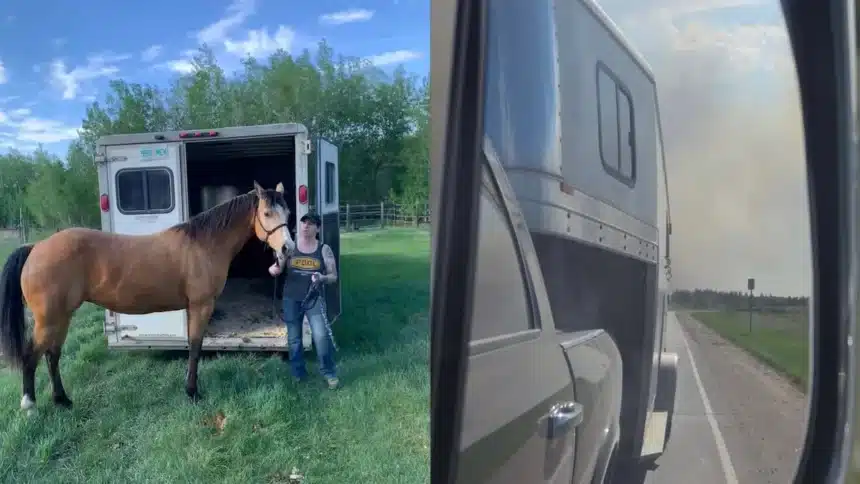
Becca Katz, a homeowner located approximately 20 kilometers west of Prince Albert, described the tense situation on her farm. “It’s definitely pretty scary. We have livestock, and the fire is kind of heading straight towards us, so it definitely puts you on edge,” Katz stated. She was observed loading horses into a trailer on Friday afternoon, preparing for a potential departure.
Katz expressed frustration with the communication regarding the escalating situation. “We’ve just been flying by the seat of our pants, really,” she said, noting that a thick black cloud of smoke had been building and her horses were showing signs of distress. She indicated that official guidance on necessary actions was unclear.
The Lobstick Fire has grown significantly in less than a week, now covering 130 square kilometers and having crossed the North Saskatchewan River. Fire bans are currently in effect across numerous areas in central and southern Saskatchewan.
“The fire was reported on Monday and we didn’t get any notice until yesterday night,” Katz added. “That was very poor communication on their end.” She received an evacuation notice around 8:30 p.m. on Thursday, which was subsequently downgraded to an alert within 45 minutes.
Katz is responsible for 99 horses, in addition to chickens, two dogs, and two cats. On Friday, she was in the process of moving the horses in groups of three to a neighbor’s property, located 30 kilometers away. While the animals were not exhibiting panic, the shifting winds and thickening smoke prompted her to take precautionary measures. “My biggest concern would obviously be losing my home or my animals,” she shared.
She reported that the primary source of information she was receiving was not from provincial or rural municipal authorities, but rather from a community Facebook page.
Provincial Response and Fire Ban
According to the Saskatchewan Public Safety Agency, the Lobstick Fire was initially reported on Tuesday at 3:10 p.m. Community Safety Minister Michael Weger confirmed that crews were dispatched within 20 minutes of the report.
The fire is currently burning within the Nisbet Forest, a provincially managed area that traverses the rural municipality of Duck Lake. Duck Lake Reeve Remi Martin had implemented a fire ban on Tuesday, coinciding with the fire’s start. Martin noted that he lacked the authority to extend this ban into the Nisbet Forest and was awaiting provincial action.
“Within seven days we went from an inch and a half of snow and rain on the May long weekend to wildfires. The government has to adapt a little quicker. Sometimes you’ve just got to grab the bull by the horns,” Martin commented. He described the severity of the situation as “bad, but not critical” based on his inquiries.
Minister Weger announced a provincial fire ban on Friday during a news conference in La Ronge. This ban encompasses all Crown land south of Highway 55, affecting areas across central and southern Saskatchewan. It prohibits open fires, controlled burns, fireworks, and recreational ATV and UTV use in provincial forests. The ban does not automatically apply to rural municipalities or incorporated towns, which must enact their own bylaws.
“I’d say we’re being proactive today by putting in the fire ban,” Weger stated. “A fire ban wouldn’t necessarily have stopped this fire from happening. We are concerned — we’re in immediate threat of wildfire in this province,” he added. “If you’re unsure if you’re in a fire ban area, assume you’re in a fire ban area.”
Impact and Ongoing Efforts
The Lobstick Fire crossed the North Saskatchewan River on Friday morning, with hot spots now present on the north side. Aerial tankers and helicopters have been actively engaged in firefighting efforts for several days, according to Minister Weger. He reported some property damage, likely to outbuildings rather than homes, and noted that some farmers have experienced crop damage, while ranchers have relocated cattle to escape the smoke and the fire’s proximity.
The community of Lily Plain remains under an evacuation alert, advising residents to prepare for potential evacuation. Communities situated within 20 kilometers of the fire, including McDowell, Duck Lake, and Beardy’s and Okemasis First Nation, are considered to be under threat.