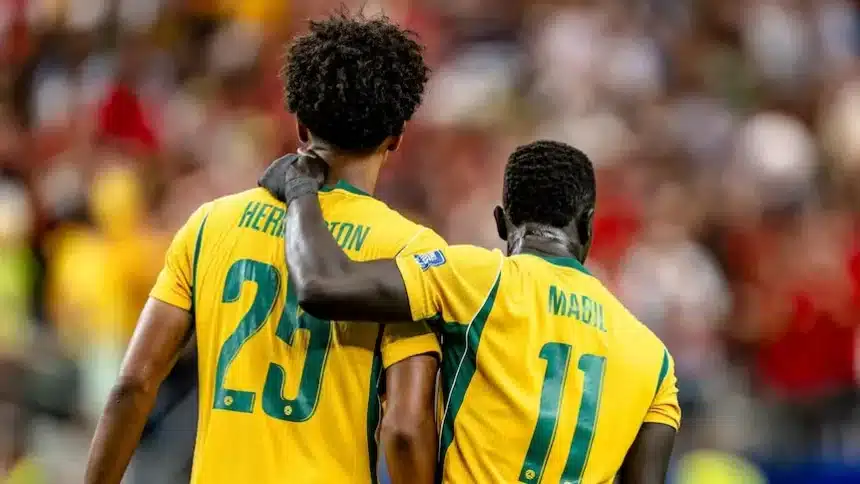
In the wake of a heartbreaking World Cup exit, the Australian national football team, the Socceroos, have rallied around young defender Lucas Herrington. The 18-year-old found himself in the spotlight during a tense penalty shootout against Egypt, a moment that ultimately sealed the team’s fate in the tournament. Despite the immense pressure, Herrington stepped forward to take Australia’s fourth penalty, but his effort struck the crossbar, paving the way for Egypt to secure their victory.
A Moment of Support from Teammates
As Herrington returned to the centre circle, visibly affected by the outcome, veteran player Awer Mabil immediately offered comfort. Mabil broke away from the group to embrace the young defender, offering words of encouragement. “Keep your head up, it’s a tough moment,” Herrington recounted Mabil telling him. He expressed deep respect for Mabil’s leadership, stating, “He’s a top, top leader in the group, and I look up to him a lot. It was a really nice moment from him to come and support me during a tough time. I respect him so much for that.”
Praise for Herrington’s Courage
The outpouring of support extended beyond Mabil, with several teammates commending Herrington for his bravery in taking the crucial penalty. Ajdin Hrustic, a key player for the Socceroos, highlighted the immense pressure on an 18-year-old in such a high-stakes situation. “I’m proud of Lucas, especially an 18-year-old kid, to step up. It’s not easy, he’s done it,” Hrustic commented. He shared a conversation with Herrington, offering perspective on the nature of a professional football career: “Your career is long, you’re going to have ups and downs. He’s been having a lot of ups and this is a down moment, but I’m sure he’s going to recover well and he’ll come out even stronger.” Herrington was making only his sixth appearance for the national team, underscoring the significance of his role in the penalty shootout.
Reflections on the Penalty Shootout
The penalty shootout was a dramatic conclusion to a closely contested match. While Herrington’s miss was a pivotal moment, the team’s collective sentiment focused on mutual support and understanding. The nature of penalty shootouts, often decided by fine margins, was a recurring theme in the players’ reflections. Hrustic also acknowledged the difficult experience of stand-in captain Harry Souttar, who missed Australia’s opening penalty after delivering a strong performance throughout the game. “I’m really proud of Harry because what he’s been through the last few years hasn’t been easy,” Hrustic said. “This stuff can happen, right? It can happen to anyone. You’ve got to feel what you’ve experienced now, good or bad.”
Looking Towards the Future
Winger Connor Metcalfe, who contributed one of Australia’s three goals during the tournament, echoed the sentiments of solidarity. He emphasized that such incidents are part of the sport and that the team stands by Herrington. “We just say it’s OK, we’re all human,” Metcalfe stated. “It’s not even a mistake. He’s gone for the top corner; fair play, he’s only 18.” Metcalfe expressed confidence in Herrington’s potential, adding, “He’s got a really bright future and I look forward to seeing him crack on.” The team’s response demonstrates a strong sense of camaraderie and a focus on the long-term development of its young talent, even in the face of immediate disappointment.
The Broader Context of the World Cup Campaign
The Socceroos’ journey in the World Cup was marked by resilience and determination. While the final match ended in a penalty shootout, the team had showcased significant progress and fighting spirit throughout the competition. The experience, though ending in defeat, provides valuable lessons for the squad, particularly for emerging players like Herrington. The collective maturity displayed by the senior players in supporting their younger teammate underscores the positive team culture being fostered within the Australian national setup. This supportive environment is crucial for nurturing talent and building a strong foundation for future international campaigns. The focus now shifts to the continued development of these players, with the expectation that they will learn from this experience and emerge stronger competitors on the global stage.
Understanding Penalty Shootouts in Football
Penalty shootouts are a common, albeit often dramatic, method of deciding knockout matches in football tournaments when scores remain level after extra time. They involve a series of penalty kicks taken alternately by players from each team. Typically, five kicks are taken by each side. If the scores are still level after five kicks, the shootout proceeds to sudden death, where a team scores and the other misses, the shootout ends. The psychological pressure on players taking penalties, especially in a World Cup context, is immense. Factors such as fatigue, the roar of the crowd, and the knowledge that a single miss can eliminate the team contribute to the difficulty. Players are often chosen based on their composure and penalty-taking ability, but even the most experienced can falter under such intense scrutiny. The outcome of a penalty shootout can sometimes feel arbitrary, highlighting the fine margins that often separate success from disappointment in elite competition. For young players like Lucas Herrington, experiencing such a high-pressure moment, regardless of the outcome, is a significant part of their development journey.
The Role of Leadership in Team Sports
The actions of players like Awer Mabil and Ajdin Hrustic in supporting Lucas Herrington exemplify the critical role of leadership within a sports team. Effective leaders not only perform on the field but also foster a positive and resilient team environment. Their willingness to offer comfort and perspective to a teammate facing adversity is vital for team cohesion and morale. This kind of support can significantly impact a young player’s confidence and future performance. It reinforces the idea that a team is more than just the sum of its individual parts; it is a collective unit that navigates both triumphs and setbacks together. The Socceroos’ response to Herrington’s situation demonstrates a mature understanding of sportsmanship and the importance of looking after one another, especially during challenging times. This leadership quality is often a key differentiator for successful teams, enabling them to overcome adversity and build lasting success.
Conclusion: Resilience and Future Prospects
While the World Cup exit was a bitter pill to swallow for the Socceroos and their supporters, the team’s reaction to Lucas Herrington’s penalty miss speaks volumes about their character and unity. The overwhelming support from his teammates underscores a strong team culture built on mutual respect and encouragement. Herrington, despite the difficult circumstances, has the backing of his senior colleagues, who recognize his potential and resilience. The experience, though painful, is likely to serve as a valuable learning opportunity for the young defender and the entire squad. With a focus on development and a supportive environment, the Socceroos are poised to build on their campaign and look towards future successes, with Lucas Herrington expected to play a significant role in the years to come.