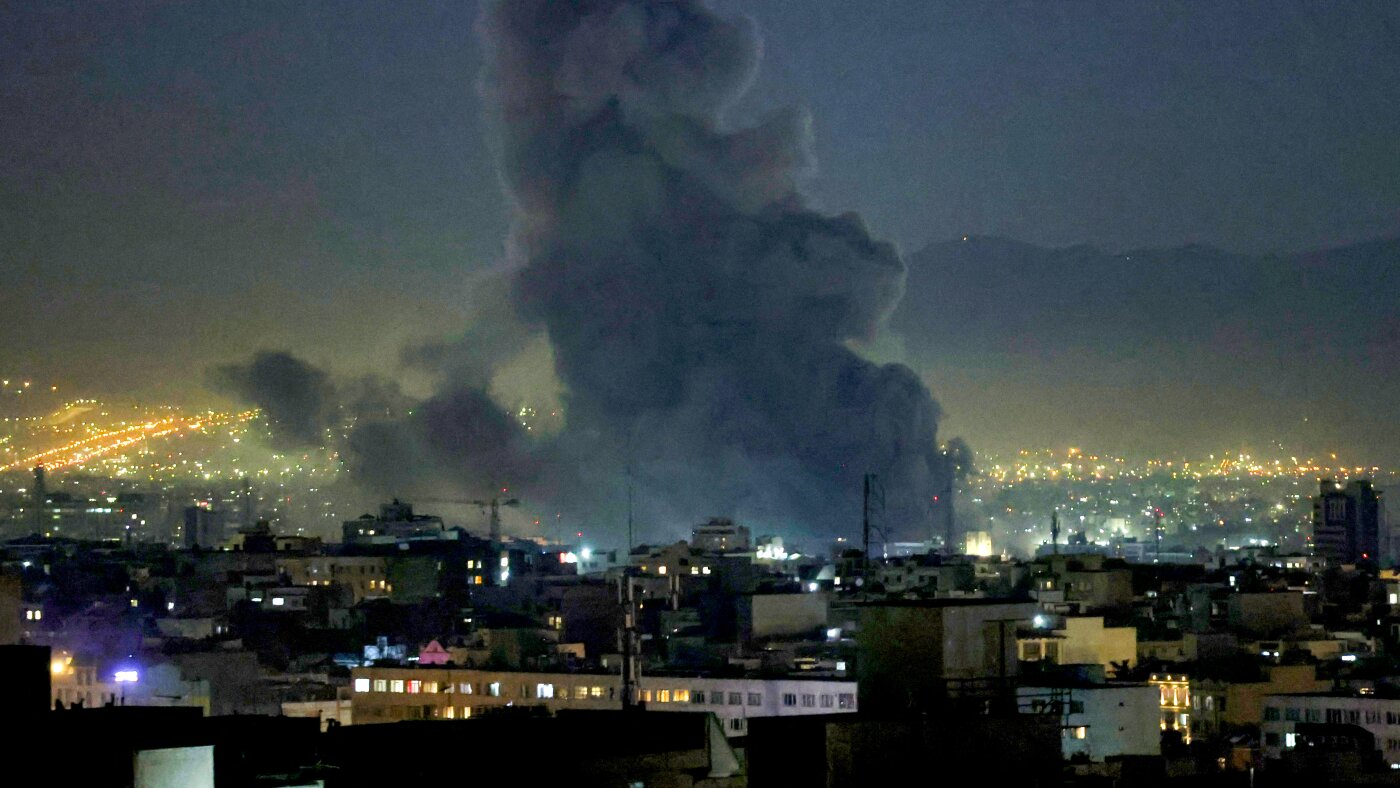
Smoke plumes rise following missile strikes in Tehran on March 1, 2026. America and Israel launched strikes in opposition to Iran on February 28, killing Iran’s supreme chief and prime army leaders, prompting authorities to retaliate with strikes on Israel and US bases throughout the Gulf.
Atta Kenare/AFP by way of Getty Pictures
disguise caption
toggle caption
Atta Kenare/AFP by way of Getty Pictures
An account buying and selling beneath the username “Magamyman” made greater than $553,000 putting bets on the prediction market Polymarket that Iran’s Supreme Chief, Ayatollah Ali Khamenei, can be out of energy simply earlier than an Israeli strike killed him on Saturday.

The trades drew scrutiny from members of Congress and critics of prediction markets, who say the platforms invite individuals with entry to labeled data to revenue on deadly army operations. On Polymarket alone, half-a-billion {dollars} was traded over when precisely U.S. forces would drop bombs on Iran.
“It is insane that is authorized,” Sen. Chris Murphy (D-Conn.) wrote on X. “Folks round Trump are profiting off battle and demise,” he mentioned, including he plans to introduce laws “asap” to outlaw this sort of exercise.

The White Home denied anybody in Trump’s orbit was behind the profitable trades.
The Trump household, nevertheless, does have ties to Polymarket. Donald Trump Jr., the president’s son, is an adviser to Polymarket and his enterprise capital agency 1789 Capital has invested tens of millions into the controversial enterprise. The Trump administration has dropped two federal investigations into Polymarket that had been opened by President Joe Biden’s officers.

A screenshot of a Polymarket dealer’s profile web page, exhibiting profitable bets on the timing of a U.S. strike on Iran.
NPR
disguise caption
toggle caption
NPR
It is the newest episode igniting debate about how authorities and army insiders can monetize state secrets and techniques.

In January, an nameless dealer made a whole lot of 1000’s of {dollars} for putting suspiciously well-timed bets forward of the arrest of Venezuelan chief Nicolás Maduro. A month later, authorities in Israel charged two individuals for utilizing labeled data to position bets on Polymarket about upcoming assaults on Iran when the nations fought a 12-day battle final June.
The tens of millions flowing into the market associated to the toppling of Iran’s supreme chief had been made on an abroad trade operated by Polymarket, which means it’s outdoors the attain of regulators in Washington.
The Trump administration has granted approval for Polymarket to open a U.S.-based platform, however it has but to totally publicly launch. Most American merchants who use Polymarket entry the positioning by a digital personal community that shields a consumer’s id and placement.
Most prediction markets, which have surged in reputation in current months, are federally regulated by the Commodity Futures Buying and selling Fee. The company views this new-fangled type of betting a “futures contract,” not a kind of playing.

Beneath U.S. commodity buying and selling legal guidelines, making trades primarily based on demise and battle are unlawful, since these sorts of bets create a monetary reward for violence, human struggling and geopolitical instability.
This constraint was on show over the weekend in the best way one other main prediction market, Kalshi, responded to a market tied to when Khamenei can be out, a prospect that attracted greater than $54 million in trades.

When Khamenei’s demise was confirmed, those that positioned bets on Kalshi on the chief’s ouster anticipated a payout, however it by no means occurred. As an alternative, buying and selling in the marketplace was paused whereas the corporate performed a “additional evaluate of the state of affairs.”
Later, Kalshi CEO Tarek Mansour wrote on X that the corporate can be refunding charges collected on the Khamenei market.
“We do not record markets straight tied to demise,” Mansour wrote. “When there are markets the place potential outcomes contain demise, we design the principles to forestall individuals from taking advantage of demise. That’s what we did right here.”
In messages despatched out to customers who positioned bets earlier than and after the Iranian chief’s demise, Kalshi mentioned it’ll challenge partial refunds amounting to the final traded value earlier than his demise was confirmed, so it didn’t run afoul of U.S. legal guidelines prohibiting markets the place individuals can revenue from demise and assassinations.
Kalshi’s choice created an uproar amongst merchants, who felt like they’d been duped.
They had been all of the extra infuriated having watched the corporate closely promote the Khamenei marketplace for days on social media.
“Getting rugged on a 100% appropriate prediction due to a fine-print ‘demise carveout’ is wild,” mentioned a consumer who goes by “pepe” on the web discussion board Discord for Kalshi merchants. “Centralized oracles will at all times bend to compliance over actuality.”
Others had been much less beneficiant, deriding Kalshi’s actions within the Khamenei market as proof that the platform is “a rip-off.”
Amanda Fischer, a former official on the Securities and Change Fee who now works on the monetary reform group Higher Markets, informed NPR that Congress must act to cease “perverse incentives and chaos brought on by betting on demise and destruction.”
She added: “Prediction markets are selling alternatives to wager on occasions that may solely be seen as a proxy for battle or assassination. The confusion and outcry over how the Khamenei-related wagers would resolve underscores that this betting market should not exist within the first place.”
.jpg "Tin Can Is a Dumb Cellphone for Children. Can Somebody Train Them The right way to Use It?")