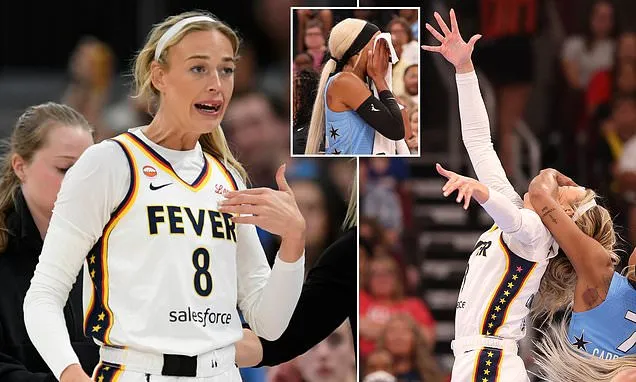
Indiana Fever player Sophie Cunningham has publicly addressed comments made by Chicago Sky opponent DiJonai Carrington, who invoked the concept of ‘white privilege’ following a contentious on-court incident. The exchange occurred during a recent WNBA game where Carrington was ejected for a flagrant foul that left Cunningham bloodied.
Incident Details and Ejection
The confrontation unfolded in the first quarter of the game between the Chicago Sky and the Indiana Fever. As Cunningham drove toward the basket, Carrington struck her in the face with her arm. Officials assessed Carrington with a Flagrant 2 foul, resulting in her immediate ejection from the game. Both Cunningham and her teammate Caitlin Clark were observed waving as Carrington departed the court for the locker room.
Shortly after the incident and her ejection, Carrington posted a message on social media platform X (formerly Twitter), stating: ‘WHITE PRIVILEGE @indianafever.’ This remark suggested a belief that racial bias played a role in the game’s dynamics or officiating.
Cunningham’s Reaction to the ‘White Privilege’ Claim
Following the Fever’s 90-86 victory, Cunningham downplayed Carrington’s accusation, asserting that the situation had no racial basis. “I think the league is taking care of that. This has nothing to do with race,” Cunningham told ESPN. She drew a parallel to a similar incident from the previous year, where she herself was ejected for a comparable foul, stating, “Last year, I did the same thing and I got kicked out. And I deserved to be kicked out. There’s no reason even to play that card.”
Cunningham suggested that Carrington’s comment was an attempt to gain attention, particularly given the increased viewership on nationally televised games featuring the Fever. “I do think when people play the Fever, we’re nationally televised, there’s a lot of eyes on us and people just want attention. And that’s her just trying to get attention,” Cunningham explained. She further noted that Carrington was not with the team during the previous season’s comparable incident, implying a lack of direct experience or understanding of the situation.
Cunningham described the foul as unnecessary and expressed surprise at Carrington’s actions, given their apparent lack of prior personal conflict. “I’ve never really spoken to her and have no beef with her, but I guess she has some pent up stuff. So get your s*** off. That’s fine. I can take it,” she commented. Cunningham implied that Carrington might have been seeking a reaction, stating, “I think everyone knows that. I think that’s why she did it because she wants attention.”
Player Conduct and Past Incidents
Video footage from courtside appeared to capture Cunningham reacting angrily immediately after the foul, shouting at Carrington and being restrained by teammates and staff. However, Cunningham maintained after the game that she was not overly upset, emphasizing her quick recovery and determination not to be intimidated. “I popped up. I’m not going to let anyone just do that to me,” she stated.
This incident occurs amidst a period of heightened attention on Cunningham, who recently faced scrutiny for comments regarding transgender athletes. Her remarks about protecting young girls from ‘biological men’ drew significant reactions within the WNBA community.
The WNBA has seen other notable player interactions. In 2024, Carrington was involved in an incident with Caitlin Clark while playing for the Connecticut Sun. Carrington poked Clark in the face, leaving her with a black eye. At the time, no foul was called, and Clark stated the poke was unintentional. Carrington later appeared to mock the incident in a social media stream.
League Context and Player Dynamics
The WNBA is experiencing a surge in popularity, with increased media coverage and fan engagement, particularly surrounding star players like Caitlin Clark. This heightened visibility often brings greater scrutiny to on-court actions and player interactions. The league’s officiating and disciplinary actions are frequently discussed, especially concerning flagrant fouls and player conduct.
Cunningham’s response highlights a common dynamic in professional sports where intense competition can lead to heated moments. Her emphasis on the physicality of the game and her belief that Carrington’s comment was a distraction rather than a reflection of systemic issues underscores the differing perspectives players may hold. The league’s handling of such incidents, including flagrant fouls and social media conduct, remains a key aspect of maintaining sportsmanship and player safety.
Conclusion
The interaction between Sophie Cunningham and DiJonai Carrington, culminating in Carrington’s ejection and subsequent ‘white privilege’ remark, has brought player dynamics and social commentary to the forefront of WNBA discussions. Cunningham’s dismissal of the racial claim, framing it as an attention-seeking tactic, contrasts with Carrington’s implied accusation. As the WNBA continues to grow in prominence, such incidents serve as reminders of the intense rivalries and the broader social conversations that intersect with professional sports.