[ad_1]
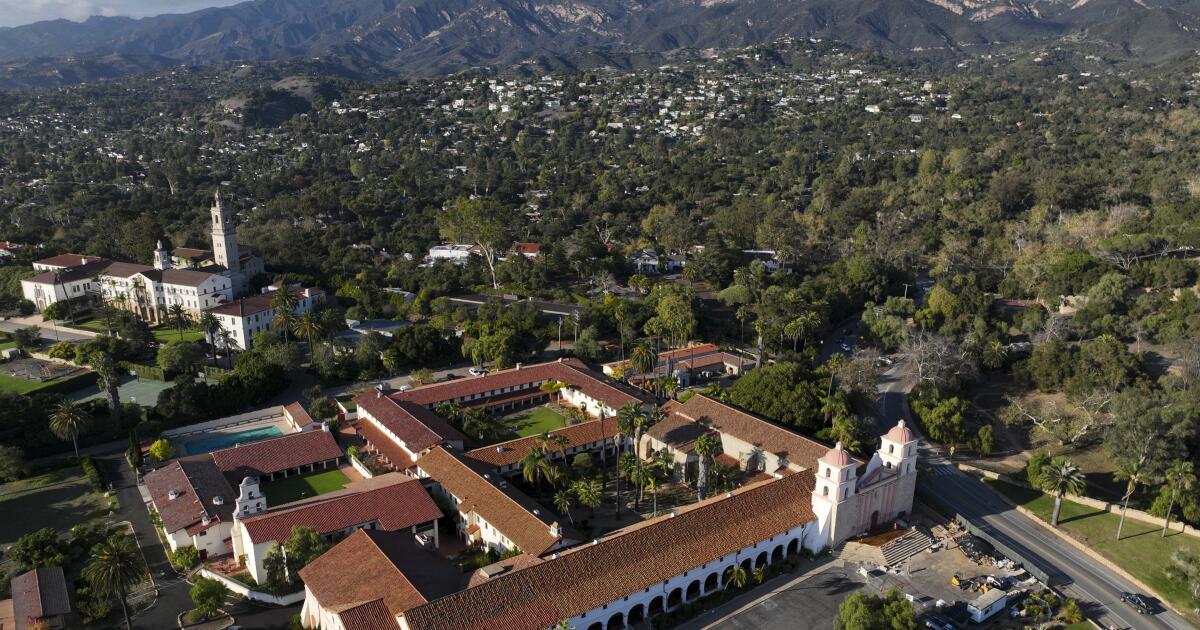
Outraged Santa Barbara residents jumped into motion when a developer unveiled plans final 12 months for a towering condo advanced nearby of the historic Outdated Mission.
They complained to metropolis officers, wrote letters and shaped a nonprofit to attempt to block the venture. Nonetheless, the developer’s plans went ahead.
Then one thing uncommon occurred.
4 hundred miles away in Sacramento, state lawmakers quietly tucked language into an obscure finances invoice requiring an environmental impression examine of the proposed improvement — which housing advocates allege was an try to dam the venture.
The laws, Senate Invoice 158, signed into legislation by Gov. Gavin Newsom, didn’t point out the Santa Barbara venture by title. However the provision was so detailed and particular it couldn’t apply to another improvement within the state.
The fallout was swift: The developer sued the state and a Santa Barbara lawmaker, the highly effective new president of the state Senate, is beneath scrutiny over her function within the invoice.

The present property situated on the proposed location for the eight-story condo tower.
(Kayla Bartkowski / Los Angeles Instances)
The saga highlights the governor’s and state Legislature’s rising affect in native housing choices, and the battle between cities and Sacramento to deal with California’s important housing scarcity.
Within the face of California’s excessive value of housing and lease, state leaders are more and more passing new housing mandates that require cities and counties to speed up the development of latest housing and ease the obstacles impeding builders.
On this case, the legislation focusing on the Santa Barbara improvement does the alternative by making it more durable to construct.
‘A horrendous nightmare’
The battle began final 12 months after builders Craig and Stephanie Smith laid out formidable plans for an eight-story housing venture with at the very least 250 flats at 505 East Los Olivos St.
The five-acre website is close to the Outdated Mission Santa Barbara, which pulls a whole bunch of 1000’s of vacationers every year.
In Santa Barbara, a slow-growth haven the place many condo buildings are two tales, the Los Olivos venture was perceived as a skyscraper. The mayor, Randy Rowse, known as the proposal “a horrendous nightmare,” in line with native media website Noozhawk.
However the developer had a bonus. California legislation requires cities and counties to develop plans for development each eight years to deal with California’s growing inhabitants. Jurisdictions are required to pinpoint areas the place housing or density could possibly be added.
If cities and counties fail to develop plans by every eight-year deadline, a provision kicks in known as “builder’s treatment.”
It permits builders to bypass native zoning restrictions and construct larger, denser tasks so long as low or moderate-income models are included.
Santa Barbara was nonetheless working with the state on its housing plan when the deadline handed in February 2023. The plan was full by December of that 12 months, however didn’t turn into official till the state licensed it in February 2024.

Opponents of the proposed Santa Barbara improvement, clockwise from backside left: Cheri Rae, Brian Miller, Evan Minogue, Tom Meaney, Fred Sweeney and Steve Forsell.
(Kayla Bartkowski / Los Angeles Instances)
A month prior, in January, the builders submitted their plans. And since they included 54 low-income models, town couldn’t outright deny the venture.
“The builders have been enjoying chess whereas town was enjoying checkers,” mentioned Evan Minogue, a Santa Barbara resident against the event.
He mentioned older generations in California resisted change, leaving the state to come back in with “heavy-handed, one-size-fits-all insurance policies to pressure cities to do one thing about housing.”
Santa Barbara, a rich metropolis that draws celebrities, bohemian artist-types and environmental activists, has an extended historical past of combating to maintain its small-town really feel.
In 1975, the Metropolis Council adopted a plan to restrict improvement, together with water consumption and site visitors, and maintain a cap on town’s inhabitants at 85,000. Within the late ‘90s, actor Michael Douglas — an alum of UC Santa Barbara — donated cash to protect town’s largest stretch of coastal land.
Hemmed in by the Santa Ynez Mountains, town is dominated by low-slung buildings and single-family houses. The median dwelling worth is $1.8 million, in line with Zillow. A metropolis report final 12 months detailed the necessity for 8,000 extra models, primarily for low-income households, over the approaching years.

Stephanie and Craig Smith, the builders of the venture at 505 East Los Olivos Road.
(Ashley Gutierrez)
Assemblymember Gregg Hart, whose district consists of Santa Barbara, helps the language within the finances invoice requiring the environmental evaluation. He doesn’t need to see the proposed improvement tower over the Outdated Mission and blames the builder’s treatment legislation for its introduction.
“It’s a superb illustration of how damaged the ‘builder’s treatment’ system is,” mentioned Hart. “Proposing tasks like this undermines assist for constructing density in Santa Barbara.”
Comparable pushback has been seen in Santa Monica, Huntington Seashore and different small cities as builders scramble to make use of the builder’s treatment legislation. A notable instance not too long ago performed out in La Cañada Flintridge, the place builders pushed via a mixed-use venture with 80 models on a 1.29-acre lot regardless of fierce opposition from town.
Nonetheless, the controversial legislation doesn’t exempt developments from evaluation beneath the California Environmental High quality Act, often known as CEQA, the state’s landmark coverage requiring a examine of the venture’s results on site visitors, air high quality and extra.
The builders behind the Los Olivos Road venture sought to keep away from the environmental evaluation, nevertheless, due to a brand new state legislation that permits many city infill tasks to keep away from such necessities. Meeting Invoice 130, primarily based on laws launched by Assemblymember Buffy Wicks (D-Oakland), was signed into legislation by Newsom in June.
When the Los Olivos builders requested metropolis officers about utilizing AB 130 for his or her venture, a Santa Barbara neighborhood developer director informed them in July 2025 that the CEQA evaluation was vital. AB 130 doesn’t apply if the venture is deliberate close to a creek and wetland habitat, or different environmentally delicate space, the director wrote.
Months later, the state Legislature handed its finances invoice requiring the evaluation.
Santa Barbara residents who oppose the venture mentioned they didn’t ask for the invoice.
But when the evaluation finds that site visitors from the event would overwhelm hearth evacuation routes, for example, they might have a better time combating the venture.
“We don’t need to come off as NIMBYs,” resident Fred Sweeney, who opposes the venture, mentioned, referring to the phrase “not in my yard.” Sweeney, an architect, and others began the nonprofit Good Motion for Progress and Fairness to spotlight the Los Olivos venture and a second one deliberate by the identical developer.
Standing close to the venture website on a latest day, Sweeney pointed as vehicles lined up alongside the primary highway. It wasn’t but rush hour, however site visitors was already constructing.
A ‘actually unusual’ invoice
Buried deep in Senate Invoice 158, the invoice handed by state lawmakers focusing on the Los Olivos venture, is a point out of the state legislation round infill city housing developments. Senate Invoice 158 clarified that sure developments shouldn’t be exempt from this legislation.
Developments in “a metropolis with greater than 85,000 however fewer than 95,000 folks, and inside a county of between 440,00 and 455,000 folks,” and that are additionally close to a historic landmark, regulatory floodway and watershed, will not be exempt, the invoice acknowledged.
In line with the 2020 census, Santa Barbara has a inhabitants of 88,768. Santa Barbara County has a inhabitants of 448,229. And the venture sits close to each a creek and the Santa Barbara Mission.
The controversial improvement match the invoice.

Monique Limón is president professional tem of the California state Senate.
(Myung J. Chun / Los Angeles Instances)
A consultant for Senate President Professional Tem Monique Limón informed CalMatters that the senator was concerned in crafting that exemption language.
Throughout a tour of an avocado farm in Ventura final month, Limón declined to touch upon her function. She cited the lawsuit and directed inquiries to Atty. Gen. Rob Bonta’s workplace.
Limón, who was born and raised in Santa Barbara, confirmed that she did speak to Sweeney — who began the nonprofit to battle the event — about opposition to the event.
The Los Olivos venture had “a number of neighborhood involvement and participation,” she mentioned. “By way of suggestions, what I perceive, studying the articles, there are over 400 folks that have weighed in on it … it’s a really public venture.”
Limón additionally defended her housing report.
“Each piece of laws I writer or evaluation, I accomplish that primarily based on the wants of our state but additionally with the lens of the neighborhood I symbolize — whether or not that’s housing, training, environmental protections or another points that come throughout my desk,” Limón mentioned.
The builders filed a lawsuit in opposition to town and state in October, claiming that SB 158 targets one particular venture: theirs. As such, it will be unlawful beneath federal legislation, which bans “particular laws” that targets a single individual or property.

The house at present situated on the proposed improvement website.
(Kayla Bartkowski / Los Angeles Instances)
The go well with claims that Limón promoted and ushered the invoice via the state Senate, argues that it must be overturned and questions the required environmental evaluation, which might probably add years to its timeline and thousands and thousands to its finances.
Stephanie Smith, one of many builders, informed The Instances that the invoice was born of the “protests of rich householders, lots of whom cosplay as housing advocates till the proposed housing is of their neighborhood.”
“As a former homeless pupil who labored full time and lived in my automobile, I do know what it means to battle to afford housing. Residing with out safety or dignity gave me a foundational perception that housing is a nonnegotiable primary human proper,” Smith mentioned.
Public coverage advocates and specialists expressed concern about state lawmakers utilizing their energy to meddle with native housing tasks, particularly when carving out exemptions from legal guidelines they’ve imposed on everybody else within the state.
“It’s exhausting to disregard when laws is drafted in a narrowly tailor-made means — particularly when such language seems late within the course of with little public enter,” mentioned Sean McMorris of fine authorities group California Widespread Trigger. “Payments developed on this method danger fostering public cynicism in regards to the legislative course of and the motivations behind narrowly centered policymaking.”
UC Davis Faculty of Legislation professor Chris Elmendorf, who makes a speciality of housing coverage, known as the invoice’s particular language “actually unusual” and questioned whether or not it will survive a authorized problem.
He expects to see extra pleadings for exemptions from state housing legal guidelines.
“Native teams that don’t need the venture are going to the legislature to get the aid that, in a earlier period, they’d have gotten from their metropolis council,” Elmendorf mentioned.
UC Santa Barbara pupil Enri Lala is the founder and president of a pupil housing group. He mentioned the invoice goes in opposition to a latest pro-housing motion within the space.
“It’s definitely out of the abnormal,” mentioned Lala. “This isn’t the sort of transfer that we need to see repeated sooner or later.”
[ad_2]