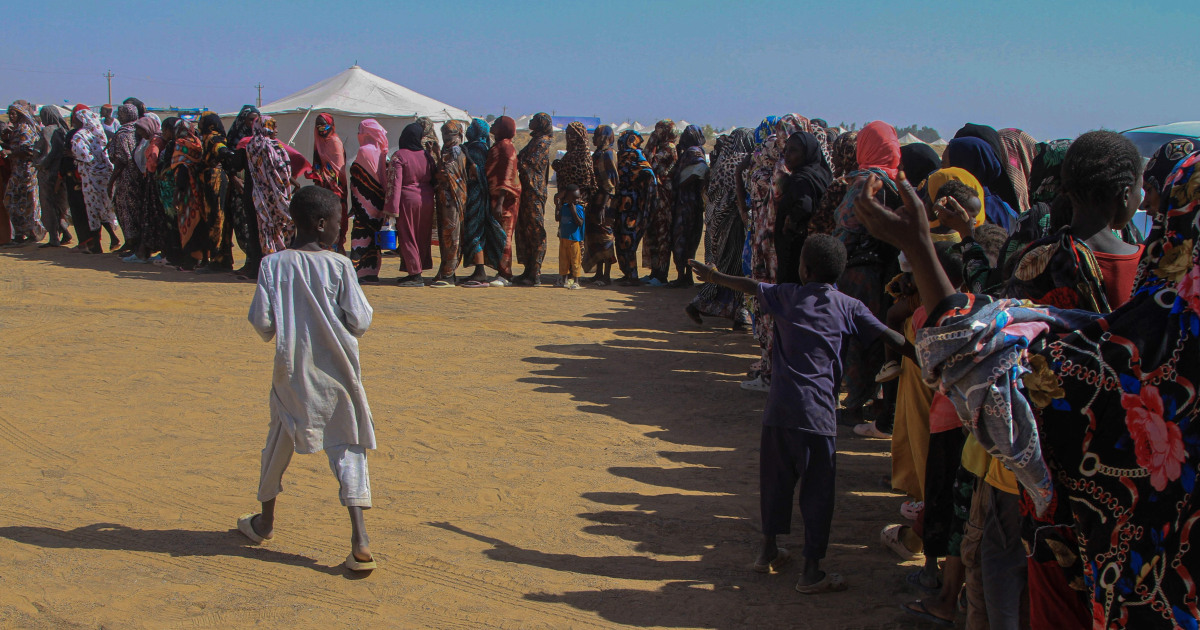
Sudan is dealing with what the World Meals Programme has known as “the humanitarian disaster of our time,” as tens of thousands and thousands battle by sieges, blockades and support shortages which have pushed total cities into famine.
What started as an influence battle between rival generals greater than two years in the past has since plunged Sudan right into a brutal civil struggle that has killed greater than 150,000 individuals and displaced thousands and thousands from their properties, with mass killings leaving bloody sand seen from area and ruined infrastructure.
Sudan “is the most important humanitarian disaster on the earth at present,” Leni Kinzli, the WFP’s Sudan communications officer, advised NBC Information on Sunday. “It will possibly now not be forgotten or ignored, just because the severity and the size is one which has actually not been seen at this degree.”
A minimum of 21.2 million individuals — roughly 45% of Sudan’s inhabitants — are actually dealing with excessive ranges of acute meals insecurity, based on the most recent Built-in Meals Safety Part Classification, the internationally acknowledged system for assessing famine and meals insecurity. Famine situations have been confirmed in Darfur’s el-Fasher and Kadugli, the place “individuals have endured months with out dependable entry to meals or medical care,” the U.N.’s Meals and Agriculture Group has stated.
Kinzli described a panorama the place even comparatively calm areas stay fragile, whereas different areas edge deeper into starvation. She stated WFP can attain 4 million to five million individuals with meals and vitamin help every month and has the capability to help 8 million, however “the sources we now have out there will not be retaining tempo with the necessity.”
Assist supply stays extraordinarily troublesome in violence-ridden areas, the place battle between the Sudanese military and the paramilitary Speedy Help Forces (RSF) continues to form the disaster.
That features el-Fasher, which was underneath siege by the RSF for greater than 18 months, throughout which era “completely no” support provides have been capable of get in, added Kinzli. The RSF finally overran the Sudanese military’s final main stronghold in Darfur in October.
In South Kordofan, a drone assault by Sudanese paramilitary forces hit a kindergarten on Thursday, killing 50 individuals, together with 33 kids, based on an area docs’ group.
United Nations support groups in Sudan issued a joint assertion on Thursday warning that the violence “is proscribing entry to meals, medication and important provides, and is limiting farmers’ entry to their fields and markets, heightening the danger of famine spreading throughout the Kordofan states.”
U.N. human rights chief Volker Türk warned: “We should not permit Kordofan to change into one other el-Fasher. It’s really stunning to see historical past repeating itself in Kordofan so quickly after the horrific occasions in el-Fasher.”
And on the bottom, situations are already bleak.
“We’re seeing just about the identical actual issues within the state of South Kordofan,” stated Dr. Mohamed Elsheikh, a spokesperson for Sudan Medical doctors Community. The RSF is “doing the identical siege, the identical blockade, they don’t seem to be permitting meals or medication to get into the cities,” he advised NBC Information, including that between Sept. 20 and Oct. 20 of this yr, 23 kids died from extreme malnutrition.
For the previous three months, Sudanese civilians have endured RSF assaults, Elsheikh stated, together with widespread atrocities and human rights violations, with civilians executed arbitrarily and key infrastructure — similar to hospitals, clinics, faculties and houses — intentionally focused by airstrikes.
The Sudan Medical doctors Community has documented 19 instances of rape dedicated by RSF forces towards girls who fled the preventing in el-Fasher and arrived on the al-Afad camp in al-Dabbah, stated Elsheikh.
Preventing in Sudan started in April 2023, when the Sudanese army, led by the nation’s prime commander and de facto ruler, Gen. Abdel-Fattah Burhan, clashed along with his former deputy, Gen. Mohammed Hamdan Dagalo — a former camel seller extensively referred to as Hemedti, who leads the RSF.

Each males had beforehand led counterinsurgency operations towards uprisings within the area, a battle that in 2005 contributed to Omar al-Bashir turning into the primary sitting head of state indicted by the Worldwide Felony Courtroom on suspicion of genocide.
Burhan and Dagalo have been a part of the army institution that ousted al-Bashir in 2019 after widespread fashionable unrest. Two years later, they agreed to share energy following a coup that introduced down the Western-backed authorities of Prime Minister Abdalla Hamdok.
Nevertheless, their alliance broke down spectacularly over methods to handle the transition to a civilian authorities. With neither keen to cede energy, full-scale preventing erupted, dragging Sudan deeper into battle and a humanitarian disaster.
With no decision in sight, the struggle is simply turning into extra entrenched and chaotic, Hager Ali, a analysis fellow on the German Institute for World and Space Research, advised NBC Information. What started as a two-sided battle has splintered right into a tangle of native battles, reopening previous regional grievances and eroding no matter central authority as soon as existed, she stated.
Each side have shifted “from making an attempt to win this struggle to making an attempt to not lose,” she added, noting that because the preventing regionalizes, it has produced “smaller fronts, smaller conflicts, which has difficult the chain of command,” making even a negotiated ceasefire practically unattainable to implement.

Practically 13 million individuals have been pressured to flee their properties in quest of security, based on the U.N. Human Rights Council, and have been displaced inside the nation or reside in neighboring international locations similar to Chad, South Sudan, Egypt and Ethiopia.
Funding for the regional response is lower than 10% of what’s wanted, it stated, making it unattainable to cowl fundamental wants.
However the place funding is obtainable, and the place preventing has abated, some areas have proven indicators of restoration.
Final yr, there have been 10 areas confirmed to be affected by famine, stated Kinzli, however “now there are solely two.” Round 3.4 million individuals who have been beforehand at “disaster” ranges are now not categorised as such, reflecting restricted stabilization in elements of Khartoum, Al Jazirah and Sennar, the place some households have begun to return.
Whereas these positive factors stay slender and uneven, and the scenario stays dire, “this reveals that when we now have entry and funding, we are able to reverse famine and enhance the scenario,” Kinzli added. “The humanitarian response can actually make a distinction if and after we are capable of ship.”