[ad_1]
Washington — President Trump’s efforts to reshape the chief department and flex his presidential energy are set to be examined on the Supreme Court docket on Monday, when the justices convene to hear a case that would result in the dismantling of protections meant to insulate impartial companies from political strain.
The case, often known as Trump v. Slaughter, arose from Mr. Trump’s transfer to fireplace Rebecca Kelly Slaughter from her submit on the Federal Commerce Fee with out trigger, regardless of a federal statute that limits a commissioner’s elimination to cases of inefficiency, neglect of obligation or malfeasance in workplace.
Now, the excessive courtroom is ready to determine whether or not these elimination protections for members of the FTC violate the separation of powers, and whether or not it ought to overturn a landmark 1935 resolution in a case known as Humphrey’s Executor v. United States.
The authorized battle is the end result of a yearslong weakening of Humphrey’s Executor by the courtroom’s conservative justices. In that 90-year-old ruling, which concerned President Franklin Roosevelt’s try to take away a member of the Federal Commerce Fee, the excessive courtroom allowed Congress to defend sure impartial company members from being eliminated by the president at will.
However in a number of latest choices, the conservative justices have chipped away on the precedent. Most lately, it ended elimination protections for officers on the Client Monetary Safety Bureau in 2020 and the Federal Housing Finance Company in 2021.
Since Mr. Trump returned to the White Home for a second time period, he has sought to broaden the bounds of presidential energy and moved to fireplace a swath of Democratic-appointed members of impartial boards and commissions.
Trump’s firing of Slaughter
Al Drago / Bloomberg through Getty Photos 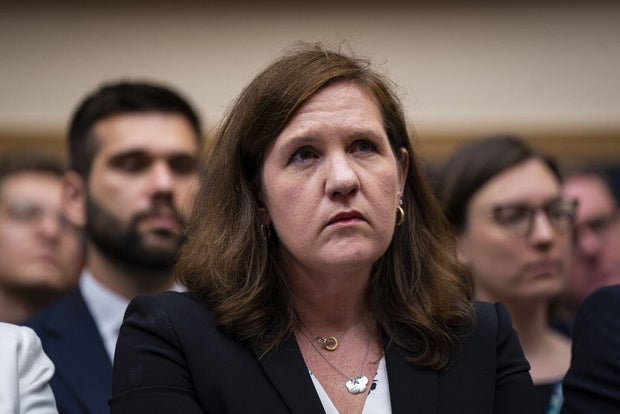
Slaughter was among the many victims of the president’s marketing campaign to “reclaim energy from this unaccountable forms.” Appointed to the FTC by Mr. Trump in his first time period and reappointed by Biden, she acquired an e mail in March with a message from the president informing her that her “continued service on the FTC is inconsistent with my Administration’s priorities.”
The president’s transfer to fireplace Slaughter and a fellow Democratic commissioner, Alvaro M. Bedoya, left the FTC with solely three commissioners, who had been all Republicans.
Slaughter, like many different impartial company leaders fired by Mr. Trump, sued to get her job again and argued that her elimination was unlawful. When Congress established the FTC in 1914, it mentioned commissioners may very well be eliminated by the president just for inefficiency, neglect of obligation or malfeasance in workplace. However Mr. Trump had not adopted the regulation, she argued.
A federal district courtroom dominated in her favor, discovering that Slaughter’s elimination was illegal. It ordered her to be reinstated to her job on the FTC. However that call was the primary in a collection of re-hirings and re-firings. Days after Slaughter prevailed earlier than the district courtroom, the U.S. appeals courtroom in Washington, D.C., issued a brief order permitting her elimination. Weeks after that, the appeals courtroom mentioned Slaughter needs to be reinstated as soon as once more.
Then, when the Trump administration sought emergency aid from the Supreme Court docket, Chief Justice John Roberts cleared the best way for her firing. The excessive courtroom agreed in late September to listen to the case and continued to maintain her out of her submit whereas it considers whether or not the elimination protections for members of the commerce fee violate the separation of powers.
What’s at stake
That situation, and the destiny of its 1935 precedent, can be earlier than the excessive courtroom Monday, when the justices convene for arguments.
“It’s extremely seemingly the Supreme Court docket goes to say that to ensure that the president to have the ability to do his job, to take care that the legal guidelines are faithfully executed, he has to have management of the folks serving to him execute these legal guidelines,” mentioned Brian Fitzpatrick, a professor at Vanderbilt College Legislation Faculty.
The Supreme Court docket’s resolution might have important ramifications for the construction of the federal authorities and curtail Congress’ energy to impose limits on the president’s elimination energy.
“The president is meant to have sure powers which can be separated from the legislative department, and if the legislative department goes in there and says we’ll intervene together with your powers by saying you are not allowed to take away these folks, that is a violation of the separation of powers,” Fitzpatrick mentioned.
The Trump administration argued that the Structure vests all government energy within the president and due to this fact grants him “illimitable” authority over officers who wield that energy on his behalf. In a submitting with the Supreme Court docket, Solicitor Basic D. John Sauer mentioned that elimination protections for members of impartial companies go away the president “saddled with subordinate officers” who forestall him from making certain that the legal guidelines are faithfully executed.
Whereas Congress’ energy to construction the chief department permits it to ascertain and set up departments below the president, it doesn’t permit lawmakers “to ascertain a Fourth Department that siphons government energy away from the chief government’s management,” Sauer wrote.
Congress has created greater than two dozen impartial companies that regulate many facets of American life, from nuclear waste to telemarketing to client merchandise, with elimination protections that search to defend their members from political strain.
In its 1935 resolution in Humphrey’s Executor, the Supreme Court docket acknowledged an exception to the president’s elimination energy for multi-member companies with quasi-legislative or quasi-judicial powers. The excessive courtroom discovered that the FTC match inside these parameters, and its commissioners might due to this fact solely be eliminated for trigger.
However the Trump administration argued that the commerce fee of immediately is completely different from the company of 90 years in the past as a result of it has amassed government powers. The trendy FTC executes greater than 80 federal legal guidelines and regulates a broad vary of issues, from meat merchandise to contact lenses to bank cards, Sauer wrote.
Moreover, the FTC can now file civil fits in search of financial penalties, make substantive guidelines, situation ultimate orders in company adjudications and examine potential violations, he mentioned.
“The notion that some companies that train government energy might be sequestered from presidential management severely offends the Structure’s construction and the liberties that the separation of powers protects,” Sauer wrote.
Impacts of the courtroom’s resolution
If the Supreme Court docket invalidates the elimination protections for FTC commissioners, such a choice is more likely to attain far past the fee.
As a result of many statutes limit a president to eradicating an official for inefficiency, neglect of obligation and malfeasance in workplace, Fitzpatrick predicted the excessive courtroom will “say these phrases are an unconstitutional restriction on the president so all the opposite companies with these phrases can be in the identical boat.”
Attorneys for Slaughter, in the meantime, warned of the broad impacts of a choice overturning the Supreme Court docket’s 1935 resolution, writing in a submitting that doing so would destabilize establishments which have been woven into the material of U.S. governance.
“Multimember impartial companies are deeply ingrained in our Nation’s historical past and custom, from the First Congress to the current day,” they mentioned. “That historical past confirms that they’re absolutely appropriate with our Structure’s textual content and construction.”
Slaughter’s authorized staff argued that the Trump administration is asking the Supreme Court docket to switch new powers to the president that Congress selected to not give him and desires courts to “jettison longstanding legal guidelines enacted by the folks’s elected representatives.”
Additionally they mentioned the present construction of multimember impartial companies — composed of members from each events who serve for staggered phrases and are insulated from political shifts — results in “extra modest actions” and due to this fact protects particular person liberty higher than an company helmed by a single particular person.
“What the statutory safety for a member’s tenure ensures is {that a} political minority, the minority celebration, will at all times be represented in deliberations, which is on the very least an vital watchdog perform,” mentioned Peter Shane, a authorized scholar at New York College Faculty of Legislation.
He continued: “However the different factor is it prevents presidents from sabotaging companies and sabotaging the congressional design, both by eliminating from the company members of the minority celebration, or sufficient members in order that an company lacks a quorum to perform in any respect.”
Mr. Trump has already tried to make his mark on the Advantage Programs Safety Board, which protects the rights of presidency employees. The president fired one among its members, Cathy Harris, in February, leaving the MSPB with no quorum between April and October.
“A president against the statutory mission of an company can completely kneecap it by depriving it of a quorum, and the president can actually deprive it of real bipartisanship by refusing to fill the seats that may belong to the minority celebration,” Shane mentioned. “The minority signaling perform is sort of vital and it has a number of audiences, together with the bulk on a selected fee. But it surely additionally contains journalists, most people and the courts.”
Slaughter’s legal professionals argued that even with protections in place for leaders of impartial companies, presidents can nonetheless exert affect over them via the candidates they nominate and the chair they choose, in addition to via recommending or vetoing spending payments that have an effect on company operations.
A key situation for the courtroom can be the way it characterizes the powers that an company wields. When the Supreme Court docket earlier this yr allowed Mr. Trump to fireplace members of the Nationwide Labor Relations Board and the MSPB, it recommended in an unsigned order that the companies “train appreciable government energy.” A divided panel of three judges on the U.S. Court docket of Appeals for the District of Columbia Circuit dominated Friday that elimination protections for the 2 labor boards are unconstitutional and mentioned Congress can’t limit the president’s potential to take away their members.
Mr. Trump has additionally tried to fireplace a member of the Federal Reserve Board of Governors, Lisa Prepare dinner. However the Supreme Court docket has to date allowed her to stay in her position, and the justices will hear arguments on the case subsequent month.
“All of the companies lately have a whole lot of powers, adjudicatory powers, rule-making powers, enforcement powers,” Fitzpatrick mentioned. “I think regardless of how they do it, all of the impartial companies except for the Fed are going to be below the president’s thumb.”
However greater than 200 members of Congress argued that multimember boards which can be protected against at-will elimination signify a longstanding compromise between the legislative and government branches that shouldn’t be upset by the judicial department. Invalidating for-cause elimination protections would have drastic penalties for the construction and operation of the federal authorities, they wrote in a friend-of-the-court transient.
“[A]t-will removals of commissioners of impartial companies would lead regulated entities and the general public to consider that the President is ready to choose winners and losers within the American financial system via intervening in particular person instances,” they mentioned. “That may detrimentally alter the best way the general public interacts with these regulators, and, consequently, the financial decisions the regulators make.”
[ad_2]