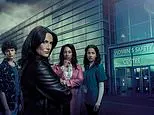
In the premiere of The Curfew, a six-part dystopian thriller on Channel 5, men face a strict 7 p.m. to 7 a.m. curfew enforced by law, complete with electronic ankle bracelets and two-year prison sentences for violations. Women roam freely at night, evoking images of vampires unbound until dawn.
A Premise That Echoes Real-World Restrictions
The concept strikes as outlandish at first—a nationwide police regime confining all men indoors after dark. Yet it mirrors recent societal experiences with prolonged lockdowns affecting everyone, accepted under simple slogans like “Keep Women Safe,” “End Night Crime,” or “Protect Our Streets.”
Despite the measures, the curfew fails to curb violence. Snatch squads target men stepping out even for a smoke, but assaults persist. A woman’s body, head bashed in, appears dumped right outside the tagging center where men report for their bracelets.
Detective Leads the Investigation
Detective Pamela Green, played by Sarah Parish, leads the probe with fury. “That level of rage,” she snarls. “Only a man could have done that!” Her reasoning hinges on the attack’s ferocity and the brute strength needed to move the body, dismissing female involvement outright.
Parish delivers a compelling performance in her anger. The cast includes Bobby Brazier as James, Alexandra Burke as Helen in her first major acting role, and Mandip Gill as single mother Sarah.
Suspects and Twists Emerge
A group of boisterous women revels in the empty town center at midnight, raising questions about potential gang involvement. Enough combined force could overpower a victim, suggesting alternatives to the detective’s assumptions.
Suspicions fall on Anita Dobson as the commanding Queen Bee of a women’s hostel and Burke’s character. Notably, Mandip Gill’s Sarah confesses early, marking her as an unlikely culprit in this unfolding mystery.
Themes of Satire and Unexplored Territories
The series blurs lines between satire and a pointed look at misogyny and sex crimes, pushing boundaries with provocative intent. However, it sidesteps the transgender question entirely. The rules target biological sex—men indoors, women free—leaving trans women post-surgery and trans men (biological females identifying as male) unaddressed in this biology-driven world.
While bold in premise, The Curfew strains to provoke without fully committing to deeper complexities.