Former President Donald Trump has renewed his criticism of CNN anchor and reporter Kaitlan Collins, recently comparing her appearance to that of transgender influencer Dylan Mulvaney. The remarks, initially made during a speech at the White House Correspondents’ Dinner, were further amplified by Trump on social media.
Trump’s Remarks at Correspondents’ Dinner
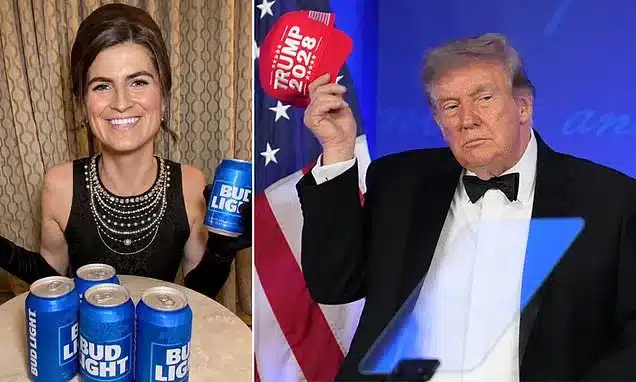
During his address at the White House Correspondents’ Dinner on Friday, July 24, 2026, held at the Waldorf Astoria Washington D.C., Trump made a jest about Collins’s perceived professional success. He stated, “I thought Kaitlan had really made it big with a major new sponsorship. But then I informed her that it wasn’t her on the Bud Light can, it was Dylan Mulvaney.” This comparison drew attention due to the controversy surrounding Bud Light’s marketing campaign featuring Mulvaney in April 2023, which led to significant backlash and boycotts from conservative consumers.
Social Media Amplification
Following the dinner, Trump took to his social media platform, Truth Social, on Sunday to reiterate the comparison. He shared an image that digitally superimposed Collins’s face onto Mulvaney’s body within the context of the widely discussed Bud Light advertisement. This action further highlighted the perceived likeness Trump was drawing between the two individuals.
Kaitlan Collins’s Response
Kaitlan Collins addressed Trump’s initial jab during the Correspondents’ Dinner by posting on social media. She remarked, “The second best part of last night’s White House Correspondents’ Dinner was receiving an award from my friend and mentor, @wolfblitzer.” She followed this by stating, “the first was reminding everyone why the First Amendment—and asking uncomfortable questions that people in power don’t like—matters.” This response was widely interpreted as a subtle counter-jab, emphasizing the importance of journalistic inquiry, particularly when challenging those in authority.
Background on Dylan Mulvaney and Bud Light Controversy
Dylan Mulvaney, a transgender influencer, gained significant public attention in April 2023 after partnering with Bud Light for a promotional campaign. Mulvaney, who has been open about her gender transition journey, appeared in a personalized Bud Light can as part of the collaboration. This campaign ignited a fierce conservative backlash, leading to widespread boycotts of the beer brand. Critics accused Bud Light of alienating its traditional customer base, while supporters defended the brand’s inclusivity. The controversy significantly impacted Bud Light’s sales and brand image throughout 2023, with the company reportedly working to recover from the fallout.
History of Trump-Collins Interactions
The exchange at the White House Correspondents’ Dinner is part of a longer history of contentious interactions between Donald Trump and Kaitlan Collins. Trump has frequently engaged with Collins during press conferences, sometimes appearing to clash over her questioning. Notably, during an Oval Office exchange earlier in the month, Collins asked Trump about his past ties to Jeffrey Epstein. Trump’s response to this question included a comment directed at Collins, remarking, “I don’t think I’ve ever seen you smile.” He added, “You know she’s a young woman,” before turning to Collins and stating, “I don’t think I’ve ever seen you smile. I’ve known you for 10 years, I don’t think I’ve ever seen you smile.”
Collins’s Perspective on the ‘Smile’ Comment
Collins, who was 33 at the time of the Oval Office exchange, later discussed Trump’s remarks on “The Late Show with Stephen Colbert.” She explained that she was not surprised by the comment, viewing it as a deflection tactic often employed by Trump when faced with difficult questions. Collins stated, “I don’t think it’s a controversial opinion that you shouldn’t smile when you’re asking questions about a sex trafficker and sexual assault victims.” She clarified that she does smile, but only “when it’s appropriate.” Collins also noted that Trump has a history of resorting to personal attacks to avoid addressing sensitive topics, such as his connection to the convicted pedophile Jeffrey Epstein. She suggested that the reaction to his comment might have differed had it been made in response to a less serious question.
Broader Context of Political Discourse
The interactions highlight the often-tense relationship between political figures and the press, particularly during public events like the White House Correspondents’ Dinner, which traditionally brings together journalists, politicians, and media personalities. Trump’s repeated targeting of Collins, including the recent comparison to Mulvaney and the earlier comment about her demeanor, underscores the ongoing scrutiny and sometimes personal nature of political commentary in the public sphere.
Conclusion
The renewed criticism from Donald Trump directed at Kaitlan Collins, focusing on her appearance and drawing parallels to Dylan Mulvaney, adds another layer to their history of public exchanges. Collins’s responses have consistently emphasized her commitment to journalistic principles and the importance of asking challenging questions, even in the face of personal remarks.