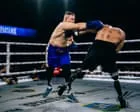
Footwork defines boxing, and for two Ukrainian war veterans on prosthetic legs, it carried profound significance. They competed in the world’s first competitive bout between double-amputee fighters during a three-round match in Brovary, near Kyiv.
The Intense Showdown
Movement remained deliberate throughout the two-minute rounds, with fighters prioritizing balance in each calculated step. Once settled, familiar jabs and short combinations emerged, thrilling spectators. An air raid alert prompted an earlier evacuation amid ongoing attacks, but the crowd returned to witness an unprecedented display, cheering resilience over raw power.
Fighters’ Motivations and Backstories
Artem Khrebet, known by his military call sign Grizzly, shared at the weigh-in: “I am boxing to remind people that, whatever happens, Ukraine and its people will get through this.” He lost both legs to artillery fire in Luhansk during the early stages of the 2022 invasion.
“We don’t want pity. Even after serious injuries like mine, life goes on. Give us the opportunity and the resources, and we’ll do the rest,” Khrebet added.
His opponent, Mykhailo Drobotenko, a former special forces member, lost his legs to a mine. “I wanted to test myself and show other guys, my fellow veterans, that despite serious injuries, you can keep living and improving,” he stated.
Ukraine confronts a massive rehabilitation challenge, with officials and international organizations estimating over 100,000 limb losses since the invasion began. Each case demands extensive adaptation amid trench and minefield warfare.
Adaptive Boxing’s Role in Recovery
From ringside, former British heavyweight champion Scott Welch highlighted boxing’s value for veterans. “Ukraine has so many veterans starting a new life, a new chapter. Boxing builds their confidence and helps their minds. It lets them feel invincible and put on a great show,” he said.
Welch’s team supplied specialized wheelchairs from the UK for a separate wheelchair bout involving two other veterans. Khrebet and Drobotenko pushed boundaries by fighting upright on prosthetics.
Drobotenko described preparation as grueling: “On prosthetics, when you don’t have a knee, your functionality and balance are obviously not the same. In boxing, a lot of power comes from the legs, so you have to adapt. You rely more on your core, pushing from the body instead.”
Both fighters credited the sport with psychological benefits. “Training helped quiet everything else. It offers focus, structure, and some sort of sense of normality,” Khrebet noted, discussing his mental health journey. “There are moments when you even forget that you don’t have legs any more. It’s therapy for me.”
Fight Outcome and Future Plans
Camaraderie defined the weigh-in, free of trash talk, but competition intensified in the ring. Coach Igor Faniian observed: “Adaptive boxing doesn’t usually involve winning or losing. But the lads made it clear they were in it to win. They kept asking why it should be a technical draw, they wanted that extra motivation. Both are champions in life. Only one will take the belt.”
In the third round, Drobotenko struggled with footing under Khrebet’s pressure, his higher amputation affecting stability. Khrebet emerged victorious, claiming the Ukrainian veterans’ championship belt.
In the changing room, Drobotenko dismissed excuses: “I’m asking for a rematch. I’m not done with him yet.”