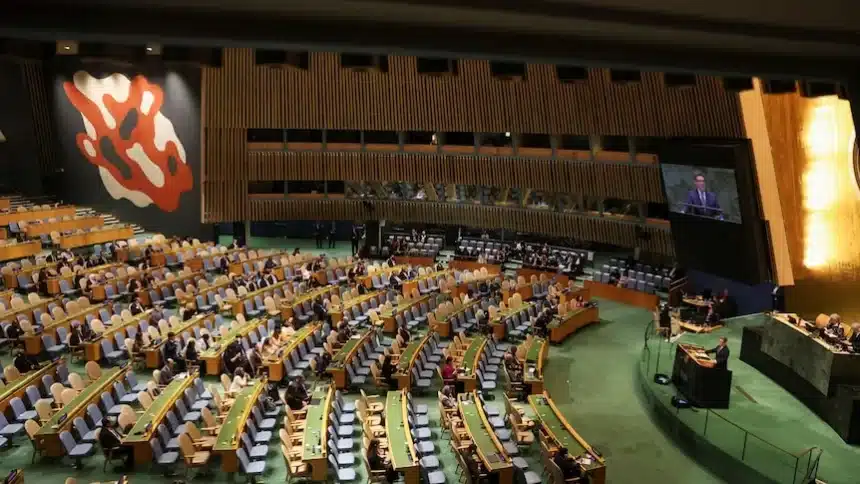
The annual United Nations General Assembly summit in New York saw world leaders convene, with discussions ranging from artificial intelligence and international conflict to geopolitical tensions. US President Donald Trump’s address, which included strong rhetoric against Iran and a rejection of global AI regulation, captured significant attention. However, the summit also featured widespread condemnation of Israel’s actions, a debate on AI governance, and a notable walkout by Cuba’s delegation.
Global Condemnation of Israel’s Policies
A significant portion of the speeches delivered by world leaders focused on criticizing Israel’s policies and actions. Concerns were raised not only regarding the situation in Gaza, which a UN inquiry has described as potentially genocidal, but also about the occupation of southern Lebanon and escalating settler violence against Palestinians in the West Bank. UN Secretary-General Antonio Guterres voiced strong disapproval of the expansion of West Bank settlements, deeming them illegal under international law and a significant impediment to peace, warning they could lead to ethnic cleansing.
Jordan’s King Abdullah II urged the international community to consider imposing sanctions or other punitive measures against Israel, stating that such tools had been used effectively in other contexts. French President Emmanuel Macron, speaking after President Trump declared an end to the war in Gaza, questioned the notion of peace when humanitarian access remained severely restricted. He posed a rhetorical question, asking if the world should passively observe a situation that should provoke shame.
In response to the widespread criticism, the office of Israeli Prime Minister Benjamin Netanyahu posted an animated video on X, featuring parrots at the UN podium repeating the phrase “blame Israel.” The video, which appeared to be AI-generated, depicted birds addressing the assembly. Prime Minister Netanyahu has consistently rejected allegations of genocide and characterized settler violence as the actions of “juvenile delinquents,” despite documented evidence from human rights groups indicating support for such attacks by Israeli authorities. He announced his intention to deliver a speech later in the week to present his perspective on the conflict.
Leaders from the United Kingdom, Brazil, Turkey, and Qatar were among those who voiced criticism of Israel. Despite the strong words, immediate action against Israel at the UN appeared unlikely, largely due to the veto power held by the United States, a key ally of Israel, within the Security Council.
Debate Over Artificial Intelligence Governance
The summit also served as a platform for a critical discussion on the governance of artificial intelligence. Australian Prime Minister Anthony Albanese was among the 22 world leaders who called for global regulations on AI. In contrast, US President Donald Trump strongly opposed this stance, asserting that the United States would not impede the growth of AI, which he predicted would surpass the industrial revolution in significance.
British Prime Minister Andy Burnham echoed the comparison to the industrial revolution but highlighted the immense suffering and exploitation that accompanied it. He emphasized the need to proactively manage AI’s development to avoid similar negative outcomes, stating, “This time we need to get it right.” Burnham announced that the UK would prioritize AI during its upcoming G20 presidency, aiming to establish a unified set of global principles and standards.
While declining to directly comment on President Trump’s remarks, Prime Minister Albanese expressed optimism that AI would be a key topic in President Trump’s upcoming meeting with Chinese President Xi Jinping. Additionally, Albanese participated in the launch of a roadmap aimed at protecting children from the risks associated with AI. He cautioned against delaying action, drawing parallels to the delayed response to social media’s impact, and suggested that earlier intervention would have been beneficial.
The roadmap focuses on issues such as chatbot security, the proliferation of AI-generated abusive material, deepfake pornography, and the importance of AI literacy. More detailed plans are expected to be unveiled at a forthcoming meeting in Paris.
Ukraine Conflict and US-Cuba Tensions
Ukrainian President Volodymyr Zelenskyy met with President Trump on the sidelines of the summit. Zelenskyy reportedly requested a “winter package” of military aid, including Patriot anti-missile systems. He also indicated an expectation that President Trump would seek to negotiate an “energy ceasefire” to potentially halt Ukrainian attacks on Russian oil refineries, which Trump has linked to rising diesel prices.
While the US, under the Biden administration, has continued its commitments to Ukraine, it has also urged NATO allies to contribute to funding new assistance. President Trump briefly addressed the Ukraine conflict in his UN speech, reiterating his prediction of an imminent end to the war.
President Trump also directed criticism towards Cuba, labeling it a “failed state” and stating that the US would not permit it to serve as a base for foreign adversaries threatening American interests. He suggested that Secretary of State Marco Rubio was engaged in significant negotiations with Cuba. In response to President Trump’s remarks, the Cuban delegation walked out of the assembly hall. Cuban President Miguel Diaz-Canel later posted on X, affirming Cuba’s commitment to peace, sovereignty, and resistance against what he described as “ruthless aggression” from the United States.
Conclusion: A Summit of Divergent Priorities
The UN General Assembly summit underscored a complex global landscape, marked by divergent priorities and significant geopolitical fault lines. While discussions on artificial intelligence highlighted a growing international awareness of its potential risks and the need for governance, the persistent conflicts in Gaza and Ukraine, coupled with long-standing US-Cuba tensions, demonstrated the enduring challenges in achieving global peace and stability. The contrasting approaches to AI regulation and the strong criticisms leveled against Israel indicate a world grappling with multifaceted crises, where international cooperation faces significant hurdles.