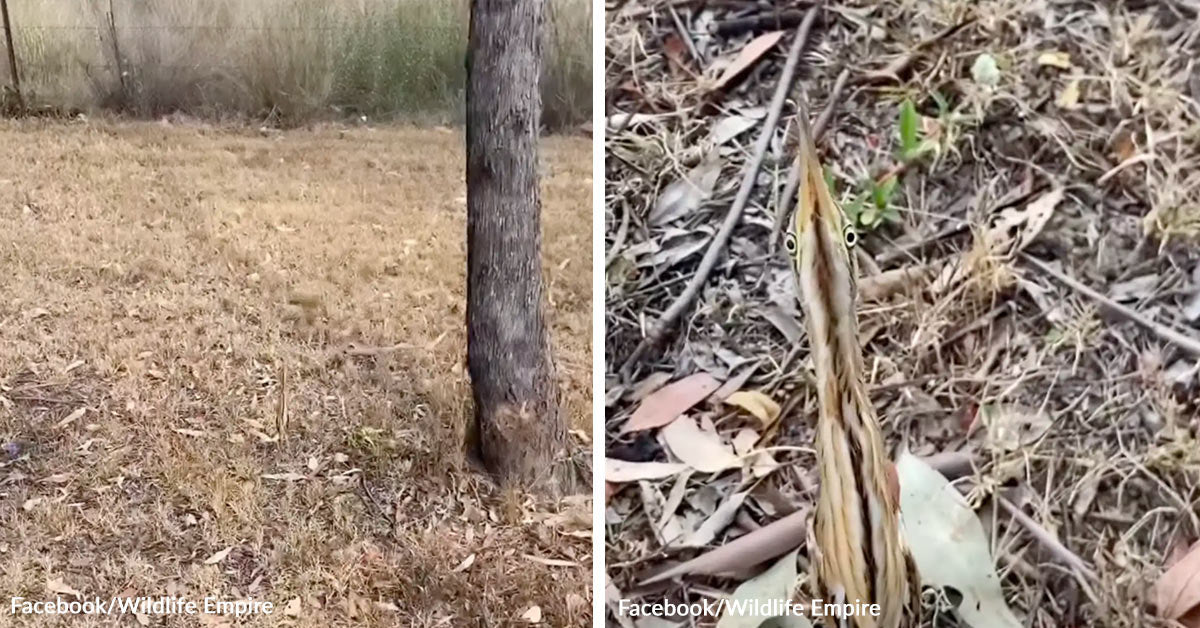
On a vivid, drying day in rural Queensland, a dad or mum stepped outdoors to verify their little one’s play space and caught sight of one thing that didn’t fairly belong. At first, it seemed to be an odd, vertical form, nearly like a forgotten toy or a stray piece of playground tools. Solely on nearer inspection did the house owner understand that this “uncommon form” was, actually, a residing creature. It was a bittern within the yard, a big, fantastically camouflaged heron native to the wetlands of Australia and Tasmania, standing so nonetheless that it practically disappeared into the backdrop.
In keeping with Wildlife Empire Rescue and Rehabilitation director Tennille Bankes, the fowl was so properly blended into the setting that it was simple to mistake him for a part of the surroundings. The house owner had first seen an odd define within the play space, a form standing very nonetheless within the daylight. From a distance, the bittern’s striped plumage and statue-like posture made it troublesome to acknowledge {that a} wild animal was quietly ready within the grass.
Curious and anxious, the property proprietor moved nearer and realized one thing was not proper. This was not a wholesome, lively fowl visiting the yard. The bittern was barely shifting and appeared drained of power. Uncertain of what to do, and recognizing that the scenario may be severe, the house owner reached out for skilled assist. They contacted Wildlife Empire Rescue and Rehabilitation, a corporation skilled in caring for native animals in misery, and requested steerage.
Bankes responded to the decision and headed to the property to find the “uncommon form” that had brought about concern. She later shared that recognizing the fowl was not easy. As a result of bitterns are identified for his or her “stick mode” posture, with their our bodies elongated and their heads pointed upward, their striped feathers line up with grasses, reeds, or any vertical shapes close by. This pure camouflage is a strong survival technique within the wild, however it might additionally make it laborious for folks to see when a fowl is in hassle.

Fb/Wildlife Empire
On arrival, Bankes scanned the play space rigorously. The fowl’s vertical stance and patterned feathers made him appear like a part of the background, and she or he famous that it may genuinely take a second to register what she was . Finally, although, the form resolved itself right into a residing bittern, standing upright however clearly not properly. Bankes later described the second as “fairly surreal,” a painted-looking determine all of the sudden revealing itself as an actual, susceptible animal.
As soon as she approached, it grew to become apparent that the bittern was not merely resting. He was weak and exhausted, exhibiting very low power regardless of his upright posture. Bankes reported that the fowl didn’t appear particularly frightened. As an alternative, his stillness regarded extra like fatigue than worry, as if he merely didn’t have a lot power left to react. The current heavy rainfall within the space had solely simply begun to ease, and the circumstances might have taken a toll on the fowl’s skill to seek out meals or shelter.
Recognizing that the bittern wanted assist, Bankes gently collected him and transported him away from the busy yard to a quiet, calm setting the place he may safely recuperate. There, she centered on offering the fundamentals that any exhausted animal wants. Hydration got here first, permitting the fowl’s physique to start regaining steadiness after what seemed to be a draining ordeal. She gave him time to relaxation in peace, with out noise or stress, and watched rigorously to see how he would reply.
Over the following few days, Bankes monitored the fowl’s situation. At first, the main target stayed on fluids and relaxation, since he was too weak to do way more. When his power improved sufficient, she started providing meals, ready till he was able to eat in order to not push him past his limits. Regularly, the adjustments started to indicate. His posture, as soon as solely barely upright, began to look stronger. The bittern grew to become extra conscious of his environment and extra alert to motion and sound, essential indicators in a wild fowl’s restoration.
One other vital marker of progress got here when his flight power started to return. The place he had as soon as appeared too depleted to maneuver a lot in any respect, he slowly regained the coordination and energy that a big heron must fly safely. In keeping with Bankes, his enchancment was regular, and every small achieve introduced him nearer to the potential of returning to his pure habitat. I discovered this element hanging, as a result of it highlights how even temporary, centered care can assist a wild animal reclaim its independence.
All through the method, the objective remained clear. Wildlife Empire Rescue and Rehabilitation goals to deal with wild animals in a approach that prepares them for a protected launch moderately than long-term captivity every time potential. Because the bittern continued to develop stronger, Bankes and her group watched for the mix of traits that may point out he was prepared: coordinated flight, constant alertness, and conduct that matched what a wholesome wild bittern ought to show.
When these indicators have been evident, it was time. The group organized his launch close to appropriate habitat, the place a bittern in Australia would naturally thrive. This cautious alternative of location helped be certain that the fowl would have entry to applicable meals sources and shelter, growing his probabilities of a profitable return to life within the wild. Bankes shared that seeing the fowl fly strongly away felt extremely rewarding, a second that validated the hassle, consideration, and care invested in his restoration.
The sight of an “uncommon form” in a toddler’s play space turned out to be a life-or-death second for a camouflaged, attractive fowl in want of assist. What started as a small flicker of concern from a home-owner led to skilled intervention, affected person rehabilitation, and in the end the picture of a once-exhausted bittern winging his approach again towards wetland habitat. The story underscores how strange folks, just by noticing that one thing appears off and taking the step to name a wildlife group, can turn out to be a vital a part of defending native species. It additionally highlights the dedication of rescuers like Bankes, who remodel quiet yard discoveries into tales of restoration and launch, one wild fowl at a time. Learn extra at The Dodo