U.S.-Israel Strikes Target Iran in Massive Coordinated Assault
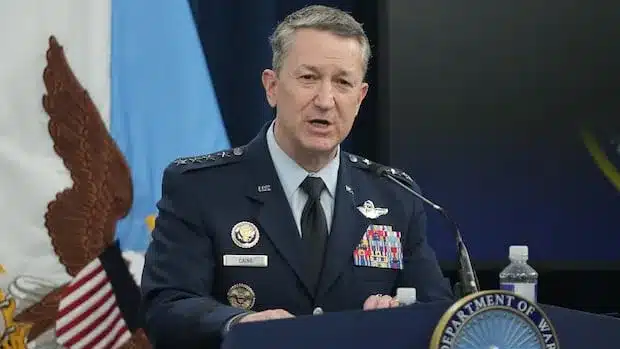
U.S. and Israeli forces launched a massive, overwhelming attack on Iran over the weekend, striking more than 1,000 targets across all domains of warfare within the first 24 hours. Air Force Gen. Dan Caine, chairman of the Joint Chiefs of Staff, detailed the operation during a Monday news conference in Washington.
The assault began at 9:45 a.m. Tehran time (1:15 a.m. ET) with over 100 aircraft deployed from land and sea in a single synchronized wave. President Donald Trump approved the operation at 3:38 p.m. ET on Friday while aboard Air Force One en route to Texas.
Command Chain and Intelligence Tracking
The order passed from the president through Secretary of Defense Pete Hegseth to Adm. Brad Cooper, head of U.S. Central Command overseeing the Middle East. Weeks of intelligence efforts by U.S. and Israeli authorities tracked senior Iranian leaders’ movements, including Supreme Leader Ayatollah Ali Khamenei, whose location had been monitored by the CIA for months.
Caine described the joint U.S.-Israeli operation as unprecedented in scale, preceded by cyber operations that disrupted Iranian communications and sensor networks, blinding their ability to respond.
Key Casualties and Iranian Response
The strikes killed several high-ranking officials, including Iran’s Defense Minister Amir Nasirzadeh and Revolutionary Guards Commander Mohammed Pakpour. Supreme Leader Khamenei, aged 86, died on Saturday in airstrikes that destroyed his central Tehran compound. Iranian state media confirmed his daughter, grandchild, daughter-in-law, and son-in-law also perished.
The Iranian Red Crescent Society reports at least 555 deaths, including civilians. Inside Iran, reactions divide sharply: some mourn Khamenei, who ruled with an iron fist for 36 years, building anti-U.S. proxies across the Middle East, while others celebrate his death, highlighting deep societal fault lines.
Expert Analysis on Khamenei’s Location
Vali Nasr, professor of international affairs and Middle East studies at Johns Hopkins University’s School of Advanced International Studies, noted the surprise of Khamenei’s presence in his office compound rather than a bunker amid imminent threats.
Military Tactics and Technology
Operation Epic Fury involved B-2 stealth bombers flying 37-hour round trips from the U.S., similar to prior strikes on Iranian nuclear sites. This time, a daytime operation emphasized speed, surprise, and violence of action. Cyber units and the U.S. Space Force played key roles in degrading enemy capabilities.
Hegseth praised Israel’s execution in the strike that killed Khamenei, while Caine confirmed U.S. and Israeli forces have achieved air superiority over Iran.
Strategic Objectives and Next Steps
The attacks aim to prevent Iran from developing nuclear weapons, curb its missile program, and neutralize threats to the U.S. and allies. A recent Defense Intelligence Agency assessment indicates Iran remains a decade from intercontinental ballistic capabilities and is not currently producing nuclear weapons but has advanced related activities.
Massive buildup preceded the strikes, including aircraft carriers USS Lincoln and USS Ford. No ground troops are deployed in Iran, Hegseth stated, declining further details on duration or end goals to protect U.S. forces.
The U.S. urges Iranians to seize this moment amid recent protests crushed by the regime. Intelligence suggests Khamenei’s successor could be a hard-line Revolutionary Guards figure or cleric, potentially maintaining the status quo.