[ad_1]

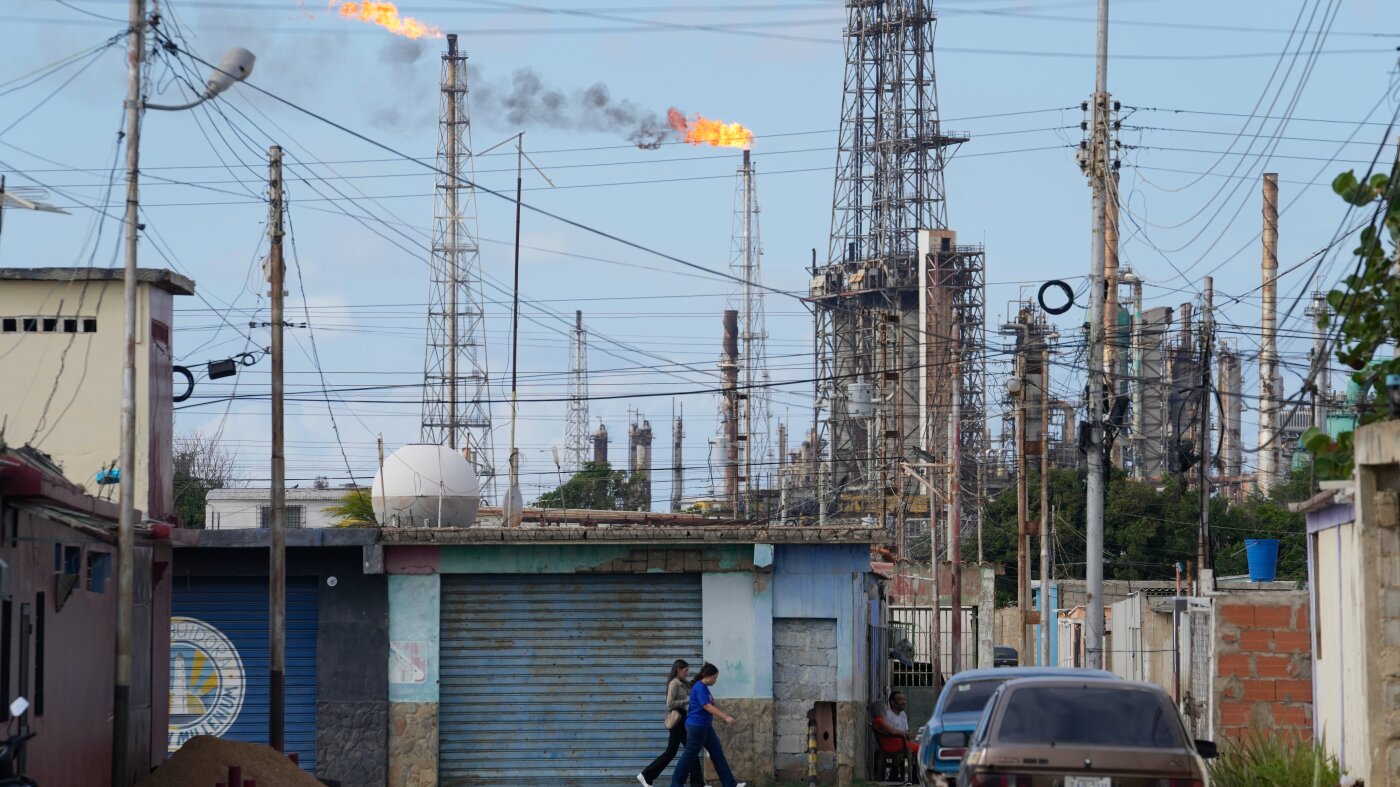
Flames rise from flare stacks on the Amuay refinery in Los Taques, Venezuela, Wednesday, Jan. 14, 2026.
Matias Delacroix/AP
disguise caption
toggle caption
Matias Delacroix/AP
CARACAS, Venezuela — Venezuela’s legislature superior a invoice on Thursday to loosen state management over the nation’s huge oil sector within the first main overhaul because the late socialist chief Hugo Chávez nationalized elements of the business in 2007.
The laws would formally break many years of state command over among the world’s largest oil reserves, create new alternatives for personal firms to speculate and set up worldwide arbitration for funding disputes.
Following the U.S. seize of former President Nicolás Maduro earlier this month, the Trump administration has ramped up strain on appearing President Delcy Rodríguez and different allies of the ousted chief to ask higher funding from U.S. vitality firms in Venezuela’s flagging oil business.

A draft of the proposed laws, a duplicate of which was seen by The Related Press, represents a stark retreat from the useful resource nationalism on the coronary heart of Venezuela’s socialist-inspired revolution.
Reflecting U.S. calls for, the proposed laws would enable personal firms to independently function oil fields, market their very own crude output and accumulate the money revenues via contracts with Petróleos de Venezuela, the state-run oil firm and lengthy the cornerstone of Venezuela’s financial system.
“The working firm shall assume the excellent administration of the execution of the actions, at its sole value, expense and danger,” the draft says, including that parts of manufacturing volumes “could also be straight commercialized by the working firm, as soon as governmental obligations have been fulfilled.”
Crucially, the invoice presents firms the choice of settling authorized disputes via arbitration in worldwide courts reasonably than simply native courts. It additionally permits the federal government to chop royalties from the present 30% to as little as 15% and slash extraction taxes to influence firms to decide to tough tasks in underdeveloped fields.
The president of Venezuela’s Nationwide Meeting, Jorge Rodríguez, instructed lawmakers firstly of Thursday’s debate that the invoice goals to “enable an accelerated enhance in manufacturing” of oil in Venezuela.
“Oil below the bottom is ineffective,” he mentioned, referring to the necessity to increase oil manufacturing and open up exploration alternatives.
Pushed by Delcy Rodríguez, the invoice is predicted to advance swiftly via the ruling party-dominated legislature.
After round two hours of dialogue, lawmakers gave preliminary approval to the invoice on Thursday and despatched it to a second spherical of debate, but to be scheduled.
In the course of the session, Orlando Camacho, a lawmaker and head of Venezuela’s nationwide Fedeindustria enterprise affiliation, mentioned the invoice ensures “that oil continues to be the driving drive of our nation’s growth.”
The proposed authorized ensures — making certain that overseas firms can carry claims towards Venezuela earlier than worldwide our bodies — are essential to draw personal funding, he mentioned, including, “It’s a daring step.”
Whilst U.S. President Donald Trump appears to lure American firms to reboot Venezuela’s oil sector, many stay involved concerning the monetary and authorized dangers of pouring billions of {dollars} into the nation.
Loads of traders have been burned earlier than, their belongings seized as Chávez nationalized elements of Venezuela’s profitable oil business in 2007.
Companies like Exxon have been making an attempt to get the Venezuelan authorities to compensate them for his or her billions of {dollars} in losses ever since, to no avail.
The present political uncertainty additionally worries traders.
There isn’t a timeline for holding democratic elections in Venezuela as Rodríguez, lengthy Maduro’s second in command, seeks to consolidate management.
Trump additionally hasn’t mentioned when the U.S. will raise crippling sanctions he imposed in his first time period to weaken Maduro’s authorities, additional complicating overseas operations within the nation’s oil sector.
[ad_2]