[ad_1]

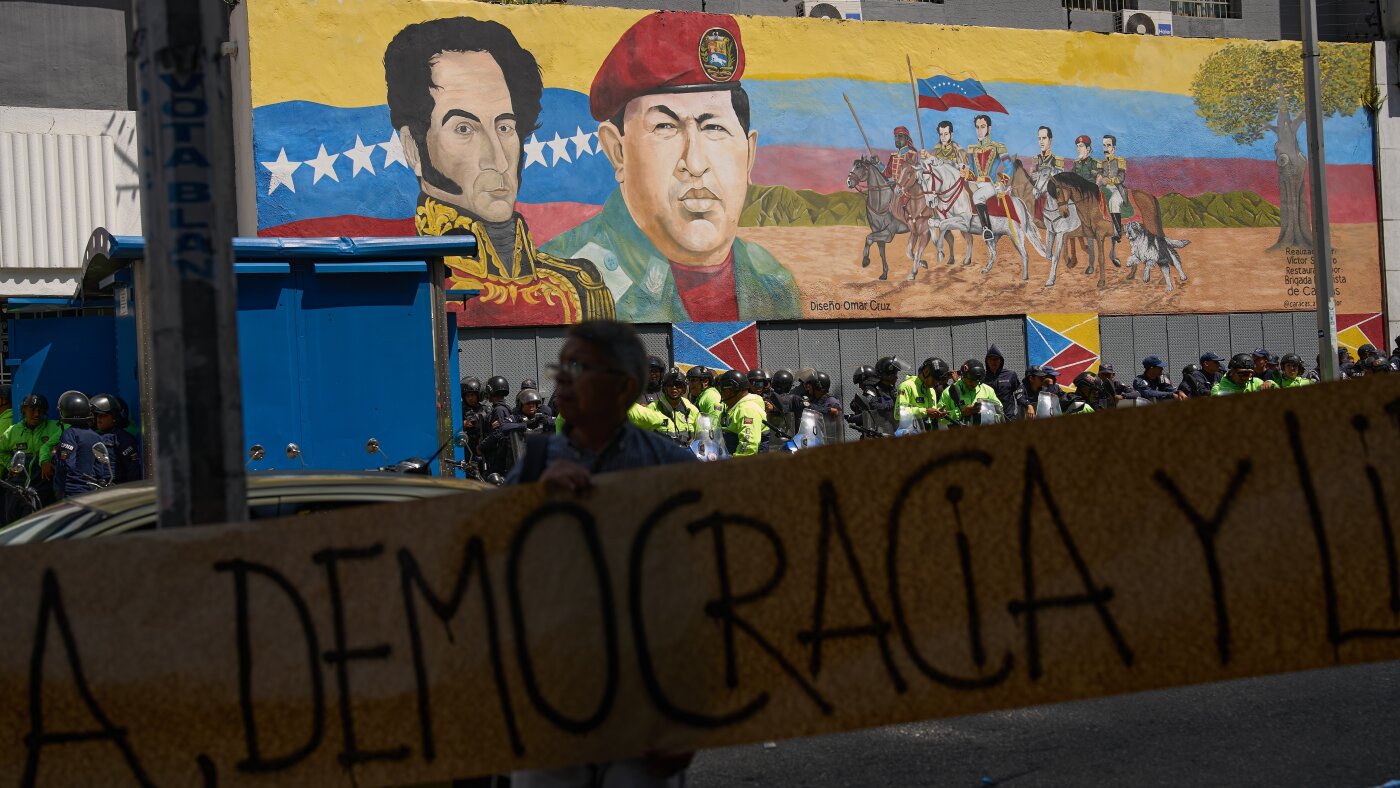
Family of political prisoners hoist a banner with the Spanish phrase for “Democracy” outdoors the Nationwide Meeting emblazoned with photos of former President Hugo Chavez and independence hero Simon Bolivar, in Caracas, Venezuela, Tuesday, Feb. 10, 2026.
Ariana Cubillos/AP
conceal caption
toggle caption
Ariana Cubillos/AP
BOGOTA, Colombia — Shortly after the U.S. navy operation final month that captured Venezuelan President Nicolás Maduro, political prisoner Nicmer Evans was launched from jail. However he isn’t off the hook but.
Evans, a political analyst and journalist, nonetheless faces prices of terrorism and hate crimes for criticizing the Maduro regime, and he may ultimately be despatched again to jail.
“I am not allowed to go away the nation,” he instructed NPR of his conditional launch from jail on Jan. 14. “I’ve to report back to the authorities each 15 days.”
Legions of Venezuelans are in comparable authorized limbo. The nation’s jails maintain tons of of political prisoners, whereas 1000’s of former detainees have prison prices hanging over their heads.
Others have been pressured into exile, misplaced authorities jobs, or noticed their properties confiscated for opposing Maduro or his predecessor, Hugo Chávez, who between them dominated Venezuela for the previous 27 years.
Beneath strain from the Trump administration, which holds vital leverage over the brand new authorities, Venezuela’s interim president Delcy Rodríguez – who had been Maduro’s vp – is beginning to make amends. Her authorities has freed 431 political prisoners since Jan. 8 and pledged to shut the infamous El Helicoide, a Caracas jail and heart for torture.
Now, Rodríguez is selling an amnesty regulation.
“Revenge, retaliation, and hatred should not overwhelm us,” Rodríguez declared in a latest speech. “We provide the possibility to reside in Venezuela in peace.”
On Thursday, the Nationwide Meeting started debating articles of a draft amnesty invoice, which is anticipated to be permitted quickly, because the ruling Socialist Celebration holds nearly all of seats and is presided over by Jorge Rodríguez, the interim president’s brother.
“We’re asking for pardon, and we have to be prepared to pardon others,” he says.

Nationwide Meeting President Jorge Rodriguez speaks with lawmakers throughout debate on an amnesty invoice in Caracas, Venezuela, Thursday, Feb. 12, 2026.
Cristian Hernandez/AP
conceal caption
toggle caption
Cristian Hernandez/AP
However already, the invoice has come below assault by human rights teams and kin of political prisoners.
For one factor, authorities officers have portrayed amnesty as a method to expedite the discharge of greater than 500 dissidents nonetheless behind bars. However authorized specialists say that could possibly be carried out instantly, with none new laws.
Though Venezuela has a brand new head of state, the corrupt and repressive authorities establishments constructed up by Maduro, who dominated the nation till 2013, stay in place, says opposition lawmaker Antonio Ecarri.
Ecarri, who’s on the legislative fee finding out the amnesty invoice, factors out that Venezuelan courts are nonetheless full of pro-regime judges who did Maduro’s bidding and despatched 1000’s of harmless individuals to jail.
But below the present model of the amnesty invoice, victims of presidency repression must go earlier than these similar judges to request amnesty.
“It is unnecessary,” Ecarri says.
Juanita Goebertus, the Americas director for Human Rights Watch, says there are “very severe limitations” within the amnesty invoice. For instance, to offer ex-political prisoners a clear slate and a contemporary begin, it requires destroying their jail recordsdata. Nevertheless, some prisoners have been sexually abused or tortured.
“We concern that this might result in the elimination of proof that could possibly be key within the eventual (prosecution) of human rights violations,” Goebertus says.
Authorities officers and closely armed safety forces dedicated the overwhelming majority of abuses over the previous quarter-century. Nevertheless, language within the invoice, together with speeches by ruling celebration legislators, portrays unarmed opposition activists as equally accountable.
Dissidents “are demanding amnesty, however they lack the humility to acknowledge that the state is ready to pardon them for all of the crimes they dedicated,” says Iris Varela, a pro-government legislator.

Folks attend a student-led march on Nationwide Youth Day to name for the discharge of detainees, thought of to be political prisoners by their kin and human rights teams, in Caracas, Venezuela, Thursday, Feb. 12, 2026.
Ariana Cubillos/AP
conceal caption
toggle caption
Ariana Cubillos/AP
Gonzalo Himiob, vp of the Venezuelan authorized help group Foro Penal, says authorities officers refuse to acknowledge political prisoners as victims of grave human rights violations as a result of that might be tacit recognition of the federal government’s accountability in abusing them.
Goebertus provides: “There must be acknowledgment that there have been very severe human rights violations dedicated by the regime. And there must be truth-telling about these crimes. And that’s actually not current on this amnesty invoice in any respect.”
Nonetheless, the present debate would have been unthinkable just some months in the past, and a few view it as step one towards a democratic opening in Venezuela.
Ecarri, the opposition lawmaker, says: “There aren’t any miraculous options, however issues are slowly beginning to occur.”
Regardless of his personal misgivings concerning the amnesty invoice, Evans, the lately freed political prisoner, was additionally optimistic.
“We’re higher off than we have been in December,” Evans says. “In December, I used to be in jail. Right now, I am not.”
[ad_2]