[ad_1]
Washington — The Pentagon gave Anthropic an ultimatum this week: Give the U.S. navy unrestricted use of its AI know-how or face a ban from all authorities contracts.
On the heart of the difficulty is a query of who controls how synthetic intelligence fashions are used, the Pentagon or the corporate’s CEO.
The Pentagon’s AI contracts
The Pentagon awarded Anthropic a $200 million contract in July to develop AI capabilities that might advance U.S. nationwide safety.
Anthropic’s rivals, together with OpenAI, Google and xAI had been additionally awarded $200 million contracts by the Pentagon final yr.
Anthropic is presently the one AI firm to have its mannequin deployed on the Pentagon’s categorized networks, by way of a partnership with knowledge analytics large Palantir.
A senior Pentagon official advised CBS Information that Grok, which is owned by Elon Musk’s xAI, is on board with being utilized in a categorized setting, and different AI firms are shut.
The Pentagon introduced final month that it is trying to speed up its makes use of of AI, saying the know-how might assist the navy “quickly convert intelligence knowledge” and “make our Warfighters extra deadly and environment friendly.”
Conflict over the guardrails
The standoff between the Pentagon and Anthropic was reportedly set off by the U.S. navy’s use of its know-how, generally known as Claude, through the operation to seize former Venezuela President Nicolás Maduro in January.
Anthropic has repeatedly requested the Pentagon to conform to sure guardrails, amongst them a restriction on utilizing Claude to conduct mass surveillance of Individuals, sources advised CBS Information.
And the corporate additionally needs to make sure Claude isn’t utilized by the Pentagon for closing focusing on selections in navy operations with none human involvement, one supply aware of the matter mentioned. Claude isn’t immune from hallucinations and never dependable sufficient to keep away from probably deadly errors, like unintended escalation or mission failure with out human judgment, the supply mentioned.
When requested for remark, a senior Pentagon official mentioned: “This has nothing to do with mass surveillance and autonomous weapons getting used. The Pentagon has solely given out lawful orders.”
Pentagon officers have expressed issues to Anthropic that the corporate’s guardrails might stand in the best way of essential actions, corresponding to responding to an intercontinental ballistic missile launched towards the US.
Any company-imposed restrictions “might create a dynamic the place we begin utilizing them and get used to how these fashions work, and when it comes that we have to use it in an pressing scenario, we’re prevented from utilizing it,” Emil Michael, the undersecretary of protection for analysis, mentioned at an occasion in February.
On the query of when AI is used to strike or kill navy targets and makes a mistake, who’s liable — the navy or the AI firm — a protection official mentioned: Legality is the Pentagon’s accountability as the tip consumer.
What high leaders are saying
Anthropic CEO Dario Amodei has been vocal in expressing his issues in regards to the potential risks of AI and has centered the corporate’s model round security and transparency.
In a prolonged essay final month, Amodei warned of the potential for abuse of the applied sciences, writing that “a robust AI wanting throughout billions of conversations from thousands and thousands of individuals might gauge public sentiment, detect pockets of disloyalty forming, and stamp them out earlier than they develop.”
“Democracies usually have safeguards that stop their navy and intelligence equipment from being turned inwards towards their very own inhabitants, however as a result of AI instruments require so few individuals to function, there’s potential for them to avoid these safeguards and the norms that help them. Additionally it is price noting that a few of these safeguards are already step by step eroding in some democracies,” he wrote.
Amodei has lengthy backed what he describes as “wise AI regulation,” together with guidelines that might require AI firms to be clear in regards to the dangers posed by their fashions and any steps taken to mitigate them.
The Trump administration, in the meantime, has favored a lighter contact, and has argued that stringent AI rules might stifle innovation and make it tougher for the American AI business to compete. The administration has sought to dam what it calls “extreme” state-level rules. At one level final yr, enterprise capitalist and White Home AI and crypto adviser David Sacks accused Anthropic of “fear-mongering” and recommended its curiosity in AI rules is self-serving.
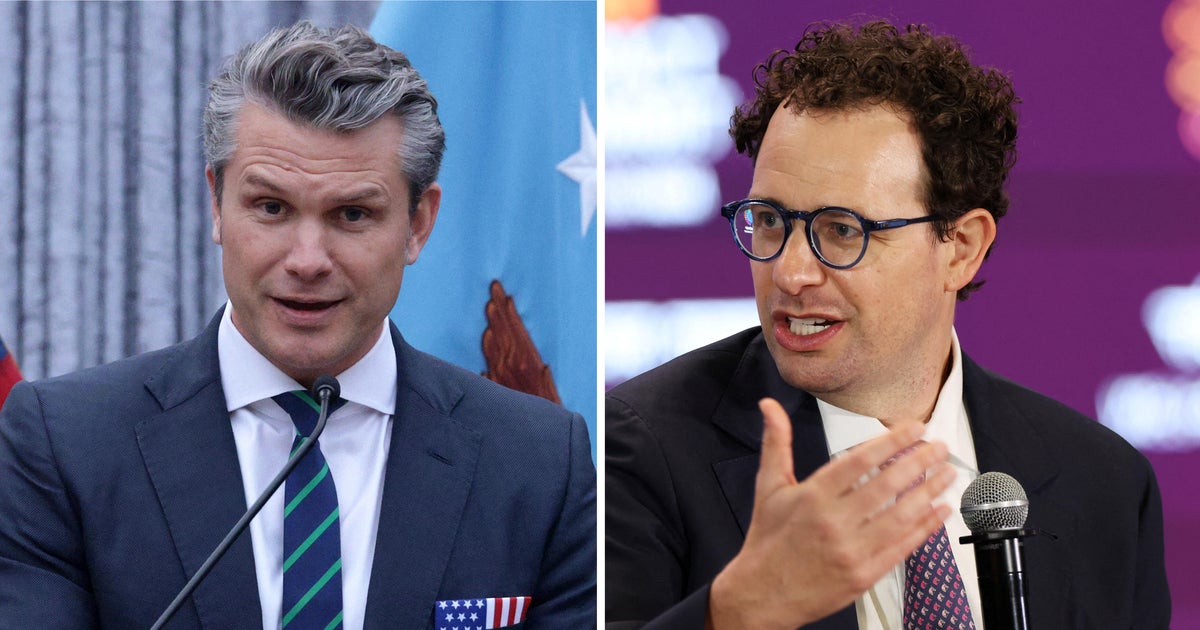
In a January speech, Protection Secretary Pete Hegseth derided what he views as “social justice infusions that constrain and confuse our employment of this know-how.”
“We is not going to make use of AI fashions that will not can help you combat wars,” Hegseth declared. “We are going to choose AI fashions on this normal alone; factually correct, mission related, with out ideological constraints that restrict lawful navy functions. Division of Battle AI is not going to be woke. It should work for us. We’re constructing war-ready weapons and techniques, not chatbots for an Ivy League school lounge.”
What’s subsequent within the Anthropic v. Pentagon saga
Hegseth gave Anthropic till Friday, Feb. 28, to agree to provide the U.S. navy unrestricted use of its know-how or danger being blacklisted, sources aware of the scenario advised CBS Information.
Pentagon officers are contemplating invoking the Protection Manufacturing Act to compel Anthropic to conform on nationwide safety grounds.
Or, if an settlement cannot be reached, protection officers have mentioned declaring the corporate a “provide chain danger” to push it out of presidency, based on the sources.
[ad_2]