In 1909, greengrocer Claude Nam Shing awoke to shouts of ‘fire’ at his store on the corner of Elizabeth and Melville Streets in central Hobart. He escaped unharmed as firefighters extinguished the blaze, which spared most of his stock but damaged a neighboring paint shop. Local newspapers welcomed the event, anticipating replacements for the aging wooden structures. Today, sturdy buildings from 1914 occupy that site.
Mapping Chinese Footprints in Hobart
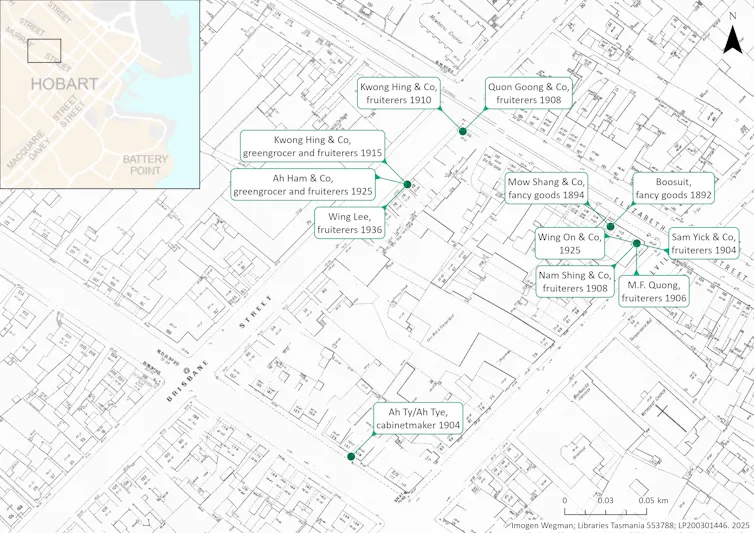
Historical research maps 105 addresses linked to Chinese businesses across Hobart’s center, revealing a dispersed presence rather than a concentrated enclave. Unlike Melbourne or Sydney, Tasmania’s capital never formed a Chinatown, yet traces of Chinese migration endure throughout the city.
Immigration Amid Policy Shifts
Claude Nam Shing, who arrived from China in the mid-1890s, resided in Tasmania for over 40 years. The 1911 census recorded 353 China-born men in the state, down more than 30% from the 1891 peak. Following federation, the White Australia Policy curtailed non-white immigration and limited residents’ rights. Some families departed for larger urban Chinese communities, aligning with city renewals that replaced fire-prone wooden shops with modern buildings.
Analysis indicates that low population density prevented Chinatown formation, but Chinese history persists beyond visible landmarks.
Diverse Historical Sources
Records from births, marriages, naturalizations, newspapers, and gravestones yield names, addresses, and dates, reintegrating Chinese families into Tasmania’s narrative. Most pre-1950s Chinese migrants hailed from Guangdong province’s Pearl River Delta, particularly Sunwui and Toishan counties, fostering networks based on kinship and dialects.
Post Office Directories track business transfers within these networks. For instance, Alfred Wood’s fruiterer shop passed to Peter Quon Goong in 1907, then Kwong Hing in 1909, soon branded as the ‘Chinese fruiterers’ amid nearby competitors.
A Variety of Chinese Enterprises
On one block, cabinetmaker Ah Tye operated near timber yards, alongside bootmakers, blacksmiths, and boarding houses. Chinese operators ran greengrocers, fruiterers, confectioneries, gift shops, and ‘fancy goods’ stores offering exotic imports and household items. Vong (John) Boosuit evolved from hawker to shop owner in the 1890s; he married English convict descendant Selina Findon, with actor Patrick Brammall among their progeny.
Clustering occurred only where infrastructure mattered, such as laundries near water sources with drying space.
Community Contributions
Newspapers highlight Chinese migrants’ generosity. Shops doubled as hubs; Ah Ham & Co’s fruiterers funded Hobart’s main hospital annually for nearly 50 years, despite limited personal use. In a small city, migrants bridged British and Chinese cultures.
Between 2011 and 2021, central Hobart’s non-English home language speakers nearly doubled from 12.5% to 24%, echoing a heritage paused by the White Australia Policy for over 70 years. Streets once lined with Chinese laundries, tobacconists, grocers, and restaurants now bustle with multiculturalism. Descendants of early migrants, many in rural areas, can take pride in their ancestors’ foundational roles.