[ad_1]

A handout photograph taken on March 11, 2026 and launched by the Royal Thai Navy exhibits smoke rising from the Thai bulk provider ‘Mayuree Naree’ close to the Strait of Hormuz after an assault.
Handout/Royal Thai Navy/AFP/Getty Photographs
cover caption
toggle caption
Handout/Royal Thai Navy/AFP/Getty Photographs
The specter of Iran laying mines within the Strait of Hormuz — the slim waterway by means of which about 20% of the world’s oil provide travels — is elevating recent fears about world oil costs amid the continued battle with the U.S. and Israel.
Already, Tehran’s ongoing drone and missile strikes in opposition to tankers have lowered the circulation of oil to a trickle, in keeping with a report from the Worldwide Vitality Company. The U.S. is additional involved that Iran will lay sea mines within the Strait, because it has executed in previous conflicts. Business ship crews concern assault, and maritime underwriters are shying away from insuring vessels that might be hit within the Strait, which connects the Persian Gulf to the Gulf of Oman.
That is brought on the worth of oil to skyrocket to its highest stage in practically 4 years, with a surge in costs on the gasoline pump. Iran’s new Supreme Chief Mojtaba Khamenei — the son of the nation’s earlier chief, Ayatollah Ali Khamenei — stated Thursday that the Gulf ought to stay closed amid Tehran’s ongoing strikes in opposition to tankers. Khamenei’s remarks may trigger oil costs to spike additional.
In the meantime, President Trump has stated that U.S. warships may start escorting oil tankers by means of the Strait of Hormuz and has efficiently pushed for nations to attract on oil reserves in an effort to blunt worth will increase.


Earlier this week, U.S. Vitality Secretary Chris Wright posted on X that the first tanker had been escorted by means of the Strait by the U.S. Navy. That announcement moved markets, nevertheless it turned out to be mistaken. It was shortly deleted, and the White Home stated the declare was incorrect. In an interview with Fox Information on Thursday, Wright stated that because the particular person in control of the division, he took accountability for the error.
The scenario has despatched jitters by means of the maritime insurance coverage trade, inflicting some insurers to cancel struggle threat protection. Nevertheless, Sir Charles Roxburgh, the chairman of Lloyd’s of London, stated in an announcement that the agency has “confidence in our marine insurance coverage market, which has remained open and continues to help worldwide commerce and transport throughout this era of heightened threat.” He additionally promised to work with the U.S. and U.Okay. to “guarantee a complete response” to the continued scenario.
“So long as Iran has drones and missiles and Iran continues to fireplace them, I feel many industrial shippers are going to suppose it is simply too harmful, even with an escort to go by means of the Strait,” in keeping with Matthew Kroenig, senior director of the Scowcroft Heart for Technique and Safety on the Atlantic Council.
Consultants say it’s nonetheless too early to start such escort operations as a result of Iran’s capability to launch weapons and lay mines has but to be minimized. That poses a threat within the confined waters of the Persian Gulf. The Strait of Hormuz is simply about 20 miles at its narrowest level, and the Gulf itself is just a few hundred miles throughout at its widest. That makes defending a ship in opposition to incoming assaults difficult.
Two incidents from 1988 seemingly give navy planners pause: The primary occurred in April 1988. The guided-missile frigate USS Samuel B. Roberts struck an Iranian mine within the Persian Gulf because the vessel was supporting tanker escorts as a part of Operation Earnest Will in the course of the Iran-Iraq Conflict. The explosion broke the ship’s keel, sending tons of water gushing into the engine room and inflicting an enormous fireplace that just about destroyed the ship. Greater than 60 sailors have been injured.

A Kuwaiti minesweeping tug tows the crippled USS Samuel B. Roberts in the direction of Dubai after it struck a mine, April 15, 1988.
AP/AP
cover caption
toggle caption
AP/AP
Months later, the guided-missile cruiser USS Vincennes, additionally working within the Persian Gulf throughout escort operations, fired two missiles at Iran Air Flight 655, a civilian airliner that had been misidentified as a navy menace. All 290 individuals aboard the Airbus A300 have been killed.
With the addition of Iranian drones and ballistic missiles within the years since, the image is in some methods much more sophisticated as we speak than within the late Eighties, in keeping with Rear Admiral Mark Montgomery, who commanded a provider strike group and is now a senior fellow on the Basis for Protection of Democracies. Alternatively, Montgomery believes Iran’s submarine menace has been eradicated and “there’s not going to be an Iranian air pressure developing or Iranian air protection property.”
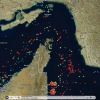
What would a convoy escort of ships by means of the Strait of Hormuz appear like? With real-time satellite tv for pc imagery and fight plane flying over the Strait, “I feel it might be two tankers with a destroyer transiting at a time,” Montgomery says.
Even so, “you may’t forestall each ballistic missile, cruise missile or drone assault,” says Michael Connell of the Heart for Naval Analyses.
“It is simpler to defend in opposition to a drone than a ballistic missile,” Connell acknowledges. “But additionally, drones are cheaper. So if it’s important to defend in opposition to lots of and lots of of drones, that type of offsets the truth that it is simpler to shoot them down.”
However the U.S. Navy can also be taking the menace from sea mines critically. This week, U.S. Central Command, which oversees the U.S. Fifth Fleet based mostly in Bahrain, posted a video on X exhibiting the strikes in opposition to Iran’s navy, together with what it says is the destruction of 16 minelaying vessels. However specialists who spoke to NPR famous that the type of low cost, simply deployed contact and magnetic mines in Iran’s stock may be dropped over the strict of just about any vessel.
Nick Childs, a senior fellow for Naval Forces and Maritime Safety on the London-based Worldwide Institute for Strategic Research, says that the U.S. “would most likely hope to have the ability to pounce on any concerted Iranian effort to mine the Gulf.” But when Iran was in a position to lay a considerable amount of mines, he provides, “these may take weeks or months to clear.”
The U.S. does have a minimum of three Littoral Fight Ships (LCS) within the area which can be geared up for mine-sweeping operations. These vessels, meant for a wide range of missions, have been plagued for years by price overruns and different structural issues.
Montgomery says that for the White Home, the scenario within the Gulf presents a fragile trade-off between political and navy threat. He tells NPR that the political threat is that the longer the Strait stays closed, the extra world and home strain will fall on Trump to do one thing. But when convoy escort operations start too shortly, “you would lose a tanker … or an American ship.”
[ad_2]