[ad_1]

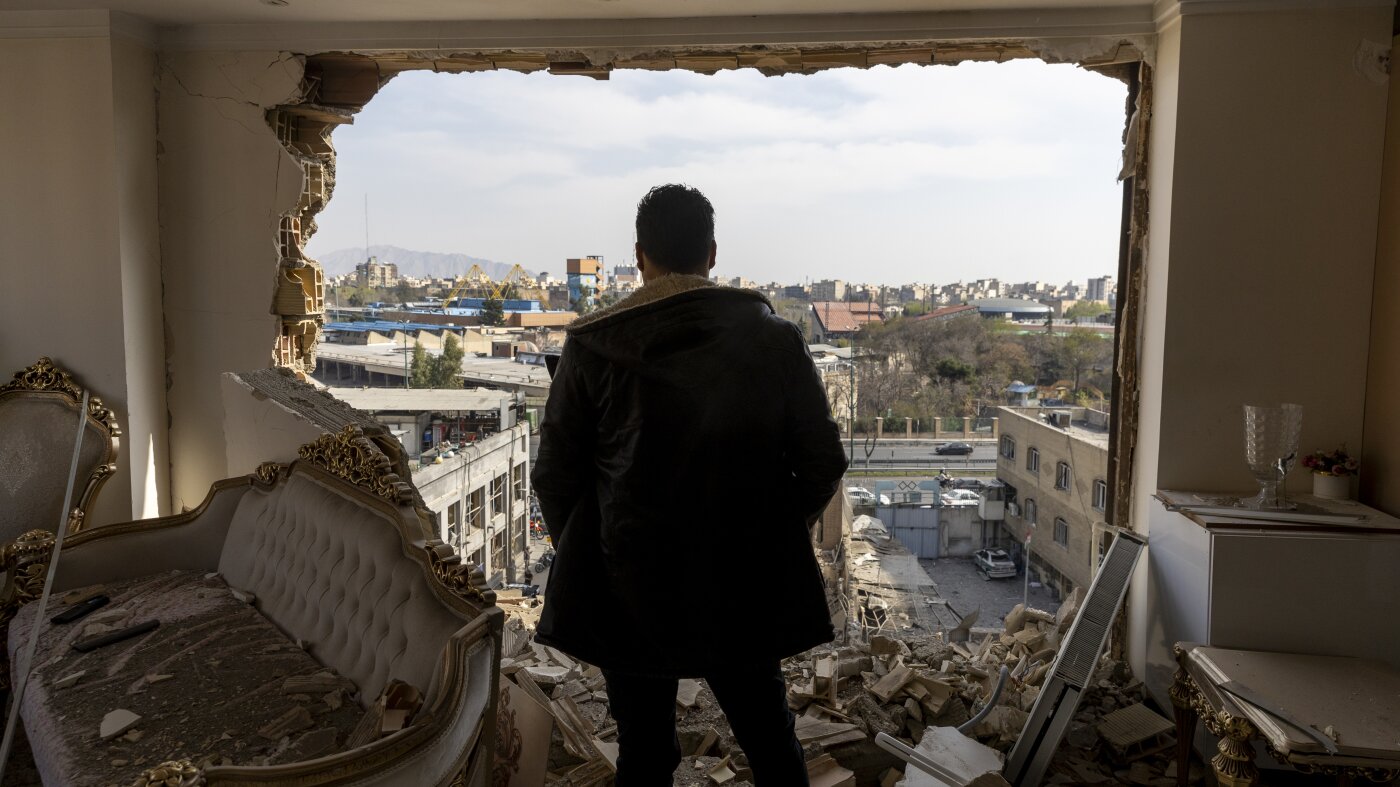
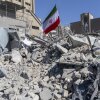
A person stands in a broken residence in Tehran on March 14.
Majid Saeedi/Getty Photographs Europe
conceal caption
toggle caption
Majid Saeedi/Getty Photographs Europe
Three weeks into the U.S. and Israel’s conflict with Iran, it stays unclear how or when the battle would possibly finish. When requested by a reporter on Sunday if he was able to declare victory, President Trump responded, “no, I do not wish to do this. There isn’t any purpose to.”
Karim Sadjadpour, a senior fellow on the Carnegie Endowment for Worldwide Peace, says the president appears to have underestimated Iran’s response to the conflict. Sadjadpour notes that Iran telegraphed from the start that it deliberate to regionalize the battle. However, he says, “President Trump stated that that took him abruptly when Iran began to assault the Persian Gulf nations or shut down the Strait of Hormuz.”
“I do not assume President Trump, in his personal phrases frankly, understood what he was entering into,” he provides.

Sadjadpour says the conflict with Iran started as what he calls a “conflict of alternative” — which means there was no imminent menace that Iran was about to amass nuclear weapons or launch missile strikes on the U.S. or its companions. However the calculus has since modified. The Iranian authorities has successfully closed the Strait of Hormuz, an important waterway by which roughly 20% of the world’s crude oil and pure fuel usually passes.
As well as, it is unclear how a lot energy Iran’s newly appointed supreme chief, Mojtaba Khamenei, really holds. Earlier as we speak, Israel introduced that it had killed Ali Larijani, the top of Iran’s Supreme Nationwide Safety Council. Larijani was anticipated to be a detailed adviser to Khamenei.
“At a time when the regime’s survival is at stake, Larijani’s a long time of home and international coverage expertise make his loss a big blow,” Sadjadpour displays. “For a revolutionary regime whose political ideology is premised on martyrdom, the central query is whether or not these assassinations will finally extinguish the ideology or assist revive it.”
Sadjadpour likens the interior functioning of the Iranian regime to a black field: “It is inaccessible to us,” he says. “What started as a conflict alternative, in my opinion, has really morphed right into a conflict of necessity. I do not assume that President Trump goes to easily be capable to finish the conflict and declare victory.”
Interview highlights
On the American authorities’s priorities on this battle
We’re in a predicament. And I believe that there actually are 4 important priorities with regards to our potential negotiations with Iran. One is clearly nuclear, and that extremely enriched uranium, which is ostensibly underneath rubble now — after the bombings of final June — that must be accounted for. … Second level now … we want a deal which additionally addresses their use of missiles and drones. A 3rd challenge are their proxies — the help for teams like Hezbollah in Lebanon, the Houthis in Yemen, the Iraqi Shiite militias. Now, these proxies have been degraded, however they nonetheless do pose an actual menace to regional stability.
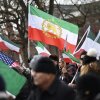
After which the fourth challenge is the explanation why we’re even on this state of affairs, which is Iran’s brutality towards its personal inhabitants. If you happen to keep in mind, final January, Trump … warned the Iranian authorities that in the event that they kill protesters, the USA would intervene. And that was his red-line he issued, … and Iran tore up that pink line. And that is what really motivated him to begin this navy buildup within the Persian Gulf.
What we have seen is that the president has form of been all over when he is requested what his objective is. Some days he says it is simply to get a nuclear deal. Some days, he says he desires a Venezuela deal. Some days it desires to implode the regime. And that lack of readability, in my opinion, has been deeply detrimental as a result of if you do not know what it’s that you just’re attempting to attain, then you definately’re placing each the U.S. navy and our companions in very tough positions.
On the probability of the conflict in Iran increasing to incorporate nuclear weapons and extra superpowers
Fortuitously, I do not assume that may be a excessive probability, and I am going to let you know why. The nations that Iran has been attacking most over the previous couple of weeks are, as I stated, these Persian Gulf nations, Saudi Arabia, the United Arab Emirates, specifically. … If you take a look at these nations, they really have most likely extra sturdy relations with China and Russia than Iran does, and so it isn’t the case that Iran is that this nation with very sturdy allies who’ve its again and people Gulf nations are solely allied with America and Israel.
In truth, the Islamic Republic of Iran might be the highest one or two most strategically lonely nations on the earth. It actually has only a few dependable allies on the earth. And so I believe that the Chinese language aren’t going to return and battle on Iran’s behalf in opposition to Gulf nations with whom they’ve even nearer power relations. And Vladimir Putin really has sturdy relations with the management inside Arabia … so I am not involved that it will deteriorate right into a World Warfare III, however … this has simply set a really harmful precedent and I do not assume that the world or particularly the Center East goes to really feel like a steady place for the foreseeable future.
On what he deems because the best-case state of affairs
Finest-case state of affairs, clearly, could be we’ve a special authorities that involves energy in Iran through which it is both Iran transitions to a democracy or a authorities whose organizing precept is the nationwide pursuits of Iran — “lengthy dwell Iran” reasonably than “demise to America.” I do not assume that that may be a short-term prospect.

And within the close to time period, I believe the best-case end result is that we liberate the Strait of Hormuz from Iranian interference and also you reestablish the protected passage of commerce and ships by the Strait of Hormuz. And clearly, Iran has ceased all of its assaults on its neighbors and on Israel. That might require the USA and Israel to additionally stop these assaults. However even then, there’s gonna be some excellent issues which we will not afford to disregard, which is what occurs with that extremely enriched uranium inside Iran? How is that going to be accounted for? What about Iran’s ballistic missiles and drones? That is been confirmed to be an actual menace to regional safety. How are we going to deal with that? What if Iran begins to rebuild and refinance its regional proxies? That is a problem we’ve to deal with.
After which lastly … the entire purpose that this battle has begun, which was the Iranian regime’s brutality towards its personal folks. … I worry that this regime is so deeply unpopular that the one method that they will proceed to handle to remain in energy is by being much more brutal than earlier than. Do we’ve a method for addressing that? I believe the president hoped for one thing seemingly fast and straightforward like Venezuela gave the impression to be for him, however that is something however.
On why he sees Iran as a tragedy
I believe there is a backside line which I really feel — I do know most individuals within the U.S. and Europeans governments really feel and tens of thousands and thousands of Iranians really feel — which is it is a nation which is not the place it ought to be. This is among the world’s oldest civilizations. It has monumental human capital, it has monumental pure assets, this wealthy historical past, it ought to be a G20 nation. … And so modern-day Iran is mostly a tragedy. And it is a tragedy above all for Iranians, each inside Iran and within the diaspora. But it surely’s additionally been a tragedy for the USA, as a result of in my opinion, America and Iran really ought to be pure companions and as a substitute Iran is considered one of our worst adversaries. And sadly, I do not see that dynamic altering within the close to future.
Monique Nazareth and Thea Chaloner produced and edited this interview for broadcast. Bridget Bentz and Molly Seavy-Nesper tailored it for the online.
[ad_2]