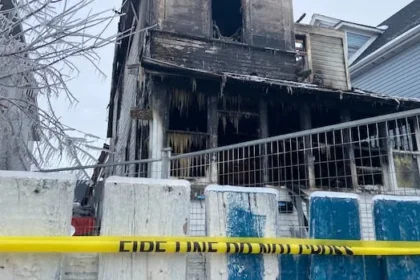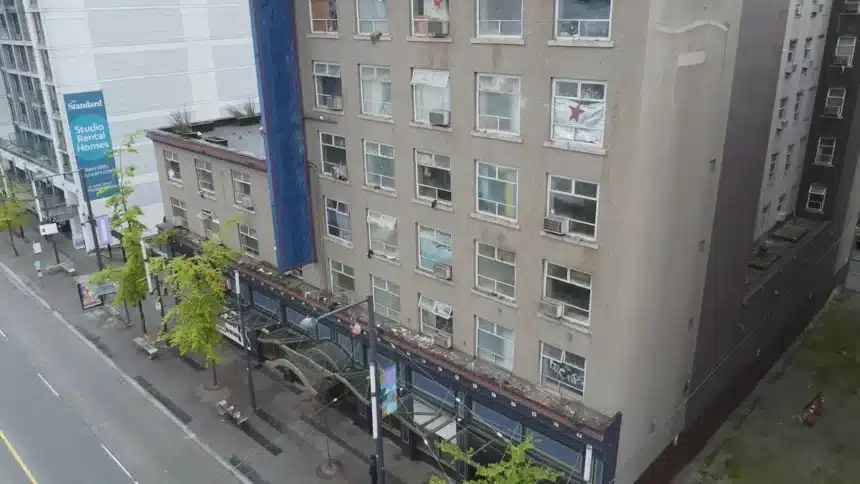
As British Columbia gears up to shut down the Luugat single-room occupancy building on Vancouver’s Granville Street by late June, authorities block public access to the former hotel converted into supportive housing at significant taxpayer expense during the COVID-19 pandemic.
A Resident’s Move to Better Housing
Luugat resident Stewart Holcombe expresses relief at leaving the premises. He and about a dozen others relocate to new homes on May 1, following notifications in September that the province would provide equivalent or superior accommodations to those at 1176 Granville Street.
Holcombe describes severe damage in his fourth-floor unit, including a caved-in bathroom roof from years of fires and flooding. His new East Vancouver suite offers major upgrades. “It’s three times the size, it’s cheaper and I have, like, a full fridge, full stove,” he states. “It’s a complete bachelor suite instead of just a little box.”
Relocation Progress
The building housed around 80 residents in fall 2025. As of April 27, 36 remain, with B.C.’s Ministry of Housing and Municipal Affairs confirming all received alternative housing offers. Officials note 18 have accepted and await moves, while others evaluate options.
Holcombe disputes this, claiming some residents still lack offers.
Recent Flood Highlights Poor Conditions
A flood on April 24 at the ground-floor Aura nightclub traced back to an overflowing toilet in a first-floor unit. Bar owner Alan Goodall, aided by a plumber, discovered two to four feet of garbage piled inside, with no bed present.
Holcombe laments the rapid decline. “It was destroyed in less than a year and a half,” he says. “Pretty sad.” He adds, “All the stuff in the hallways, pictures were taken off the wall, the TVs were all taken and sold – like, it was destroyed in less than a year.”
Flood damage affects every floor, with multiple rooms inaccessible due to caving roofs. Holcombe urges public inspection of the conditions.
From Promise to Decay
BC Housing acquired the ex-Howard Johnson hotel for $55 million in 2020 to shelter encampment residents. Early tours revealed supports like safer supply machines, overdose prevention, and health care workers. “It was beautiful in the beginning,” Holcombe recalls.
Over five years, fires, floods, and $1.87 million in repairs took a toll. BC Housing now denies access to common areas and vacant rooms, citing resident privacy and the stressful relocation process. “This is a destabilizing and stressful moment in people’s lives and our focus is on supporting the move-out process,” the Crown corporation states.
Holcombe, who endured over 24 hours trapped in a ventilation shaft in August 2024, remains optimistic. “I’m quite excited,” he says ahead of his move.