[ad_1]
Washington — The Senate defeated a conflict powers decision on Wednesday that aimed to dam President Trump from ramping up the conflict with Iran, because the operation approaches a fourth week.
In a 53 to 47 vote, a Democrat-led effort to limit Mr. Trump from taking army motion in Iran fell brief for a 3rd time. Sen. John Fetterman of Pennsylvania was the only Democrat to vote in opposition to advancing the decision. GOP Sen. Rand Paul of Kentucky supported it.
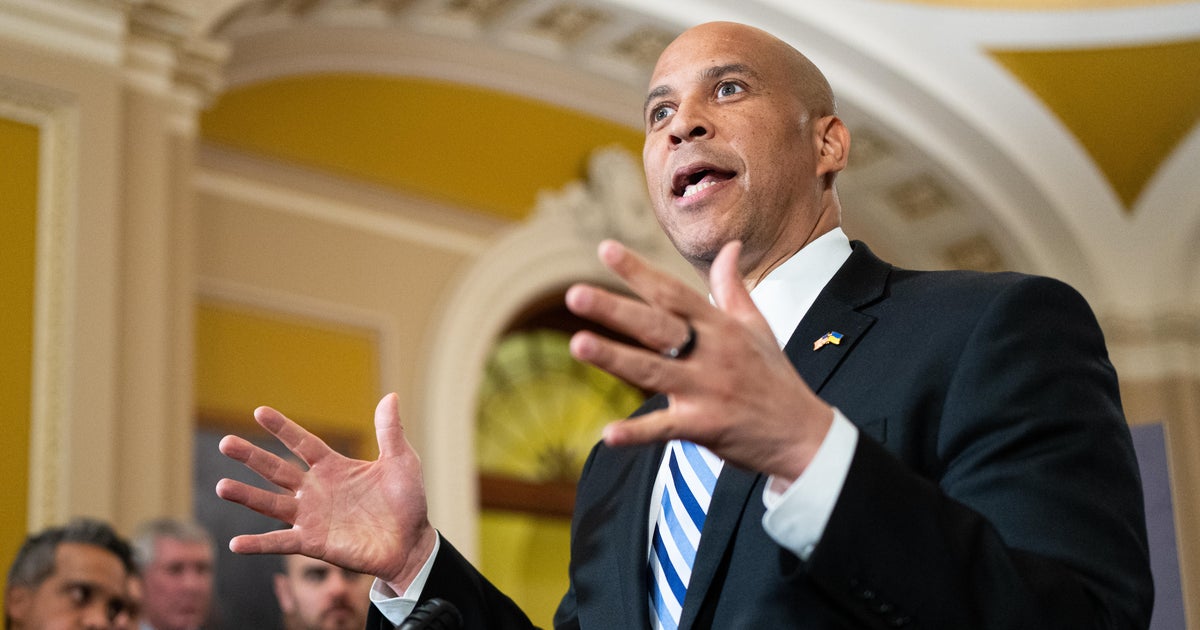
The decision, led by Democratic Sen. Cory Booker of New Jersey, would have directed the president to “take away america Armed Forces from hostilities inside or in opposition to Iran, except explicitly licensed by a declaration of conflict or a particular authorization to be used of army drive.” Congress has not licensed army drive in opposition to Iran.
The vote got here as Republicans are holding an uncommon and prolonged debate on elections laws amid stress by Mr. Trump, who has threatened to withhold his signature from different payments that attain his desk till the measure passes. Democrats have been in a position to drive the conflict powers vote regardless of the ground takeover as a result of the decision is privileged.
The Senate had beforehand defeated an Iran conflict powers decision launched by Democratic Sen. Tim Kaine of Virginia on March 4. It was the second time in lower than a 12 months that the higher chamber had voted down an effort to rein in Mr. Trump’s potential to strike Iran, following an identical vote after final June’s U.S. airstrikes on Iranian nuclear websites.
However because the Iran conflict approaches the one-month mark, Mr. Trump has but to clarify an exit technique and has not dominated out sending floor forces into the nation. The president has mentioned he expects the conflict to finish “quickly,” however hasn’t specified a timeline.
After the early March defeat, a gaggle of Democratic senators vowed to maintain urgent the difficulty if Secretary of State Marco Rubio and Protection Secretary Pete Hegseth didn’t testify in public concerning the conflict. The Democratic senators behind the conflict powers push indicated in a letter to Senate Majority Chief John Thune, a South Dakota Republican, that they’d abandon votes on a handful of resolutions if the Trump officers testified at public hearings.
“We will use each lever that we’ve to cease enterprise as common and drive the Senate [to do] what it ought to have finished already,” Booker instructed reporters earlier this month.
Sen. Chris Murphy, a Connecticut Democrat, accused the Trump administration of dodging public hearings on Iran out of concern of dropping any public assist for the conflict.
“I do not assume they will defend this conflict,” Murphy instructed reporters earlier this month. “I feel they’re going to lose votes within the Senate if they really should go in entrance of the American public and clarify why gasoline costs are so excessive, clarify whether or not we’re engaged in regime change or whether or not we’re not, clarify how they are going to get the nuclear weapons and the nuclear materials with out the bottom invasion.”
The Trump administration’s prime intelligence officers testified Wednesday to the Senate Intelligence Committee in a listening to that was pegged to the discharge of the annual worldwide threats evaluation, although questions largely targeted on Iran. Director of Nationwide Intelligence Tulsi Gabbard deferred to Mr. Trump when pressed on the president’s claims that Iran posed an “imminent” risk to america.
The administration and most congressional Republicans have argued that Mr. Trump acted inside his authorized authority when ordering strikes on Iran. In a letter to Congress in early March, the president mentioned the strikes have been essential to eradicate threats.
“Regardless of my Administration’s repeated efforts to attain a diplomatic answer to Iran’s malign habits, the risk to america and its allies and companions grew to become untenable,” the president wrote. He acknowledged that “it isn’t attainable right now to know the complete scope and period of army operations that could be mandatory.”
[ad_2]