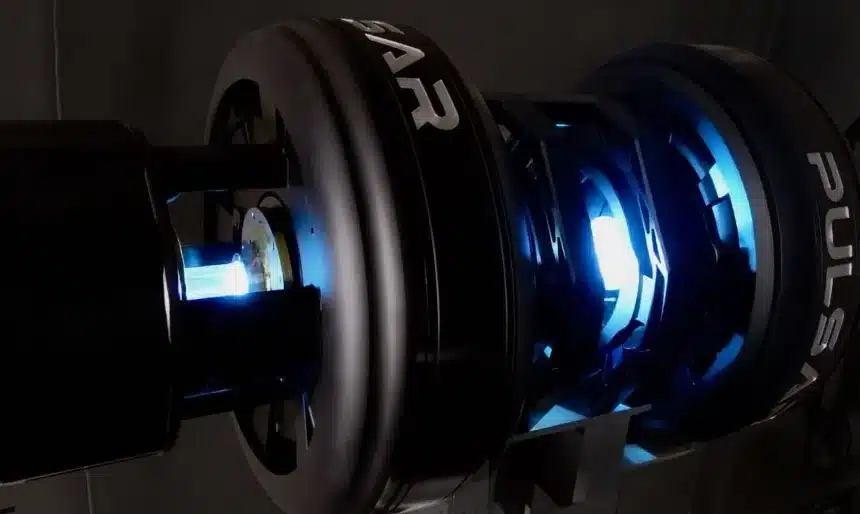
Fusion propulsion promises efficient spacecraft travel across the solar system with minimal fuel. A UK-based developer, Pulsar Fusion, advances this technology through its Sunbird exhaust system.
First Plasma Demonstration
During Amazon’s MARS Conference in California, Pulsar Fusion showcased “first plasma” from the Sunbird test system. Engineers conducted the experiment in Bletchley, UK, and streamed it live to the audience.
The test confined plasma and directed it through the exhaust structure, validating key elements of fusion-powered thrust beyond simulations.
Sunbird: Reusable Orbital Tug
Chemical rockets deliver powerful bursts but consume vast propellant. Electric systems conserve fuel yet accelerate slowly. Fusion propulsion combines high thrust and exhaust velocity.
Sunbird operates as an orbital space tug. Lightweight spacecraft dock with it for propulsion to destinations like the Moon. Modeling indicates over 90% reduction in propellant for Artemis II-style missions.
Insights from Pulsar Fusion CEO Richard Dinan
Pulsar Fusion CEO Richard Dinan highlights the integration of plasma generation, containment, and direction using electromagnetic fields. “The breakthrough was the successful integration of several difficult elements into one working system,” Dinan states. “Controlling plasma is fundamental before advancing to higher-energy systems.”
Specific impulse measures propulsion efficiency. Dinan explains its impact: lighter spacecraft launch to orbit, then use efficient tugs. This design cuts fuel, weight, and costs while enabling reusable infrastructure.
Dinan envisions space as a transport network, shifting from single-use launches to reusable vehicles for cargo and assets. “Propulsion becomes an operational service rather than disposable hardware,” he notes.
Sunbird generates megawatt-scale power alongside thrust. While current tests focus on plasma control, mature systems could power deep-space operations and advanced payloads.
Pulsar Fusion progresses rapidly on a focused architecture. Dinan differentiates it from tokamaks, designed for Earth-based power: “A space system prioritizes efficiency, mass, and exhaust in mission environments.”
This milestone advances fusion hardware toward practical spacecraft, promising faster, cheaper deep-space missions.