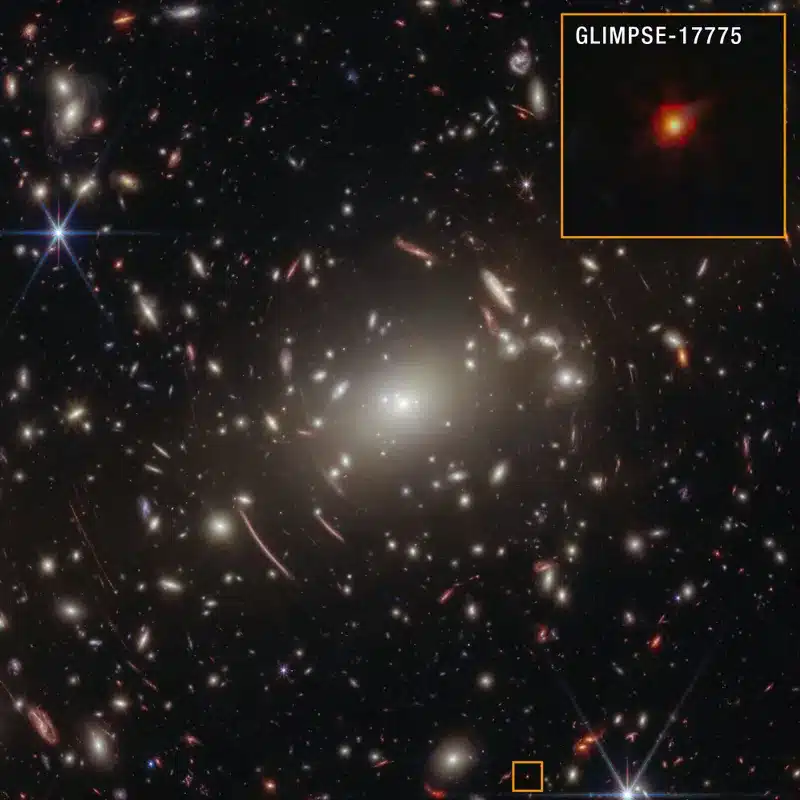
Early Universe Mystery Deepens with New Telescope Findings
The enigma of the universe’s peculiar ‘little red dots’ is gradually yielding to the advanced capabilities of the James Webb Space Telescope. Since commencing its scientific mission in 2021, Webb has identified a novel class of celestial objects in the nascent universe, appearing approximately 600 million years after the Big Bang. These abundant red sources have spurred extensive scientific inquiry, with one prominent theory suggesting they are powered by rapidly growing black holes concealed within dense gas clouds.
GLIMPSE-17775: A Key to Understanding Distant Objects
A research team, spearheaded by Vasily Kokorev at the University of Texas at Austin, has pinpointed GLIMPSE-17775 as a significant example for study. Through meticulous spectral analysis, the team has gathered compelling evidence indicating that this object is a supermassive black hole enveloped by a thick, partially ionized gas cocoon.
“I believe a consensus is forming within the scientific community that these ‘little red dots’ can be explained by black hole star models,” stated Kokorev, the study’s lead author. “However, previous examples lacked the comprehensive evidence we have with GLIMPSE-17775. Its exceptionally detailed spectrum allows us to rigorously test these models.”
Webb’s Observations Shed Light on Early Cosmic Phenomena
The findings, detailed in The Astrophysical Journal, reveal that GLIMPSE-17775 was observed under exceptionally advantageous circumstances. The object was part of Webb’s observational program targeting Population III stars and extremely faint early galaxies within the Abell S1063 galaxy cluster. Despite its apparent proximity to the cluster, GLIMPSE-17775 is situated much further away, with its light significantly amplified by gravitational lensing – a phenomenon where gravity acts as a natural cosmic telescope.
With a cosmological redshift of 3.5, the object dates back to approximately 1.8 billion years after the Big Bang. The telescope’s data provides multiple independent indicators supporting the theory that this ‘little red dot’ represents a black hole star.
Hakim Atek, of the Institut d’Astrophysique de Paris and Principal Investigator of the GLIMPSE program, noted, “The source was identified through the GLIMPSE program, which was designed to detect the faintest objects in the early universe. Furthermore, gravitational lensing magnification allows for a more in-depth characterization of brighter objects, including LRDs like GLIMPSE-17775.”
Unprecedented Spectral Detail Reveals Clues
Webb captured a 30-hour spectrum of GLIMPSE-17775. The gravitational lensing effect effectively extended this observation time to an equivalent of around 80 hours. This combination of Webb’s infrared sensitivity and the natural magnification enabled astronomers to identify over 40 spectral lines, providing the most detailed spectrum ever obtained for a ‘little red dot’.
Kokorev described the initial spectral readings: “When we first saw the spectrum, it felt like having all the puzzle pieces scattered on the floor. We examined each piece, measured the lines, and began assembling them into a mosaic. Initially, some pieces seemed insignificant, but as more came together, we realized we were onto something significant.”
Black Hole Star Model Gains Traction
The observations offer several converging lines of evidence supporting the hypothesis that GLIMPSE-17775 is a ‘black hole star’ – a rapidly accreting black hole surrounded by a dense gas envelope that absorbs and modifies the light emitted near it.
Among the over 40 spectral features identified were signatures of hydrogen, oxygen, and helium that did not align with a simple rotating gas cloud model. Instead, researchers concluded that the most plausible explanation involved electron scattering, indicating the presence of dense gas layers surrounding the object. The intensity and combination of specific spectral lines, including 16 iron lines forming what the team terms an ‘iron forest,’ along with oxygen features, point to a powerful high-energy source, such as a growing black hole.
Astronomers also detected evidence of helium fluorescence and absorption, both of which suggest a dense environment around an energetic central object. This black hole star model may also account for the faint X-ray emissions observed from many ‘little red dots,’ as any X-ray radiation would likely be absorbed by the surrounding gas cocoon.
Addressing Remaining Puzzles with Combined Data
A lingering question regarding GLIMPSE-17775 was the absence of the Balmer break, a distinct dip in emitted light commonly found in ‘little red dots.’ To investigate further, the team integrated Webb’s findings with additional data from the NASA/ESA Hubble Space Telescope’s Frontier Fields and BUFFALO programs.
This combined analysis revealed that GLIMPSE-17775 is situated within a large host galaxy. Although such a galaxy has not been a common association with ‘little red dots’ at this scale, researchers believe it remains consistent with the dense gas cocoon model. The black hole star explanation also suggests that excess blue light observed from these objects could originate from stars within their surrounding host galaxies.
When ‘little red dots’ were first observed by Webb, some scientists speculated they might challenge existing cosmological paradigms, questioning how galaxies could have formed so rapidly in the early universe. However, the team studying GLIMPSE-17775 asserts that this object aligns with current cosmic evolution models, as the black holes involved do not require exceptionally large masses to explain the observed characteristics.
“Everything fits, nothing is broken, and I believe this makes the puzzle of our universe even more compelling,” Kokorev remarked. “Looking forward, I am eager to delve deeper and understand the power sources behind these ‘little red dots.’ While we suspect black holes, other intriguing theories are also being explored, which is exciting. It’s possible we will have a definitive answer within the next year or two.”