EV Public Charger Availability Debated Amidst Growing Demand
Persistent claims of a severe public electric vehicle (EV) charger shortage across Australia have been a recurring theme in public discourse, appearing in AI summaries, media reports, parliamentary submissions, and even regulatory documents. However, exclusive data analysis suggests a different reality: EV drivers seldom face queues at public fast-charging stations. While some remote and regional areas may experience strain during peak travel periods, the vast majority of public fast charger sites nationwide remain underutilised for most of the year.
Rapid Expansion of Australia’s Fast Charger Network
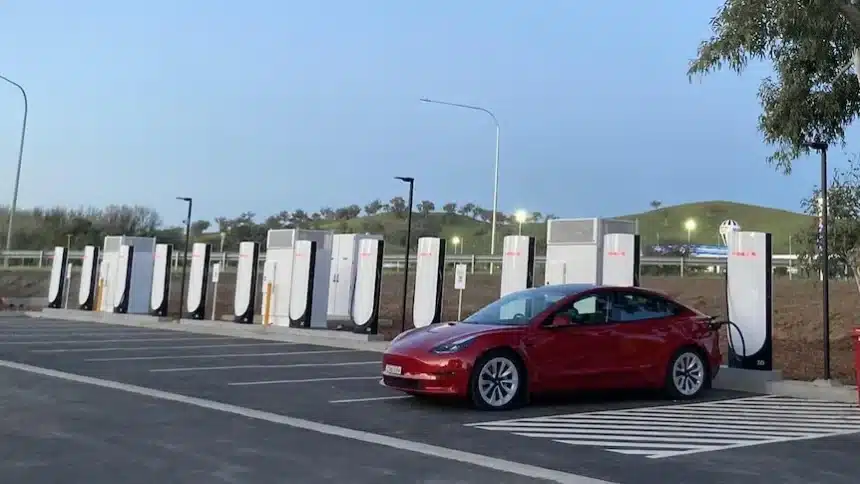
Over the past eight years, Australia has witnessed a significant expansion of its public EV fast-charging infrastructure, with networks establishing a presence in urban centers and along major continental highways. EV chargers are broadly categorized into two types: AC (slow) and DC (fast). Slow chargers, ranging from standard power outlets to dedicated units up to 22kW, can take many hours to recharge an EV. In contrast, fast DC chargers can replenish an EV battery in approximately half an hour. The most powerful publicly available DC chargers in Australia boast outputs of 400kW, vastly exceeding the capacity of a standard power socket.
Evidence from both Australia and international markets indicates a strong correlation between EV adoption and access to public fast chargers, addressing drivers’ concerns about battery range anxiety. The current charging network ensures that an EV can traverse the approximately 5,000-kilometre seaboard route from Ceduna to Port Douglas with a public fast charger typically within 50 kilometers. The number of fast charger sites has surged from just 55 nationwide in 2018 to over 1,500 today. Projections suggest that more fast charger bays will be added in 2026 alone than were installed in the entire decade leading up to 2024, signalling an exponential growth trajectory.
Navigating the ‘Edge of Utilisation’
The critical question remains whether this expansion is occurring at an optimal pace. Projections indicate Australia may require an additional 40,000 fast charger plugs within the next decade to accommodate a national fleet of 5 million EVs. Building the network too slowly risks congestion, while constructing it too rapidly could lead to underutilised chargers, degradation, and financial losses for operators. This delicate balance is often referred to as ‘riding the edge of utilisation’.
Assessing the pace of the charger rollout relative to EV uptake involves analyzing utilisation data to gauge how frequently drivers queue for fast chargers. This means determining the duration each day when nearly all charging bays at a site are occupied. While this data is not widely public, analysis from Carloop, a company managing utilisation data for a substantial portion of the fast charger network, offers key insights.
Urban vs. Regional Charging: A Tale of Two Networks
In major Australian cities, the data reveals that EV drivers rarely experience queues for fast chargers. On average, across all urban fast charger sites, the period when 90% of bays are in use amounts to just over half an hour per day. Richard Laxton, a data expert at Carloop, described this as “not terrible congestion,” noting a high probability of immediate charger availability upon arrival.
The situation in regional and remote areas presents a different picture. For most of the year, these sites experience minimal congestion, with some areas demonstrating superior EV charging infrastructure compared to major cities. Mr. Laxton remarked, “Pick a random day, I can guarantee you would not see congestion at any charging station along the route from Melbourne to Sydney.” However, during certain public holidays, when a significant number of EV drivers travel out of cities, the regional network can face severe strain. Congestion spikes during the Easter period, for instance, have led to lengthy queues at chargers in key transit towns and along major highways. Easter typically marks the highest annual traffic between capital cities, and Mr. Laxton noted that the volume of traffic, particularly on the Hume Highway, overloaded the chargers.
Easter Congestion: A Glimpse of Future Challenges
The town of Coolac, situated along the Hume Highway, hosts one of the few ultra-fast charger sites. This location, a convenient stop approximately 350km from Sydney, features a dozen chargers capable of recharging most standard EV batteries in under 30 minutes at full power. During peak times, however, power is shared, potentially extending charging durations. While typically free of queues, this past Easter saw the site overwhelmed, with some vehicles waiting up to five hours on Good Friday. Mr. Laxton described the congestion as starting at 9 am and continuing until 6 pm, highlighting it as a significant issue.
The problem could be exacerbated next Easter. With an anticipated 50% increase in EVs on the road by Easter 2027, driven by record sales potentially influenced by rising petrol and diesel prices, the strain on charging infrastructure may intensify. Mr. Laxton cautioned, “The lead time on building EV charging stations is 12 to 18 months. There is a reasonably good chance things will get worse before they get better,” adding that “During peak travel in 2027 we may actually have bigger problems than this year.”
Record EV Sales and Infrastructure Pressures
The surge in EV sales is also impacting the urban fast charger network, with congestion levels seeing a recent uptick in Sydney and Brisbane. The EV Council, the peak industry body, advocates for an accelerated charger rollout. Alina Dini, head of energy and infrastructure at the EV Council, stated that the charger rollout had been keeping pace with EV adoption until recently. She explained that policymakers had anticipated a slower rate of adoption, which has now been surpassed. “I expect that while we have enough infrastructure in place for the market as it was planned to be, there will be a need for more and more urgently in the coming months,” Dr Dini commented.
Despite increased usage, Australia’s fast chargers generally remain underutilised. The average time-based utilisation rate for fast chargers in major cities stands at 14%, a slight increase from 13% in February. This compares to California’s average utilisation rate of approximately 20%.
Global Comparisons and Australia’s Unique Position
Publicly available data on EV charger rollout is limited, despite the significant investment involved. Many analyses rely on a simple ratio of EVs to public charger plugs, but the difficulty in accurately counting slow AC chargers often leads to inaccurate annual reports. A frequently cited claim that Australia’s charger rollout lags behind the world often stems from a 2023 reports the International Energy Agency which initially miscalculated charger plugs. The corrected figure indicated Australia’s ratio was four times lower than the global average, not six times, though the initial misinformation has appeared in numerous subsequent inquiries.
Furthermore, Australia requires fewer public chargers than many other EV markets due to a higher proportion of detached houses with off-street parking. Its EV-per-charger ratio is comparable to other low-density urbanised countries like Norway, which boasts the highest EV uptake globally. The global average is heavily influenced by China, the world’s largest EV market, where a greater reliance on public chargers is necessitated by a higher prevalence of apartment living. Andrew Simpson, an expert in charger rollout and managing director of Verdant Vision energy consultancy, stated, “[China] is not really a good benchmark for us. It really frustrates me when people talk about the global average.”
While charger utilisation data offers a more robust indicator of rollout progress than EV-per-charger ratios, it does not encompass all challenges. Issues such as broken chargers, complex software and login procedures, and a general lack of public charger access in many regional and remote towns persist. Nevertheless, Ross De Rango, former head of infrastructure at the EV Council and now running EV Charging Solutions, highlighted that the public charger network has supported record EV sales growth. “For a very large number of people, the public charging infrastructure is perfectly adequate,” Mr De Rango asserted. “We’re bolting on 25,000 new EV drivers every month at the moment. Those people clearly think the charging infrastructure is adequate or they wouldn’t be buying EVs.”
The Australian Energy Market Commission is expected to decide whether to remove ring-fencing rules that currently prevent electricity network providers from entering the EV charging market. Network providers have contended that the commercial charging industry has failed to install sufficient chargers since 2025. However, the EV Council maintains that the rollout has largely kept pace with EV uptake. Dr. Dini commented, “I wouldn’t call it a market failure.”