Supreme Court Limits Gun Ban for Marijuana Users
The Supreme Court has issued a significant ruling that restricts the federal government’s ability to prosecute individuals for possessing firearms if they are marijuana users. The unanimous decision, delivered in a case involving a Texas man, Ali Danial Hemani, affirmed that the government’s blanket application of a law prohibiting drug users from owning firearms violates Second Amendment rights.
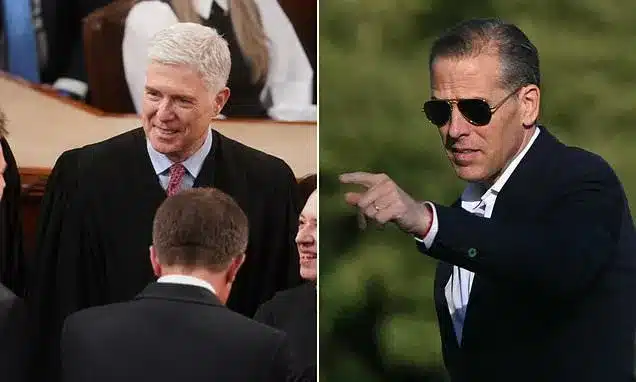
Hemani was charged under the Gun Control Act of 1968, which criminalizes possession of firearms by any ‘unlawful user of or addicted to any controlled substance.’ This law carries a potential penalty of up to 15 years in prison. The same statute was recently used to bring charges against Hunter Biden, son of President Joe Biden.
Hunter Biden Conviction and Supreme Court Ruling
In June 2024, a jury convicted Hunter Biden on three counts related to his firearm purchase and possession in 2018, including making false statements about his drug use and possessing a firearm while being an unlawful drug user. The current Supreme Court ruling, however, could have implications for how such cases are prosecuted moving forward.
In Hemani’s case, authorities found him in possession of a gun during a 2022 raid. He admitted to using marijuana approximately every other day. The government sought to strip Hemani of his Second Amendment rights and imprison him based solely on his regular, albeit not incapacitating, use of a controlled substance.
Justice Gorsuch’s Opinion on Drug Use and Gun Rights
Writing for the majority, Justice Neil Gorsuch stated, ‘We appreciate that drugs and guns can sometimes make for a dangerous mix.’ However, he questioned the government’s approach of ‘automatically strip[ping] Hemani of his Second Amendment right to possess a firearm’ and imposing a lengthy prison sentence based only on the showing that Hemani ‘regularly uses any amount of any controlled substance.’
Justice Gorsuch highlighted that the government’s interpretation could potentially extend to prosecuting individuals who take prescription medication for sleep or use stimulants for academic purposes. The ruling emphasizes that the government must demonstrate a direct link between drug use and an individual’s danger to themselves or others to enforce such firearm prohibitions.
Scope and Implications of the Decision
The Supreme Court clarified that the ruling is narrow and does not question the government’s ability to prosecute individuals if there is proof that their drug use renders them a danger. The court did not address whether a prosecution is permissible if the government possesses evidence of a user posing a danger to themselves or others.
Nevertheless, this unanimous decision is anticipated to lead to a reduction in prosecutions, particularly for casual drug users found in possession of firearms. For Hunter Biden, while his conviction stands, the broader legal landscape surrounding such offenses may shift.
It is important to note that Hunter Biden was pardoned by then-President Joe Biden in December 2024, before his sentencing phase could commence.