A Look Back at Scotland’s World Cup Encounters with Brazil
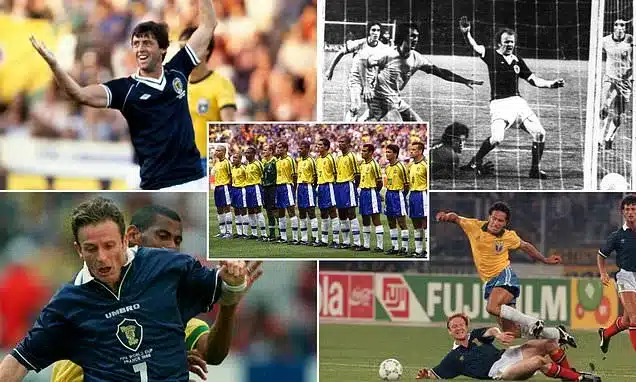
Scotland has faced Brazil four times in the World Cup over the past 52 years, with the quest for an elusive victory continuing. Ahead of a recent match in Miami, accounts from four players who have experienced this momentous fixture offer a unique perspective on what it’s like to stand alongside and compete against the legendary Brazilian team.
David Hay: Germany 1974 – A Stalemate with the Holders
In the 1974 World Cup, Scotland drew 0-0 with Brazil. David Hay recalls the team’s initial satisfaction after a 2-0 win against Zaire, their first World Cup match since 1958. However, he reflects that perhaps the team eased up, a decision that ultimately impacted their goal difference. Brazil, the reigning champions, presented a different challenge than the iconic 1970 squad. Hay noted that only a few players from the previous victorious team remained, and their approach had evolved. He described the Brazilian team as more physical, seemingly having learned from past encounters where they were outmuscled. Standing in the tunnel, the iconic yellow jersey still held a powerful aura, creating a sense of immense pressure to perform for teammates and country.
Hay remembers the initial stages of the match where Brazil dominated the midfield. He and Billy Bremner were tasked with controlling the center, but the Brazilian players were overwhelming. The team adjusted, with Kenny Dalglish dropping deeper, which helped regain control of the game. Hay genuinely felt Scotland deserved to win, and as the match neared its end, it became apparent that Brazil was content with a draw. He addressed a controversial missed opportunity by Billy Bremner, describing it as a chaotic rebound rather than a simple miss. Despite not winning, the team was pleased with their performance, especially with a crucial match against Yugoslavia still to come. Looking back, Hay believes Scotland could have and perhaps should have beaten Brazil, highlighting the high level of performance required. Ultimately, a lack of a decisive effort in the final game led to their exit from the tournament.
Alan Rough: Spain 1982 – A Thrilling Encounter
In the 1982 World Cup, Scotland lost 4-1 to Brazil. Goalkeeper Alan Rough remembers the reassuring presence of manager Jock Stein. The initial focus was on securing a vital win against New Zealand, which they achieved. Rough acknowledged that beating Brazil seemed a long shot, and Stein encouraged the players to enjoy the experience and soak in the atmosphere, with the USSR match being the ultimate decider. Some players had faced Brazil in a friendly in 1977, but the World Cup stage was entirely different. They had observed Brazil’s impressive opening game against the USSR but also recognized that strong teams can sometimes take time to find their rhythm in a tournament.
The Brazilian squad boasted stars like Socrates, Zico, and Eder at the peak of their careers. Rough vividly recalls the warm-up, with Scottish players visibly sweating profusely due to the intense humidity, even before the game began. He mentioned Graeme Souness losing significant weight during the match. In contrast, the Brazilians appeared relaxed. Scotland started with high intensity, and when Dave Narey scored, there was a glimmer of hope. However, Brazil elevated their game, increasing the pace of their passing and movement. Rough noted that Scotland’s team featured several European Cup winners and a striker playing for Barcelona, yet Brazil’s star players delivered. He cherishes a photo of the Scotland team and another capturing Zico’s free-kick, acknowledging that even with foresight, he couldn’t have saved it. The consolation, Rough admits, is that Brazil’s 1982 team is widely considered one of the greatest never to win the World Cup. He found them a joy to watch, though not to play against.
Maurice Malpas: Italy 1990 – A Late Defeat
Italy 1990 saw Scotland lose 1-0 to Brazil. Maurice Malpas recalled a Brazilian team with prominent players like Romario and Careca, though not necessarily overwhelming favorites to win the tournament. After a disappointing opening game against Costa Rica, Scotland had played exceptionally well against Sweden, suggesting they could challenge any opponent. The team was still riding that positive momentum heading into the Brazil match. Malpas observed their training sessions, noting their intense fitness levels and direct style of play, which combined pace and strength. For his generation, Brazil, with legends like Pele, Jairzinho, and Tostao, represented the pinnacle of football, and watching them on television was a must.
The surreal experience of walking out to face them in the World Cup was profound. The national anthems evoked strong emotions, but as professionals, the focus quickly shifted to the task of winning. Malpas recounted Murdo MacLeod being struck by Branco’s free-kick, leaving him disoriented. Scotland felt they were on the verge of securing a draw, only to concede a late goal. A crucial save by Claudio Taffarel from Maurice Johnston in the dying moments symbolized their misfortune. Although not immediately eliminated, their fate depended on other results, which ultimately did not go their way. Malpas’s advice to current players is to savor the moment and play to their strengths, focusing on creating chances, scoring, and defending effectively. He emphasized that success hinges on a complete team performance on the day.
Kevin Gallacher: France 1998 – A Dream Realized
In the 1998 World Cup, Scotland narrowly lost 2-1 to Brazil. Kevin Gallacher’s childhood dream was to play Brazil at the World Cup, and seeing them drawn together in the opening fixture made him feel like a 10-year-old again. The build-up to the first game was immense, with global attention focused on the encounter. A delay in the team bus due to traffic caused some disruption, particularly as the players had planned a kilt-wearing surprise that had to be managed discreetly. The overwhelming atmosphere and the sight of a near-full stadium two hours before kick-off underscored the magnitude of the occasion.
Despite a squad rich in experience, nerves were undeniable. Gallacher admitted to being in awe of the Brazilian players he had watched on television. The walk down the tunnel and seeing the iconic yellow jerseys, worn by stars like Ronaldo, Rivaldo, Roberto Carlos, Cafu, and Dunga, was a special moment. The national anthem served as a release for nervous energy, sung with passion, albeit out of tune. Brazil took an early lead through Cesar Sampaio’s header from a corner, a rarity for Scotland to concede from set-pieces. They responded with a penalty from John Collins and were holding their own, posing a threat on the break. However, a freak own goal by Tom Boyd and a missed opportunity by Gordon Durie in the second half proved costly. Gallacher believes a second goal would have secured a victory, but the team remained proud of their performance, leaving the pitch with their heads held high. He described the experience as their World Cup Final and an awe-inspiring moment to be a part of.