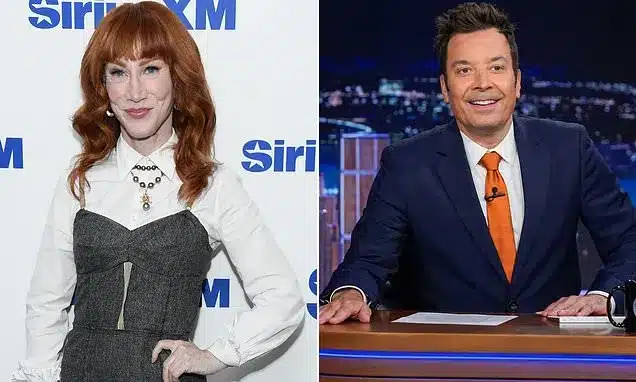
Comedian Kathy Griffin has publicly stated she believes she has been blacklisted from NBC’s The Tonight Show, asserting she hasn’t been invited to appear since Jimmy Fallon took the helm of the popular late-night program. Griffin, 65, shared her perspective via an Instagram clip on Tuesday, claiming her last appearance on the show was in 2011, prior to Fallon’s tenure which began in 2014. However, sources close to the production suggest a different narrative, pointing to a series of events and professional decisions that may explain her absence.
Griffin’s Claim of Blacklisting
In her Instagram post, Griffin expressed frustration over her perceived exclusion from The Tonight Show. She stated that she has not been booked for an appearance since 2011, a period predating Jimmy Fallon’s hosting duties which commenced in February 2014. Fallon, 51, succeeded Jay Leno, who had hosted the show for two distinct periods from 1992 to 2009 and again from 2010 to 2014.
Griffin, known for her candid and often controversial humor, suggested that her absence from the program was a deliberate choice by the show’s producers or network. While she did not explicitly name Fallon as the orchestrator of this alleged blacklisting, her statement implied a systemic decision to keep her off the guest list. This claim has sparked discussion among her followers and in entertainment circles, with many wondering about the reasons behind her prolonged absence from such a prominent platform.
The Timeline of Appearances
To understand the situation, it’s important to examine Griffin’s history with The Tonight Show. While Griffin stated her last appearance was in 2011, records indicate she did appear on the show during Jay Leno’s second stint as host. Her most recent known appearance on The Tonight Show Starring Jay Leno was in 2011. Following Fallon’s takeover in 2014, the show’s guest booking strategy and overall tone shifted, as is common with new hosts.
Fallon’s version of The Tonight Show has generally focused on a more lighthearted and viral-friendly approach, often featuring elaborate games, musical sketches, and celebrity interviews that emphasize fun and camaraderie. This style, while successful in terms of ratings and online engagement, may differ from the type of comedic performance Griffin typically offers.
Insider Perspectives on Griffin’s Absence
Contrary to Griffin’s assertion of a deliberate blacklisting, individuals familiar with the show’s operations have offered alternative explanations. These sources suggest that Griffin’s absence is not the result of a specific ban but rather a confluence of factors, including evolving show formats, booking priorities, and perhaps a mismatch in comedic style or public perception.
One perspective is that booking decisions are complex and depend on many variables, such as the current promotional needs of guests, the show’s thematic focus for a given week, and the overall chemistry between the host and the guest. It’s possible that Griffin’s specific brand of comedy, which has sometimes courted controversy, may not have aligned with the desired tone or guest mix for The Tonight Show under Fallon’s leadership.
Furthermore, the landscape of late-night television has changed significantly since 2011. The rise of social media and digital content has influenced how shows book guests and what types of segments are prioritized. Shows often aim for guests who can generate viral moments or participate in popular recurring bits, which may not always align with a comedian’s traditional stand-up or interview style.
Past Controversies and Public Image
Kathy Griffin has a history of engaging in provocative humor and has faced significant public backlash for some of her actions. Most notably, in 2017, she faced widespread condemnation after posting a photograph of herself holding a prop resembling the bloody head of then-President Donald Trump. This incident led to severe professional repercussions, including the cancellation of her New Year’s Eve special with CNN and the loss of various other performance opportunities.
While Griffin later apologized and stated she had been “profoundly sorry” for the image, the controversy undoubtedly impacted her public image and professional standing. It is plausible that the network and show producers, mindful of potential controversy and brand image, might be hesitant to book guests who have been involved in such high-profile public relations crises. This caution is standard practice in the broadcast industry, where maintaining a broadly appealing and non-controversial image is often a priority.
The Nature of Late-Night Bookings
Late-night talk shows operate on a tight schedule and have a finite number of guest slots available each week. Bookers must make strategic decisions about who to invite, often prioritizing guests who are currently promoting a project, have a unique story to tell, or fit the show’s established comedic tone. A comedian’s appearance on a talk show is typically tied to a specific booking strategy, such as promoting a new special, movie, or book.
If Griffin has not had a major project to promote that aligns with The Tonight Show‘s booking needs since 2011, or if her promotional opportunities have been with different networks or platforms, this could also explain her absence. The decision to book a guest is rarely arbitrary and is usually driven by a combination of factors aimed at maximizing viewership and maintaining the show’s brand identity.
Conclusion: A Matter of Strategy, Not Necessarily Blacklisting
While Kathy Griffin feels she is being deliberately excluded from The Tonight Show, the reality may be more nuanced. The show’s format has evolved under Jimmy Fallon, and booking decisions are influenced by a complex interplay of current events, promotional needs, and the desired comedic atmosphere. Griffin’s past controversies, while not explicitly cited as the sole reason, could contribute to a cautious approach by network executives and show producers.
Ultimately, her absence from The Tonight Show appears to stem from a combination of factors related to the show’s strategic programming, evolving comedic landscape, and potentially, the lingering effects of past public controversies, rather than a direct, personal blacklisting by Jimmy Fallon himself.