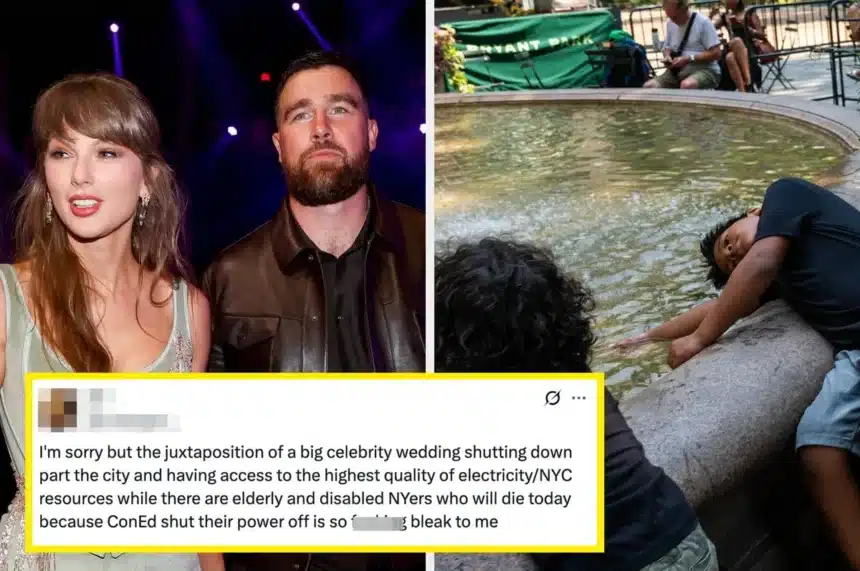
The recent wedding of global superstar Taylor Swift and NFL player Travis Kelce has ignited a firestorm of criticism, with many New York City residents expressing anger over the significant disruptions caused by the event. The lavish ceremony, held at Madison Square Garden, coincided with a city-wide call for energy conservation due to a severe heatwave and widespread power outages, leading to accusations of insensitivity and a stark “disgusting” juxtaposition of extreme wealth against public hardship.
Street Closures and Transit Chaos
Preparations for the wedding on Friday led to extensive street closures around Madison Square Garden, significantly impacting daily commutes for thousands of New Yorkers. The NYPD’s announcement of these closures affected both vehicular and pedestrian traffic, with strict warnings issued about vehicles being towed if not removed from surrounding streets. This created a ripple effect, disrupting access to major transit hubs like Penn Station and Moynihan Train Hall. Commuters relying on subway lines, Amtrak, Long Island Rail Road, and New Jersey Transit faced rerouted access points, raising concerns about potential overcrowding during a busy holiday weekend.
The timing of these disruptions, particularly on the eve of a major holiday weekend, drew sharp rebukes. Social media platforms buzzed with frustration. One widely shared sentiment highlighted the perceived disconnect: “She’s a billionaire making people’s lives unnecessarily difficult for her own pleasure – on 4th of July of all weekends.” Another comment lamented the apparent lack of consideration from the ultra-wealthy amidst broader societal struggles, stating, “On a holiday weekend. Amidst all this worldwide suffering, the ultra-wealthy still have no compunction. Unreal.”
Energy Conservation vs. Celebrity Extravagance
The backlash intensified as New York City grappled with a severe heatwave, prompting Con Edison to issue urgent calls for energy conservation. The utility company was forced to implement rolling blackouts, shutting off electricity to thousands of residential and commercial customers due to grid strain caused by extreme temperatures and high power demand. This plea for conservation stood in stark contrast to the elaborate celebration taking place at Madison Square Garden.
Residents pointed out the perceived hypocrisy of being asked to limit electricity usage while a high-profile event was seemingly consuming vast amounts of power. One poignant observation captured this sentiment: “I’m sorry but the juxtaposition of a big celebrity wedding shutting down part the city and having access to the highest quality of electricity/NYC resources while there are elderly and disabled NYers who will die today because ConEd shut their power off is so fucking bleak to me.”
Visual evidence amplified these concerns. A video shared from a chaotic Penn Station, where air conditioning was reportedly not functioning, contrasted sharply with the event happening just above. The accompanying caption noted, “No AC in Penn Station but plenty of electricity for the crass corporate wedding happening just above it today.” This was met with further outrage, with one user calling the situation “fucking disgusting! Only a completely selfish pair of people would do this in the middle of a terrible heat wave on a holiday week!”
Specific Examples of Perceived Waste
- Madison Square Garden Event: Critics questioned the energy demands of a large-scale wedding held in a major arena, especially when thousands of residents were experiencing power outages.
- Times Square Billboards: The continued illumination of numerous large electric billboards in Times Square was cited as another example of excessive energy consumption occurring simultaneously with mandated conservation efforts.
- Empire State Building Illumination: Adding to the controversy, the iconic Empire State Building was lit up in blue in honor of the wedding. The building’s official social media account shared a video of the display, captioned “Her something blue 🩵.” This act drew immediate criticism, with comments like “the optics of this while entire neighborhoods don’t have power rn lol” and “Great use of electricity 👍” highlighting the public’s disapproval.
The contrast between the city’s plea for austerity and the visible extravagance of the wedding celebration fueled widespread public discontent. Many felt that the event, while perhaps intended as a joyous occasion, underscored a troubling disparity in resource access and a lack of awareness regarding the daily struggles faced by ordinary New Yorkers during a critical time.
Public Reaction and Calls for Accountability
The online discourse reflected a deep sense of frustration and a call for greater consideration from public figures and large-scale event organizers. While the wedding itself was a private affair, its public impact and the timing of its associated disruptions resonated strongly with a populace facing genuine hardship.
Some comments humorously, yet pointedly, suggested that Swift should bear the financial responsibility for the city’s electricity costs during the period. More seriously, the situation highlighted ongoing debates about the responsibilities that come with immense wealth and influence, particularly in densely populated urban environments where large events can have significant logistical and resource implications.
The scrutiny over the Swift-Kelce wedding serves as a potent reminder of the delicate balance between celebrating personal milestones and maintaining public order and equity, especially during times of crisis. The incident has prompted discussions about event planning, urban infrastructure, and the societal expectations placed upon high-profile individuals.